Retro Jewelry of the 1940s: Rose Gold, Sculptural Volume and the Glamour of Wartime
When wartime restrictions put platinum out of reach, jewelers turned to warm, sculptural gold and the bold, colorful jewels now known as Retro.
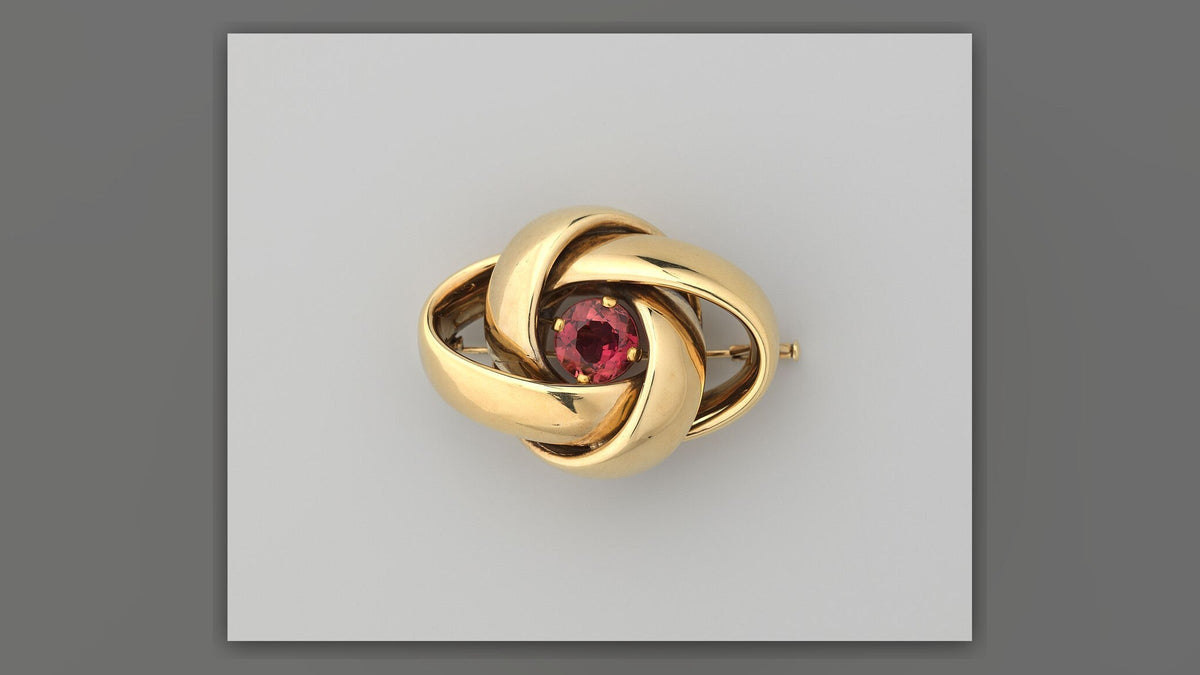
Imagine a jeweler’s bench in 1943, somewhere in New York or Paris or Amsterdam. The platinum that had made the evening jewels of the previous decade is no longer there to be had; the supply has gone to the war. What remains on the bench is gold—warm, yielding, willing to be rolled, domed and folded into forms that would have looked heavy a few years earlier. From that constraint, and from a public hungry for color and confidence, came Retro jewelry: a style at once sculptural, optimistic and unmistakably of its moment.
What Defines Retro Jewelry
Historians generally place the Retro period between the mid-1930s and about 1950, with its fullest expression in the 1940s. It is sometimes called Retro Modern, a name that captures the contradiction at its heart: the designs look forward in their scale and engineering, while borrowing freely from earlier centuries for their ornament.
Retro belongs within a longer story of vintage and estate jewelry, and its closest neighbor is the one it left behind. The break with the Art Deco era is easiest to see in the metal and the line. Deco favored the flat plane, the strict angle, the white glitter of platinum and diamonds. Retro turned toward volume. Surfaces curve and swell; ribbons of gold twist into knots, scrolls and folded bows; stones sit in generous, raised mounts rather than recessed into geometry. Where a Deco jewel is drawn, a Retro jewel is modeled—it is meant to be seen from the side as well as from above.

The motifs are a catalogue of soft, domestic and slightly theatrical forms: bows and ribbons, buckles and belts, scrolls, fans, flowers and the pleated, draped fold of a gold “fabric.” Many echo the tailoring of the period—the padded shoulder, the cinched waist—and it is no accident that so much Retro jewelry is made to be pinned or clipped to a lapel or neckline.
Why Retro Jewelry Turned to Rose Gold
The shift in color was, at first, a matter of supply. From 1942 the United States War Production Board restricted platinum for non-military use, reserving it for industrial and defense purposes; similar pressures were felt across the Allied nations and in occupied Europe. Jewelers who had built their reputations on platinum and white diamonds were obliged to work in gold, and in the lower karats that stretched the metal further. Platinum did not vanish entirely—it was often retained for a small setting or a claw—but it ceased to define the look of the day.
What might have been a limitation became a palette. Pure gold is too soft for jewelry and is always alloyed, and the alloy decides the color. Copper deepens it into the warm, pinkish tone we call rose or red gold; silver, and in some alloys zinc, lightens it toward green or pale yellow. Craftsmen soon discovered that these tones could be combined in a single piece—a rose-gold flower on a yellow-gold leaf, a bracelet of alternating links—and the two- and three-color jewel became a signature of the decade.
It is worth saying plainly that gold carried its own associations. Warm, rounded and unmistakably substantial, it suited a decade that valued reassurance. The jewels of these years look generous, and they were designed to be.
The Cocktail Ring and the Big Gesture
The cinema, and the world of leisure it advertised, shaped the taste of the 1940s as surely as the metal shortage did. Wartime audiences filled the picture houses; the studios offered an escape of evening gowns, nightclubs and gleaming surfaces, and the jewelry of the screen—bold, bright, a little theatrical—set the tone for what women wished to wear. The cocktail hour became a social institution, and with it came the vintage cocktail rings that have since become the emblem of the era.
A Retro cocktail ring is built on a raised, often tiered gold mount, with a central stone of considerable size flanked by volutes, pleats or small fans of gold. The related ballerina ring, with its skirt of small stones around a larger center, belongs to the same family of ideas, as do the clip-brooches—double clips, fur clips and dress clips—that were worn in pairs or singly on a lapel. Van Cleef & Arpels’ ballerina clips of the early 1940s remain among the most admired of the type, and the idea was widely copied and reinterpreted.
The scale is part of the point. These are jewels conceived to be noticed across a room, and to be worn with ease: the gold is rounded rather than sharp, the backs are finished, the weight sits comfortably on the hand.
Tank Bracelets and Gas-Pipe Links
If the cocktail ring was the era’s exclamation, the bracelet was its sentence. The so-called tank or tank-tread bracelet is generally said to take its name from the flat, interlocking links of military vehicles, and it was one of the defining forms of the decade. So too were the gas-pipe or tubogas links, a flexible tube of coiled gold strip that moves like fabric, and the brick-link and snake-link chains that fell in smooth, articulated lines. Necklaces followed suit: fans of gold, collars of tubogas, and fringed, buckled or bow-fronted pieces that sat close to the collarbone.
The engineering is quietly remarkable. Every segment is hinged, soldered and finished by hand, so that the finished bracelet drapes on the wrist without a visible seam. This is also why surviving examples are so rewarding to handle: the gold has the supple, liquid weight of a well-made chain.

The pairing of rose and yellow gold in one bracelet, as in the example above, is a clear demonstration of the period’s two-color taste. It reminds us, too, that Retro jewelry was made well beyond the great houses: goldsmiths in the Netherlands, Britain, Italy and across America produced work in the same idiom, often anonymously and in karats that reflect local hallmarking.
The Stones of the Retro Era
Retro jewelry is a jewelry of color, and its stones were chosen for presence rather than rarity. With fine diamonds scarcer and wartime travel limited, jewelers turned to large, richly colored gems that could be cut generously and set for impact: citrine in golden and sherry tones, aquamarine, amethyst, topaz, and tourmaline. The stones were frequently step-cut or emerald-cut, with broad, clean facets that catch light like a window.
Synthetic rubies and sapphires, grown by flame-fusion methods since the early twentieth century, were in common use, as was synthetic spinel in green and blue. These were not regarded as inferior; they offered clean, saturated color in sizes that natural stones could not match at the same cost, and the best are beautifully cut and set. A careful catalogue will always say which is which—and we do. Alongside them, natural rubies and sapphires, often small and calibré-cut, were laid into scrolls and flowers as accents, and diamonds were used sparingly as highlights.
The period’s great houses each found their own voice within the style. Van Cleef & Arpels, already known for its Mystery Setting, produced sculptural clips and bows. Cartier worked gold into rolled, braided and tubogas forms alongside its animal jewels. Boucheron made scroll and ribbon clips of notable refinement; Tiffany & Co. offered bold gold jewels for the American market. In New York, the Sicilian-born designer Fulco di Verdura, who had come to jewelry through his years with Chanel, opened his own house in 1939 and made gold and colored-stone jewels of wit and natural inspiration.
A particular chapter belongs to Trabert & Hoeffer–Mauboussin, whose “Reflection” line combined the Parisian house of Mauboussin with an American retailer. Its pieces, with their convex, mirror-bright gold and bold stones, are among the most recognizable of the era and remain deeply sought by collectors.
Collecting 1940s Retro Jewelry
For the collector, the first pleasure of Retro jewelry is the gold itself. These are substantial pieces, made in a metal that holds its color and can be cared for without fuss; the warm tones sit easily against both daytime and evening dress, and the volume gives them a presence that more delicate periods cannot always match.
The things worth examining are the same ones that matter in any fine antique. Look for clear hallmarks and maker’s marks; for well-finished backs and soldering; for hinges that move freely without looseness; and for stones that are original to the piece, honestly described, and not too heavily worn at the edges. A bracelet of a good weight, a brooch with a crisp scroll, a ring whose mount has kept its proportions: these are the signs of a jewel that has been properly made and properly kept.
Provenance matters, and it is rarely tidy. Many Retro jewels were made by workshops that left no signature, or were sold through retailers whose names, rather than makers’, appear in the box. We record what we can verify—a signature, a hallmark, a fitted case, a family history—and we say plainly when a piece has none. Honest attribution is part of what makes a jewel trustworthy.
If you would like to see these jewels as they are meant to be seen—on the hand, in natural light, with their history set out in full—we welcome you to explore our Retro jewelry collection and to request a private viewing with Eleanor Verane and her team. Each appointment is unhurried, and each piece is presented individually.