Belle Époque Jewelry: The Platinum Lace of a Vanished Season
In the first years of the twentieth century, platinum let Europe's great jewelers set diamonds in bows, swags and laurel so fine they read as lace—a brief, feminine style that stood between Victorian naturalism and the hard geometry of Art Deco.
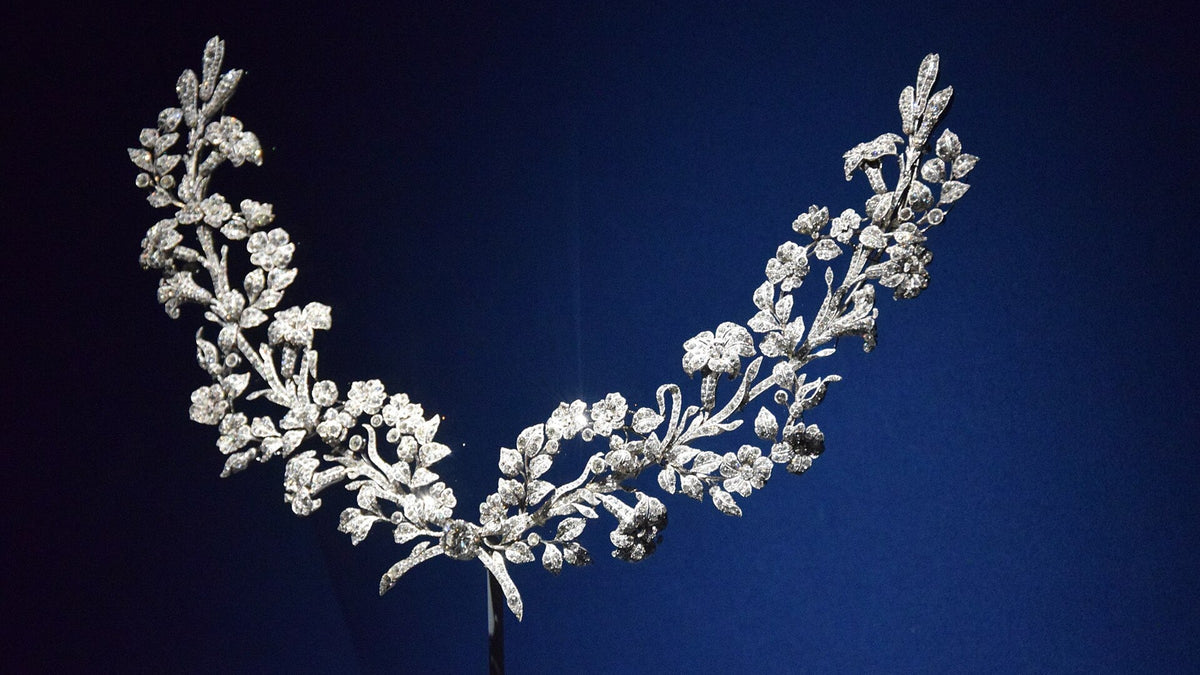
There is a moment, somewhere around the turn of the twentieth century, when diamonds stopped looking like stones and began to look like cloth. Jewelers in Paris and London had found a metal strong enough to be drawn out as fine as thread, and they used it to make ornaments that read, at a glance, as lace, ribbon and spun sugar. We now call the period the Belle Époque—the “beautiful era”—and its jewelry belongs to the briefest and most feminine chapter in the history of European adornment.
The name is retrospective, a phrase the French reached for after 1914 to describe the long, comparatively tranquil years that followed the Franco-Prussian War. In the jeweler's vocabulary it is narrower. The style at the center of it, the garland style, took shape in France in the 1890s and held until the First World War; in Britain, where it overlapped with the reign of Edward VII, the same jewels are called Edwardian. We keep both names in our galleries—Belle Époque jewelry for the French reading and Edwardian jewelry for the English—one named for the Seine, the other for the throne, and both for a single sensibility.

Edwardian Platinum Jewelry and the Making of Lace
Everything about the style follows from a single material. Platinum had long frustrated European goldsmiths: it melts only at extraordinary temperatures, and for much of the nineteenth century it served chiefly as a backing, with silver or gold carrying the work that the eye could see. Silver had a fault the Belle Époque could not forgive—it tarnished, and it dulled the whiteness of the diamonds set in it. A history of the house records that Cartier turned to platinum to solve the oxidation of silver, and found in it a metal malleable, white and strong enough to make mounts “resembling diamond lace and garlands.”
Strength is the whole secret. Platinum can be rolled and sawn far thinner than gold of comparable strength and still hold a stone against the pull of a pin, a clasp or a lifetime of wear. Jewelers could therefore pierce the metal in repeating patterns of scroll and leaf until little remained but a tracery of supports, and set small diamonds along the edges of the tracery so that the metal seemed to vanish. The newer, hotter torches of the early 1900s are usually credited with making work in solid platinum practical; the exact date and device are given differently by different authorities, and we hold to the general account rather than a single year.
Then came the finishing touch. Along the rims of the settings, the jeweler's knurling tool rolled a row of minute beads—milgrain, or millegraining—that softened the hard line of the metal and gave it the appearance of picot edging on a handkerchief. Pierced work and milgrain together are what collectors mean when they speak of platinum “lace,” and the comparison was not a modern flourish. Contemporary makers set out to simulate fluid fabrics, and the wearers dressed to match, in chiffon, tulle and ribbon-trimmed lingerie gowns that such jewels were designed to sit upon.
The Garland Style: Bows, Swags, Laurel and Tassels
The decorative language was borrowed, quite deliberately, from the court of Louis XVI. Cartier's Paris house, which moved to 13 rue de la Paix in 1899 under the influence of the young Louis Cartier, was among those that revived the eighteenth-century vocabulary of ribbon and flower, and the manner of the day takes its name from the garlands that fill it. The repertoire is easily learned and endlessly varied: bow knots with trailing ribbon ends, swags of graduated diamonds hung between two points, laurel wreaths, sprays of leaf and blossom, and the fine tassels and drops that fall from them.
It was a deliberate rejection of what had gone before. The Victorian jeweler had favored the naturalistic—the bird, the serpent, the lock of hair under glass—and the Art Nouveau jeweler had pushed that naturalism into enamel and dragonfly wings, as we describe in our account of Art Nouveau jewelry. The garland style was calmer, more symmetrical and wholly white. Where Art Nouveau looked to the orchid and the insect, the garland looked to the drawing room, to formal gardens and ribbon-tied bouquets, and it preferred the diamond's cool brilliance to color.

This brooch by Tiffany & Co. shows the whole grammar in less than two inches of metal: a wreath of laurel, a frame of milgrained diamonds, a central stone held with almost no visible metal. It is an American piece, but it speaks the same French dialect as its Parisian cousins—proof of how completely the garland style traveled with the ocean liners and the great fortunes of the period.
Cartier and the Great Houses
The names that attach most firmly to the style are Parisian. Cartier is the best documented, with Boucheron, Chaumet and Lacloche Frères working in the same idiom. Cartier recorded its first large tiaras around 1900, and although a few were still made in silver-topped gold, most were platinum. In 1904, according to the usual account, Edward VII granted the house a royal warrant, and the phrase the king is said to have used for it—“the jeweller of kings and the king of jewellers”—has been repeated ever since; the sentiment is certainly authentic to the period, though the exact words are better treated as tradition than as quotation.
What the great houses sold was not a single jewel but a wardrobe. A lady of 1905 might have owned a tiara for the evening, a devant de corsage or bodice ornament pinned to the front of her gown, a bow brooch for the shoulder, a rope of pearls, and a dog collar for the neck. Some pieces were made to convert—a tiara that divides into brooches, a necklace whose center detaches to be worn alone—and they carry, even now, the air of having belonged to a particular woman rather than to a showcase.
Dog Collars, Négligée Pendants and the Line of the Neck
No object is more closely associated with the period than the collier de chien. The diamond dog collar—several rows of pearls or diamonds held in a band at the base of the throat, often with a jeweled plaque at the front—reached fashion in France in the 1860s and in England around 1880, and the dog collar was a favorite of Alexandra, Princess of Wales and later queen consort. It is often said that she wore hers to conceal a scar; the story is told more readily than it is documented, and we offer it as legend only. What is certain is that the style suited the high, boned collars of day dress and the low necklines of evening alike, and that a plaque of openwork platinum was the natural ornament for it.
Around 1910 the line of the neck changed. Collars lowered and fell open to a V, and the dog collar gave way to the long, light necklace. The jewelers answered with the lavallière, a fine chain carrying a single delicate pendant, and with the négligée, an asymmetrical double pendant in which two drops hang at different lengths from a single chain, as if the jewel had been put on carelessly and fell by accident into grace. The effect was of studied ease, and it was the final refinement of the style.

The necklace above, from the museum in Cleveland, shows the family at its most economical—a single drop where the négligée would hang two. A chain of collet-set diamonds carries a small ribbon bow between two floral clusters, and from the bow a pair of round stones leads to a kite-shaped drop that shades from white diamonds to yellow. The clasp, a rectangle of pierced platinum holding a single pearl, is as finely finished as the front—a reminder that the best makers worked as carefully on the parts never meant to be seen.
The End of the Garland: War and Art Deco
The change did not arrive all at once. As early as 1904 Cartier was producing designs with geometric lines and abstract shapes that departed from the garland style, and the arrival of the Ballets Russes in Paris in 1909 filled the jeweler's palette with new, brighter colors. Yet the garland held its place in the salon until the summer of 1914, and the war ended it less by fashion than by force. Platinum was needed for munitions; restrictions on its use in jewelry followed, and by 1917 the British government had taken control of the metal, while the United States prohibited it in jewelry in 1918. Jewels grew lighter and plainer, and the habit of wearing them in quantity came to seem unfeeling.
When the jewelers returned to platinum after the war, they used the same metal for a different vision. The soft curve and ribbon gave way to the straight line and the right angle that culminated in the Paris exhibition of 1925, and the style we know as Art Deco—which we trace in our account of the Art Deco era—made a virtue of everything the garland had avoided. Seen from that side of the war, the platinum lace of the 1900s is a style at the end of its own world: perfected, unhurried, and made for a way of life that did not outlast it.
Pieces of this kind reach us one at a time, each of them one of a kind and each carrying the quiet marks of its maker and its century. If the garland style appeals to you, our estate necklaces are a natural place to begin, and we would be glad to arrange a private viewing, so that you may see in the hand what a photograph can only suggest.