Art Nouveau Jewelry: Nature, the Female Form, and the Revolt Against the Machine
Between 1890 and 1910, a generation of Parisian jewelers — Lalique, Fouquet, Vever — staged a revolt against mass production and the tyranny of the diamond. What they created, in plique-à-jour enamel and carved horn and baroque opal, was art nouveau jewelry: nature transformed into gold, the female form merging with dragonfly and iris and serpent. It lasted barely twenty years. Nothing quite like it has been made since.
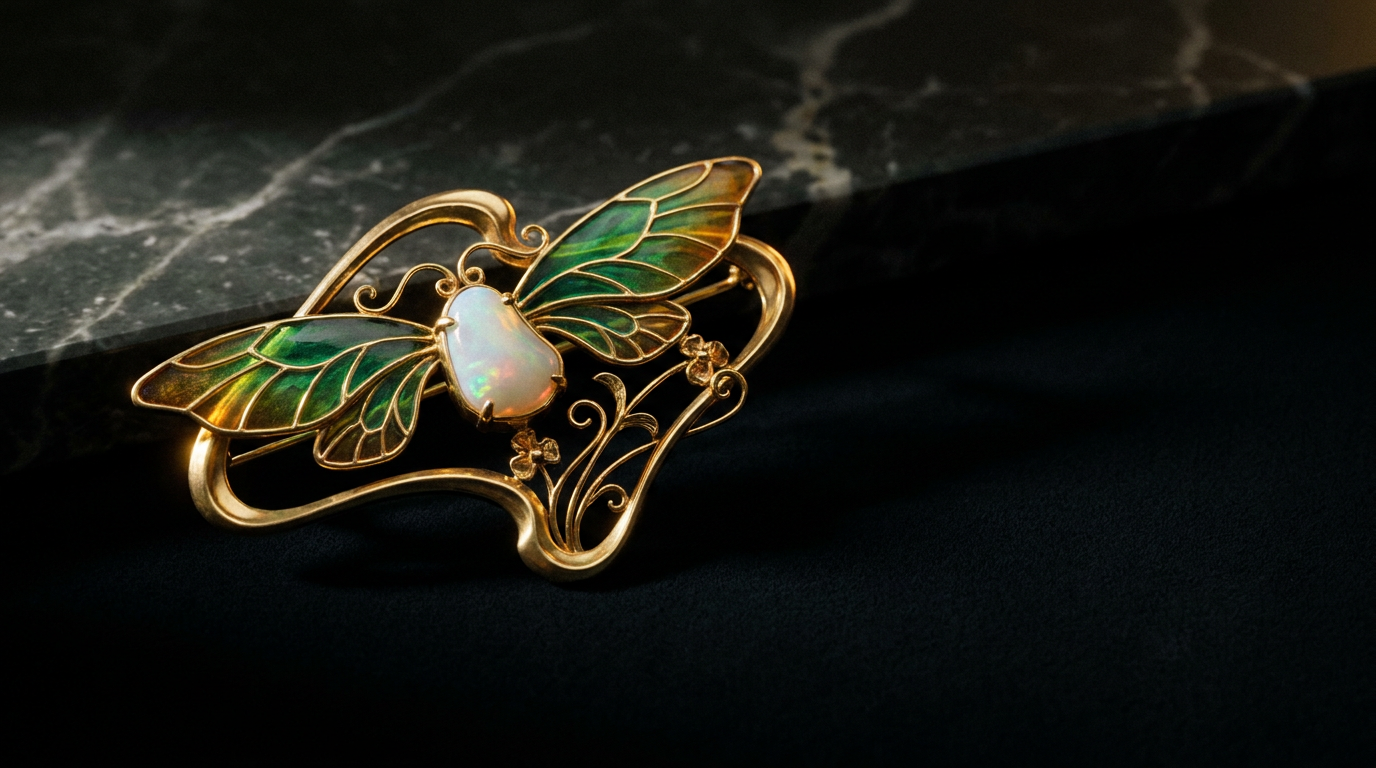
A Revolt Against the Machine
By the final decade of the nineteenth century, Paris had grown uneasy with its own prosperity. The factories of the Industrial Revolution had flooded the market with machine-stamped jewelry — symmetrical, interchangeable, cut to a formula — and the educated bourgeoisie who wore it had begun to sense, however quietly, that something had been lost. The revolt, when it came, did not arrive as a manifesto. It arrived as a brooch.
Between roughly 1890 and 1910, a generation of goldsmiths and designers in France, Belgium, and Germany produced art nouveau jewelry that remains, more than a century later, some of the most unsettling and beautiful work ever set in gold. They borrowed from Japanese woodblock prints, from the Pre-Raphaelites, from the sinuous lines of fern fronds and dragonfly wings. They discarded the tyranny of the diamond — or rather, they demoted it, allowing the stone to serve the composition rather than define it. What emerged was a new grammar for the decorative arts: the whiplash curve, the female form dissolving into petal or wing or serpent, the surface alive with plique-à-jour enamel that glowed like a cathedral window held up to the light.
It lasted barely twenty years. Art Deco arrived after the First World War and swept it away with geometric severity. But the pieces that survive — held now in the Calouste Gulbenkian Museum in Lisbon, the Walters Art Museum in Baltimore, the Musée des Arts Décoratifs in Paris — are not museum curiosities. They are among the most collectible objects in the history of jewelry, and for collectors who understand Belle Époque jewelry, they represent a singular, unrepeatable moment.
Lalique and the Dragonfly-Woman

No single object better defines the movement than the piece Lalique created around 1897–98 and presented to stunning effect at the 1900 Exposition Universelle in Paris: the Dragonfly-Woman corsage ornament, now held permanently at the Calouste Gulbenkian Museum in Lisbon. To look at it is to experience a mild vertigo. A woman's torso emerges from the thorax of an enormous dragonfly, her head helmeted in enamel and gold. The wings — hinged, articulated, shimmering with plique-à-jour enamel in tones of amber and teal — can open and close. The body of the insect is set with chalcedony cabochons; the claws are those of a griffin. It is simultaneously beautiful and deeply strange, and that strangeness was the point.
René Lalique (1860–1945) trained as a goldsmith in Paris and London before establishing himself as the defining jeweler of the Art Nouveau era. What distinguished him from his contemporaries was not merely his technical virtuosity — though that was formidable — but his willingness to treat jewelry as sculpture. He carved ivory and horn. He used glass as a primary material at a time when glass was considered too humble for fine jewelry. He placed a carved chrysoprase face at the center of his most important pieces when his clients expected diamonds. At the 1900 Exposition, critics unanimously declared Lalique's display the finest contemporary work in the decorative arts. Calouste Gulbenkian, the oil magnate and collector, purchased the Dragonfly-Woman in 1903 and went on to acquire more than 140 Lalique pieces — the most significant private collection of his work in the world. The legend that the ornament was worn on stage by Sarah Bernhardt, while unconfirmed, is entirely plausible: Bernhardt was Lalique's most famous patron and his most theatrical advertisement.
Plique-à-Jour Enamel: Stained Glass in Gold

The technique that gave the movement its most distinctive visual signature was plique-à-jour enamel — a process so demanding that few goldsmiths ever fully mastered it. The method involves filling an openwork metal framework with translucent enamel and then dissolving the temporary metal backing, leaving only the enamel suspended in its cells, unsupported, admitting light from behind. The effect, when held to a window, is exactly that of a small stained-glass panel: colors layered and glowing, the internal structure of the piece visible in silhouette. On Lalique's dragonfly wings, on the peacock tails and iris petals of Henri Vever's combs, on the serpentine bracelets of Georges Fouquet, plique-à-jour turned jewelry into something the Gothic cathedrals had achieved in stone and glass — and which no machine could replicate.
The contrasting technique, basse-taille enamel, applied translucent color over an engraved metal ground, allowing the carving beneath to modulate the depth and intensity of the color. Together, these two methods gave Art Nouveau jewelers a palette unavailable to any previous generation, and they used it not to imitate nature's colors in miniature but to amplify them — making an iris more violet than any iris, a dragonfly's wing more luminous than any wing an entomologist had pressed in a case.
For collectors approaching the era for the first time, plique-à-jour remains the surest indicator of technical ambition. A piece that carries it well — cells intact, no cracks in the enamel membranes, color even and translucent — represents hundreds of hours of work and a level of craft that the Art Deco period that followed largely chose not to pursue. Our own published guide to plique-à-jour enamel takes that story further for those who want to understand the technique in full.
Nature and the Female Form
If there is a single grammar shared by every maker of art nouveau jewelry — Lalique, Fouquet, Vever, Lucien Gaillard, the Belgian Philippe Wolfers — it is the grammar of metamorphosis. Woman becomes orchid. Woman becomes dragonfly. Woman becomes iris. The movement took its cue from Japanese printmaking, which had flooded Paris after the opening of Japan's ports in the 1850s and which showed European artists how to flatten a composition, to give equal weight to the negative space, to find in a single lily or wave or cicada the whole weight of a season. The women in Art Nouveau jewelry are not the prim Victorians of mid-century brooches. They float in their own hair, half-submerged in it, the hair itself becoming tendril or vine. They gaze from the center of pendants like figures in a dream — not portraits of anyone in particular but archetypes, the feminine as natural force.
Alongside this fascination with the female form ran an equally passionate rejection of the diamond's primacy. The conventional jeweler of 1880 thought in carats — the larger the stone, the better the piece. The Art Nouveau jeweler thought in surfaces, in the relationship between one material and another. Lalique used carved horn at a time when horn was considered a plebeian substance. Fouquet set opals for their shifting color, moonstones for their lunar ambiguity, baroque pearls for their irregularity. When diamonds appeared in Art Nouveau pieces, they typically appeared as accents — defining a wing's edge, picking out the veins of a leaf — not as the reason for the piece's existence. This was a philosophical as much as an aesthetic position: the value of the object resided in the mind that conceived it and the hand that made it, not in the weight of the stones it contained.
Georges Fouquet's collaboration with Alphonse Mucha, the Czech-born poster artist who had become the visual voice of Belle Époque Paris, produced some of the era's most theatrical commissions. In 1899, Mucha designed a serpent bracelet for Sarah Bernhardt that Fouquet executed in gold and enamel, with cloisonné work, rubies, opals, and diamonds — the coil wrapping the wrist, the snake's winged head resting on the back of the hand, linked by chains to a matching finger ring. The piece was made for Bernhardt's role in Médée and, once she saw it, she commissioned a wearable version for daily use. It sold at auction more than a century later for over $757,000 — the highest price ever realized for an Art Nouveau jewel at that time. It now lives in the Alphonse Mucha Museum in Sakai City, Japan. For context on the broader Edwardian and Belle Époque world that framed these commissions, our essay on Victorian hair jewelry traces the preceding generation of intimate, sentimental adornment that the Art Nouveau jewelers were reacting against.
The Movement's Short Life — and Art Deco's Reaction
Art Nouveau jewelry was always, in some sense, an art for a narrow public. It was expensive — the labor-intensive techniques demanded it — and it appealed to clients who were educated, culturally adventurous, and comfortable with beauty that could be described as strange. The working class had neither the money nor, often, the taste for a brooch in which a woman's face dissolved into dragonfly wings. By 1910 the movement was already contracting, its most prolific practitioners — Lalique included — shifting toward glass and broader decorative work.
The First World War ended it entirely, and not merely by interrupting production. The war changed what beauty was supposed to look like. The fluid, organic, deeply feminine forms of Art Nouveau felt, to a generation that had survived the trenches, like the indulgence of a vanished world. Art Deco — geometric, hard-edged, symmetrical, unashamedly in love with the machine — arrived as its precise antithesis. Where Art Nouveau had celebrated the curve, Deco celebrated the angle. Where Art Nouveau had reveled in the irregularity of natural forms, Deco imposed order. Where Art Nouveau had treated woman as nature, Deco treated her as architecture. The two aesthetics share a historical proximity — barely a decade separates the peak of one from the emergence of the other — but they represent opposite philosophical poles. Collectors who pursue Art Deco jewelry are often surprised to discover how completely it repudiated everything Art Nouveau had stood for.
This makes Art Nouveau jewelry, in retrospect, a genuinely rare category. There was not a long tradition of it; it was not produced in large quantities; and the techniques involved — plique-à-jour enamel chief among them — were abandoned and largely forgotten until the scholarly revivals of the 1960s and 1970s brought the great pieces back to public attention. Signed examples by Lalique, Fouquet, Vever, and Wolfers now appear at the highest levels of the international auction market and in the permanent collections of a handful of world-class museums. Unsigned but quality pieces — a dragonfly brooch with intact enamel, a hair comb carved in horn with lily pads in relief, a pendant with a moonstone at its center and plique-à-jour wings — remain available to the patient collector at prices that reflect their beauty more than their rarity.
Collecting Art Nouveau Jewelry
For the collector approaching this era for the first time, a few principles are worth holding. Condition is paramount in a way it is not for, say, a Victorian diamond ring. The enamel cells in plique-à-jour work are fragile; a crack or a missing cell is irreversible and dramatically affects value. Horn carving — a Lalique specialty — can warp or crack if not properly stored away from heat and humidity. Look for pieces where the organic forms are internally consistent: the whiplash curve should feel inevitable, not forced; the female face, if present, should be fully resolved rather than a smear of gilding.
Signatures and maker's marks matter, but the absence of a signature does not preclude an exceptional piece. Many of the finest Art Nouveau brooches, pendants, and vintage brooches were produced by ateliers working in the manner of the great designers without carrying their names. Attribution requires expertise, and the honest answer, with unsigned work, is usually "in the manner of" rather than "by." Any seller who confidently assigns an unsigned piece to Lalique without a robust provenance trail should be questioned closely.
What cannot be faked is the quality of the hand. The sinuous line of a true Art Nouveau piece — the way a goldsmith modeled the transition from stem to petal, the way an enamelist varied the color within a single cell to suggest the iridescence of a dragonfly's actual wing — is the product of a specific training, a specific cultural moment, and a specific rejection of the mechanical. That quality of attention is what the machine could not provide in 1900 and cannot provide today. It is what collectors come for, and what they take home.
The Verane Collection
VERANE's collection of Belle Époque jewelry includes estate pieces from the turn-of-the-century years that bracket the Art Nouveau movement — the decades when the serpentine curve and the enamel palette were at their height. Each piece is authenticated, documented, and offered as one of a kind. We invite collectors with a serious interest in this period to request a private viewing at their convenience.