Plique-à-Jour Enamel: The Art Nouveau Technique That Turns Jewelry Into Stained Glass
The art of capturing light in metal-free enamel — the painstaking Art Nouveau technique that gives jewelry the translucency of a cathedral window.
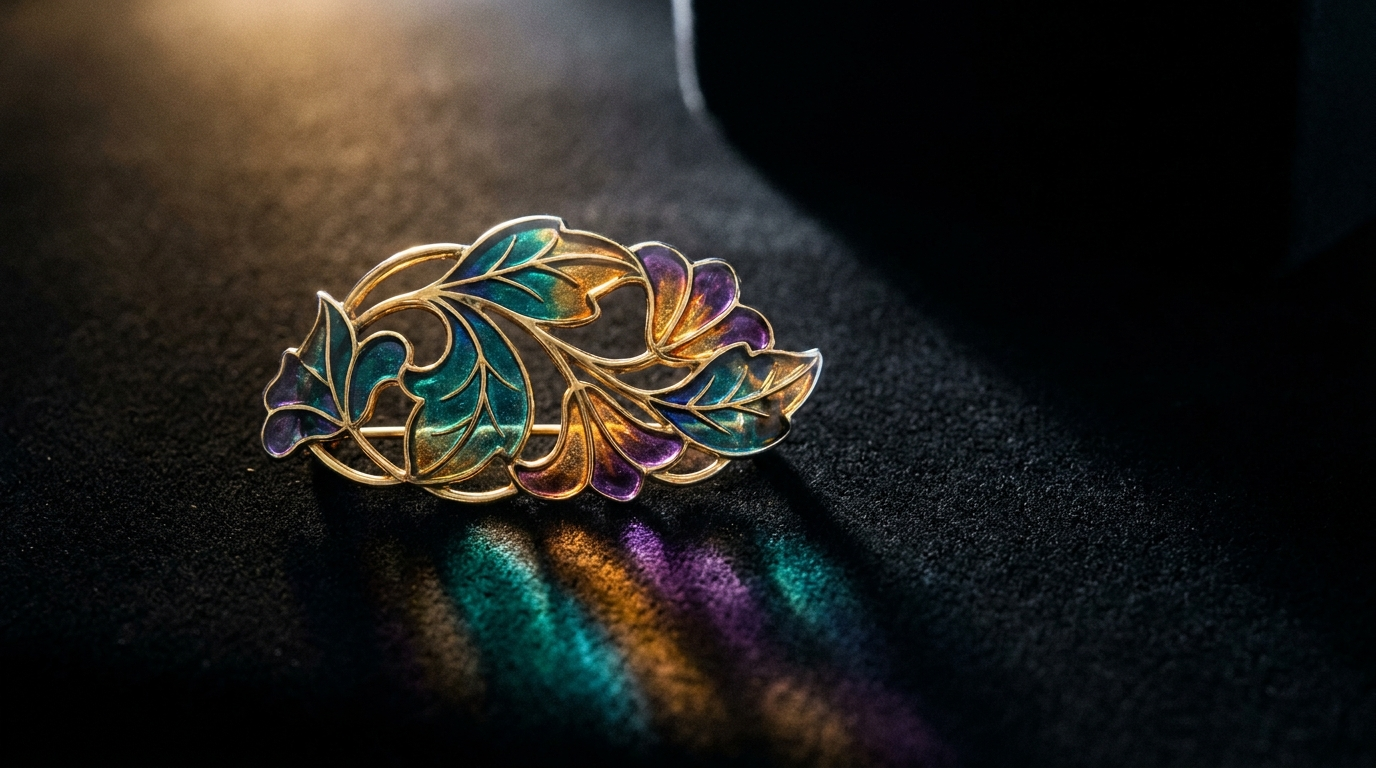
There is a moment, when light moves behind a piece of plique-à-jour enamel, that the jewelry stops being jewelry. The gold wires thin to nothing. The colored glass — deep teal, amber, the dusty violet of a late-afternoon sky — begins to glow with an internal warmth that cannot be explained by reflected light alone. It is the effect of transmitted light, the same physics that animate the clerestory windows of a Gothic cathedral, rendered in a brooch small enough to rest in a closed hand.
Plique-à-jour enamel is, by any technical measure, one of the most demanding crafts in the jeweler's repertoire. It asks the maker to fill thin cells of metal wirework with powdered glass — and then, having fired that glass to translucency, to remove any backing so that light may pass through freely. The enamel hangs unsupported except at its edges, a membrane of vitrified color held in place by metal no thicker than a sewing thread. At every stage the technique courts failure: the glass may crack on cooling, may slump or bubble in the kiln, may refuse to fill the cell cleanly. A single piece can take months. Many never survive the process intact.
What survives is something close to miraculous — a category of object that sits between jewelry and architecture, between the lapidary arts and the art of light itself. The finest examples, made during the Art Nouveau movement's decade of peak intensity between roughly 1895 and 1910, have never been surpassed for sheer technical audacity. They are among the most coveted objects in Belle Époque jewelry, and among the rarest.
The Name and Its Meaning
The French term plique-à-jour translates, with some poetic latitude, as "letting in daylight" — from plique, a variant of plique meaning a fold or opening, and à jour, which is used in French to mean pierced or open to the light. The phrase appears in French royal inventories from the fourteenth century onward, though the objects it described then were almost certainly different in character from what the term came to mean in the nineteenth. By the time Art Nouveau jewelers adopted it as their own, plique-à-jour had become a precise technical term for a single category of enamel work: translucent or semi-translucent fired glass in an unsupported cell framework.
This is worth belaboring because the technique is sometimes confused with cloisonné, its closest cousin. In cloisonné, thin metal wires are soldered to a solid metal backing to form compartments, each of which is then filled with enamel and fired. The result is opaque or semi-opaque enamel anchored to a solid surface — beautiful, durable, and flat. A third relative, guilloché enamel, differs again: it fires translucent color over a mechanically engraved metal ground rather than into open or backed cells, producing its glow through reflection off the engraved pattern beneath rather than through admitted light — a technique we explore in our piece on guilloché enamel jewelry. The crucial difference between plique-à-jour and cloisonné is negative space: plique-à-jour has it; cloisonné does not. That negative space is what the light enters.
A Technique Older Than Art Nouveau
The origins of the technique reach back considerably further than the Belle Époque. Archaeological and documentary evidence suggests that enamel work with light-admitting qualities was practiced in the Byzantine Empire in the sixth century, and that Russian craftsmen of the Kievan period — before the Mongol invasions of the thirteenth century interrupted the tradition — had developed sophisticated versions of it. The Japanese tradition of shotai shippo, or plique-à-jour cloisonné, was independently developed and produced some of the most technically refined examples in the nineteenth century, when Japanese decorative arts were entering European collections in significant numbers and reshaping Western aesthetic taste.
In Western Europe, the technique surfaces in scattered documented examples from the Renaissance period. Benvenuto Cellini, in his Treatise on Goldsmithing of 1568, describes a process that matches the essentials of filigree plique-à-jour — though whether his description reflects direct practice or theoretical knowledge remains a matter of scholarly discussion. The French court inventories that first use the term plique-à-jour do not preserve the objects they describe, and by the seventeenth century the technique seems to have retreated into obscurity in Western workshops, preserved if at all in Scandinavian silver guilds and in the specialized ateliers of a few Russian goldsmiths.
What the Art Nouveau movement did, with characteristic energy, was rediscover and amplify. The 1890s brought a generation of jewelers who were simultaneously interested in Japan, in medieval stained glass, in the Symbolist movement's obsession with light as a metaphysical phenomenon, and in the technical virtuosity that could separate fine jewelry from the merely expensive. Plique-à-jour was available as a technique, if barely practiced; it answered all of those interests at once.

The Three Methods: How Plique-à-Jour Is Made
There is no single way to make plique-à-jour enamel, and the approach a given maker chooses reflects both practical considerations and artistic intention. The three principal methods differ chiefly in how the cell framework is constructed and how (or whether) a backing is used during the firing process.
The filigree method begins with the framework itself. The craftsman draws fine wires of gold or silver — sometimes both — and forms them by hand into the cells that will hold the enamel. These wires are soldered at their junctions to create a stable open lattice: the design exists, from the beginning, as negative space. The assembled lattice is then laid over a temporary copper backing, which prevents the liquid enamel from running before it fires. Powdered enamel, mixed to the consistency of a thin paste, is applied by brush or pick to each individual cell. The piece is fired in a kiln at temperatures between 750 and 850 degrees Celsius. The enamel vitrifies — melting, fusing, cooling — but rarely fills the cell completely in a single firing. The process of adding enamel and firing is typically repeated three to five times per cell, building up the glass layer by layer, until the surface is level with the wire and the color is uniform. When the enamel work is complete, the copper backing is dissolved in an acid bath, leaving the finished piece: metal framework and glass membrane, nothing else.
The pierced sheet method begins differently. A flat sheet of gold or silver is pierced — sawed through — with a pattern of openings: the negative spaces of the design. This produces a more rigid framework than the filigree approach, and the cells it creates tend to be larger and more geometric. Enamel is then applied to the openings, using the same technique of repeated small firings, until each space is filled. Because the sheet itself provides structural integrity, the backing used during firing can be as simple as a sheet of copper foil temporarily adhered to the surface and peeled away after the final firing.
The Japanese method — shotai shippo, literally "body-less cloisonné" — reverses the process in an instructive way. Instead of building the framework first and then dissolving the backing, the craftsman begins by applying a base coat of clear flux enamel over a copper form. Metal wires are then embedded in this flux and fired into position, creating compartments exactly as in cloisonné. The cells are filled with colored enamel and fired in the usual sequence of multiple small applications. Only when the piece is complete is the copper base dissolved away — leaving the enamel surface as a freestanding shell, supported only by the wire network embedded within it. The result tends to be more curved and dimensional than Western plique-à-jour, and the wires are typically finer, giving the finished piece an appearance closer to painted glass than to wirework.
All three methods share the essential characteristic: the final object has no solid backing beneath the enamel. All three carry significant failure rates — cracking during firing and cooling, enamel that refuses to hold in a cell, metal frameworks that distort under heat. A skilled practitioner working in plique-à-jour accepts that a significant fraction of pieces begun will not survive to completion. This acceptance of loss is built into the economics of the technique and, historically, into its pricing.
René Lalique and the Art Nouveau Moment
René Lalique (1860–1945) is, for most collectors, the name that arrives first when plique-à-jour is mentioned. This is not entirely fair to his contemporaries — the Norwegian goldsmiths David Andersen and J. Tostrup in Oslo were producing technically extraordinary work in the same period, and the Russian imperial workshops of Fabergé used the technique to remarkable effect — but Lalique's primacy in the Art Nouveau jewelry canon is not contested, and his plique-à-jour work represents, in many ways, its apotheosis.
Lalique came to jewelry from an unusual angle. Trained at the École des Arts Décoratifs in Paris and subsequently in London, he spent his early career working as a designer for established jewelry houses before opening his own workshop in the 1880s. His influences were eclectic and voracious: Japanese woodblock prints, Gothic stained glass, Symbolist painting, entomology, botany. By the time he debuted his own collections at the Paris Salon in 1894 and achieved international celebrity at the 1900 Exposition Universelle, he had developed a visual vocabulary that was unmistakably his own — and plique-à-jour enamel was one of its essential elements.
What distinguished Lalique's plique-à-jour from the work of his contemporaries was, in part, his willingness to use the technique on unconventional forms and in combination with unconventional materials. Where other jewelers confined translucent enamel to small decorative accents, Lalique made it structural — entire wings of dragonflies rendered in plique-à-jour so that the gold wirework of the wing veins was visible through teal or amber glass; hair combs whose teeth parted panels of luminous enamel; pendants where the enamel formed the primary plane of the composition and the gemstones were secondary.
His most famous plique-à-jour piece, the Dragonfly Woman corsage ornament of approximately 1897–1903, now in the Calouste Gulbenkian Museum in Lisbon, combines a female torso in sculpted gold with wings of plique-à-jour enamel spanning some 26 centimeters — the scale of a small painting, the intimacy of a brooch. The wings are articulated; they move. The enamel is in shades of deep blue-green and amber-gold, and the effect when lit from behind is one of absolute translucency: the wings become windows, and the figure within them becomes something between a woman and an insect and a source of light.

Lalique was also an innovator in method. Where earlier craftsmen had confined plique-à-jour to silver and gold frameworks, he worked with copper, aluminum, and iron as well — metals that were then newly available as industrial products and that he used without the prejudice of the traditional jeweler. He understood that the wire framework was not merely structural but compositional: the gold veins of an insect wing were simultaneously engineering and drawing. He trained his own craftsmen in the technique and kept the workshop's processes proprietary; the full details of his specific methods were not documented until decades after the major jewelry period ended.
Beyond France: Fabergé, Norway, and the East
The Art Nouveau moment in Paris was not the only context in which plique-à-jour achieved its finest expressions. In St. Petersburg, the workshops of Carl Fabergé — Peter Carl Fabergé's commercial empire of ateliers producing objects for the Russian imperial court and international clients — used plique-à-jour as one element in objects of extraordinary complexity. The technique appeared in small but telling applications: the windows of miniature architectural objects, the wings of decorative figures, the translucent flowers that ornamented cigarette cases and small boxes. Fabergé's craftsmen were disciplined by a different tradition than Lalique's — more systematic, less experimental, more concerned with the integration of multiple techniques in a single object — and their plique-à-jour work has a precision that reads differently from Lalique's romantic exuberance. It is, perhaps, the difference between a jeweler who thinks like a painter and one who thinks like an engineer.
In Norway, the tradition of plique-à-jour took on a distinctly national character. David Andersen of Kristiania (now Oslo) and the firm of J. Tostrup — both of which had connections to the craft revival movements of the late nineteenth century — developed a style that drew on Norse ornamental traditions while using the translucency of the enamel to produce work of unusual delicacy. Norwegian plique-à-jour tends toward cooler colors — pale blues and greens, silvery whites — that suit the northern light and that distinguish it immediately from the jewel-saturated palette of the Paris masters. These pieces were exported widely in the early twentieth century, particularly to Britain and North America, and they remain a distinct and significant category in the Edwardian jewelry market.
The Japanese tradition, as noted above, proceeded on an independent technical path. Japanese shotai shippo was not plique-à-jour in any direct line of transmission — it developed from the cloisonné tradition that Japanese craftsmen had absorbed and transformed from Chinese sources — but it converged on the same optical effect: translucent enameled color held in a wire framework, glowing with transmitted light. The finest Japanese plique-à-jour pieces, by makers including Namikawa Sōsuke and Ōtake Norikuni, have a refinement of surface that Western pieces rarely match: the wires are almost invisible, the enamel more like watercolor than glass, the gradations of color within a single cell achieved by techniques that have never been fully documented in Western sources.
Identifying Plique-à-Jour: What the Collector Looks For
For a collector approaching plique-à-jour enamel for the first time, the identification of authentic examples from the Art Nouveau and Edwardian periods requires a combination of technical observation and contextual knowledge. The technique is distinctive enough that a genuine example is rarely confused with other types of enamel work — but the range of quality within the category is wide, and condition issues specific to the technique require close examination.
The most fundamental diagnostic is transmitted light. Plique-à-jour enamel, by definition, allows light to pass through it. Hold a piece to a window or a bright lamp and look at the enamel from both sides. If the enamel is translucent or transparent and the metal framework is visible through it from the back as well as the front, and if there is no solid backing beneath the glass, the piece is plique-à-jour. If the enamel is opaque, or if a solid metal surface is visible behind the glass, it is not.
Within the broader category of Art Nouveau and Art Deco jewelry that a collector might encounter, plique-à-jour almost invariably features organic motifs — wings, flowers, leaves, dragonflies, peacock feathers — rendered in asymmetric or flowing compositions. The Art Nouveau period's commitment to nature as its primary vocabulary was particularly well-served by a technique that made enamel behave like a leaf held up to sunlight. Geometric plique-à-jour, using angular compartments and rectilinear compositions, was produced in the Art Deco period but is rarer and less typical; the technique's natural affinity is with curves.
The color range in period pieces is typically rich but not garish: the French workshops favored teal, blue-green, amber, pale violet, and soft gold; the Norwegian tradition runs cooler; the Russian examples are often deeper and more saturated. Colors that look contemporary or that fall outside the range of Victorian-era glass technology — certain bright oranges, synthetic-looking purples, pure primary reds — should prompt closer examination of the piece's age and provenance.
Condition is a critical consideration unique to plique-à-jour. Because the enamel has no structural backing, it is vulnerable to impact damage, thermal shock, and the accumulation of fine cracks that may not be visible in reflected light but become apparent when the piece is held to transmitted light. Missing enamel — cells where the glass has been lost entirely — is common in very old pieces and is not necessarily disqualifying, but it affects value substantially. A piece with all cells intact, no cracks, and original surface patina is considerably rarer than it might appear in catalogue photographs.
Maker's marks, where present, are invaluable. Lalique signed his work with a variety of marks across different periods, and the literature on authenticating Lalique jewelry is extensive. Pieces from the Tostrup or David Andersen workshops typically carry Norwegian maker's marks and silver content stamps. Fabergé pieces are signed by the workshop head craftsman responsible for their production and carry the requisite imperial marks. Unsigned pieces — which represent the majority of plique-à-jour work produced in the period, since not every small atelier signed its production — must be assessed on technical and stylistic grounds alone, which demands either expert examination or a well-documented provenance chain.
Signed pieces by the major Art Nouveau masters command significant premiums. Authenticated Lalique jewelry from the peak period can realize between $20,000 and $200,000 or more at auction, depending on condition, complexity, and provenance. Pieces by Fouquet, Gaillard, or other significant French ateliers occupy a somewhat lower range. Norwegian and unsigned Continental pieces from the period can be found in the $1,000 to $15,000 range — considerably more accessible, and often technically excellent. Japanese shotai shippo pieces by documented makers have their own, separately developed market in which the criteria of authentication differ.
Plique-à-Jour and the Connoisseur's Eye
Part of what makes plique-à-jour enamel distinctive as a collecting category is that it requires the collector to develop a specific sensory discipline: learning to look with light, not just at it. The standard conditions of a jewelry display — controlled gallery lighting, reflected from above — are not unfavorable to plique-à-jour, but they are not its best environment. The technique reveals itself fully only in transmitted light, when the enamel becomes an active source rather than a passive surface. Collectors who spend time with plique-à-jour develop an instinct for this — a preference for natural light, an inclination to hold pieces up rather than lay them down, a sensitivity to the way the color shifts as the angle of illumination changes.
This sensitivity is itself historically appropriate. The Art Nouveau movement, which embraced plique-à-jour with such intensity, was deeply invested in the idea of jewelry as wearable art — as an object experienced in motion, in natural light, against living skin rather than in a case. The dragonfly corsage ornament was meant to be worn at a concert or a reception, where the play of gaslight or early electric light through the wings would create a shifting, animated impression quite different from any static display. The technique was designed for this: for the jewelry as performance, as event, as something that changes in time.
The finest plique-à-jour pieces share with the great stained glass windows they resemble a quality that is difficult to name but easy to experience: a sense that the light is not merely passing through the material but being changed by it. The glass does not simply admit daylight; it transforms it, filters it, gives it color and weight. Standing before a good piece of plique-à-jour enamel in raking afternoon light, it is possible to feel what the craftsman felt — or what the craftsman wanted the wearer to feel — in the atelier in Paris or Oslo or St. Petersburg, in the decade before the world that produced these objects changed forever.
The collectors who seek out this kind of work are rarely interested in jewelry as investment alone, though the market for authenticated Art Nouveau plique-à-jour has strengthened steadily since the 1970s. They tend to be drawn to the specificity of the technique — its difficulty, its history, the way it embeds a particular set of aesthetic intentions in glass and gold — and to the irreducible fact that no reproduction, however technically accomplished, carries the weight of a piece made by hand in the last years of the nineteenth century. The light that enters a century-old cell of plique-à-jour enamel is the same light that entered it the day it left the workshop. That continuity is, in itself, a form of provenance.
For those exploring the broader world of vintage and estate jewelry, plique-à-jour offers an entry point that connects directly to the most serious collecting traditions: the study of technique, the attention to condition, the patience required to find pieces whose history can be traced. It connects to the fundamental logic of estate jewelry — that the object carries within it the labor and intention of its making, and that this is worth more than the sum of its materials. And it reminds us that the most ambitious jewelry of the Art Nouveau period was not primarily about gemstones or precious metals, but about light — the oldest luxury of all.
A Note for Prospective Collectors
Plique-à-jour enamel from the Art Nouveau and Edwardian periods represents one of the more demanding categories in estate jewelry collecting — demanding in terms of the knowledge required to assess condition, the patience required to find examples that meet serious standards, and the discernment required to distinguish between the exceptional and the merely adequate. It is also, for those with the appetite for that kind of engagement, one of the most rewarding.
The market for unsigned or workshop-attributed plique-à-jour pieces from the 1890s to 1910s remains more accessible than many comparable categories of Belle Époque jewelry. A collector who develops a reliable eye for condition and authenticity, and who is willing to seek pieces outside the major auction houses, can still find work of real quality at prices that reflect the difficulty of the technique rather than the name of the maker. Norwegian pieces in particular — and certain Continental examples from smaller ateliers — offer strong technical and aesthetic merit at prices well below the Lalique market.
At VERANE, pieces that exhibit plique-à-jour work are examined closely for cell integrity, color uniformity, and the quality of the wire framework before being offered. We work within the estate and vintage market rather than outside it, which means that every plique-à-jour piece we handle comes with whatever provenance documentation survived alongside it, and with a frank assessment of its condition. If a piece interests you from a photograph but questions of condition or authenticity require closer examination, we invite you to arrange a private viewing. There is no adequate substitute for holding a piece of plique-à-jour enamel up to natural light and letting it speak for itself.