What Is Estate Jewelry? A Collector's Guide
Estate jewelry simply means previously owned jewelry of any age; here is how antique, vintage and estate differ, and how to buy with confidence.
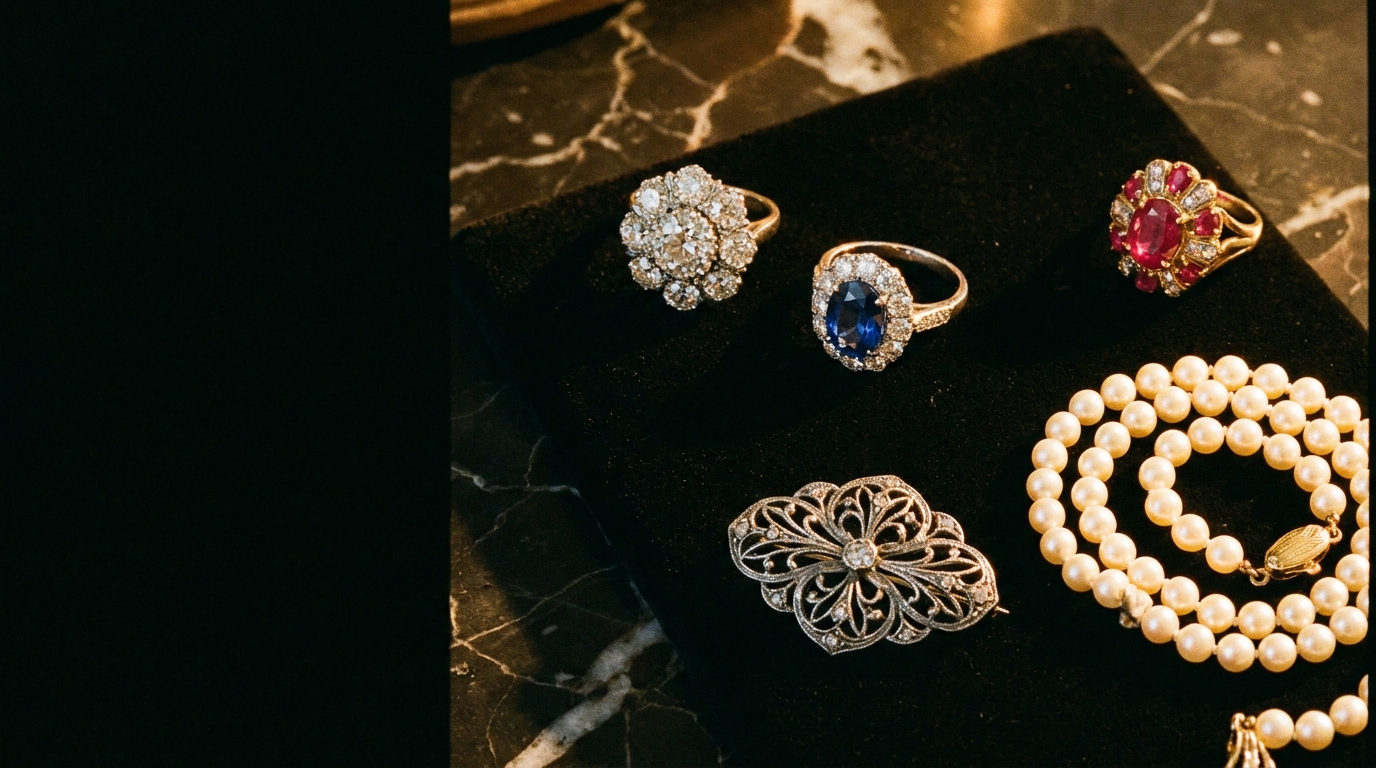
To ask what is estate jewelry is to open a door onto one of the most beautiful and most misunderstood corners of the jewelry world. The phrase carries a faint air of grandeur, as though it must refer only to heirlooms drawn from great houses and sealed family vaults. The truth is gentler, and rather more generous. Estate jewelry simply means jewelry that has been previously owned. It need not be a century old. It need not have belonged to a duchess. A diamond ring purchased three years ago and sold onward is, by the trade's own definition, estate jewelry the moment it leaves its first owner's hand.
At Maison Verane, where we have cared for jewels since 1921, this distinction matters because it shapes how you read a piece, how you value it, and how you buy it well. Understanding the language is the first act of confident collecting. So let us take the three words that are so often used interchangeably and give each its proper meaning.
Antique vs. Vintage vs. Estate Jewelry
These three terms describe different things, and the most common error is to treat them as synonyms. Two of them speak to age. One speaks only to ownership.
Antique jewelry refers to pieces generally one hundred years old or more. An antique jewel was made in an era when the goldsmith's bench did most of what machines now do, when stones were cut by eye and set by hand, and when each piece carried the small, telling irregularities of human craft. Georgian, Victorian, Edwardian, and the earliest Art Deco creations fall within this realm; some of the most personal antiques of all are the woven Victorian hair jewelry pieces of the mourning era. Their scarcity is genuine: a hundred years of wear, loss, and remodeling thins the survivors considerably.

Vintage jewelry occupies the middle ground, broadly twenty to one hundred years of age, with many specialists drawing the line at a minimum of twenty to thirty years before a piece earns the word. This is the territory of mid-century glamour, of bold Retro silhouettes, of the cocktail rings that defined post-war elegance. It also encompasses the designer revolution of the 1970s and 1980s, when names such as Elsa Peretti — whose organic silver forms transformed Tiffany & Co. into a design house as much as a jewelry house — created pieces now avidly collected as estate objects in their own right. A jewel from the 1950s or 1960s is vintage; it is not yet antique, though one day it will be.
Estate jewelry is the broadest term of the three, and the one that confuses most buyers. It describes any piece that has had a previous owner, regardless of its age. Every antique jewel is, by definition, also estate. Every vintage jewel is estate too. But a great deal of estate jewelry is neither antique nor vintage; it is simply pre-owned. The word tells you about a jewel's history of ownership, not the year it was born.
So, What Is Estate Jewelry, Really?
Returning plainly to the question, what is estate jewelry at its heart: it is a jewel with a past. That past may stretch back a hundred and fifty years or merely a handful of seasons. What unites every estate piece is that someone chose it before you, wore it, and let it go, leaving it ready to begin a second life.
This is precisely what we find so moving about the category. An estate jewel is never anonymous. It was selected for an occasion, a person, a moment that mattered. Our role at Maison Verane is to receive these pieces with care, to examine them honestly, and to present them with the provenance they deserve. When you browse our vintage cocktail rings, you are not looking at manufactured newness but at jewels that have already proven their character across decades.
Is Estate Jewelry Worth Buying?
For many collectors, estate jewelry offers a rare combination of beauty, value, and individuality that contemporary retail cannot easily match. Older pieces frequently display craftsmanship that would be prohibitively expensive to commission today: hand engraving, intricate milgrain, calibrated stones cut to fit a setting exactly. You are often acquiring more artistry for your investment than a comparable new piece would provide.

There is also the matter of distinction. A new ring from a current collection exists in the thousands. An estate jewel is frequently one of very few, sometimes the only one of its kind still in circulation. For those who dislike the idea of wearing what everyone else is wearing, this singularity is the entire point. Our estate diamond rings and estate sapphire rings are chosen precisely for that quality of being unrepeatable. At the extreme end of that scale, a certified Kashmir sapphire — from a mine exhausted within five years of its discovery in the 1880s — is perhaps the purest example the colored-stone world offers of a supply that is genuinely, permanently fixed.
A word of honesty is owed here, because the subject of worth is often dressed up in the language of finance. We are jewelers, not financial advisors, and we will not tell you that a jewel is a guaranteed appreciating asset. Some estate pieces hold or grow in value handsomely; others are bought purely for the pleasure of wearing something lovely. Buy what you love, buy it well, and let any future value be a happy consequence rather than the reason. A jewel with a famous history, such as the storied stone we explored in our journal entry on the Hope Diamond, reminds us that provenance and beauty, not speculation, are what endure.
How to Buy Estate Jewelry with Confidence
Confidence in this market comes from knowledge and from the reputation of the house you buy through. A few principles will serve you well. And provenance matters more than many buyers realize: anonymous, undocumented stones are precisely what thieves covet, as the story of the Antwerp diamond heist reminds us — a documented past is a jewel's best protection.
First, insist on clarity about condition. A reputable seller will tell you frankly whether a piece has been resized, repaired, or had stones replaced, and none of these is necessarily a flaw, provided it is disclosed. Second, ask about the stones. Natural gemstones and older diamonds carry their own character, and you should understand what you are paying for. When you consider our estate ruby rings, for example, we are glad to discuss origin, treatment, and the qualities that make each stone distinct.
Third, examine the craftsmanship up close. Hallmarks, maker's stamps, the quality of the setting, and the wear at the back of a piece all tell a story to a trained eye — and knowing how to spot a fake signed piece is one of the most useful skills a new collector can learn. Fourth, and most importantly, buy from a house that stands behind what it sells. The reassurance of a knowledgeable jeweler is worth a great deal, which is why we invite serious buyers to request a private viewing rather than purchase blind.

Why Estate Jewelry Is More Sustainable
There is a quiet virtue to estate jewelry that grows more relevant each year. To wear a jewel that already exists is to spare the earth the cost of mining new gold and new gemstones. No fresh ore is dug, no new ground is broken. The piece on your hand has already paid its environmental price long ago, and choosing it is among the most genuinely sustainable decisions a jewelry lover can make.
This is not merely a fashionable claim. The most considered jewelry collectors have understood for generations that the greenest jewel is the one already above ground. Estate jewelry lets you honor both beauty and responsibility at once, carrying forward something fine rather than commissioning something new. It is luxury with a conscience, and a longer memory.
Beginning Your Own Collection
Every estate jewel was once chosen by someone who could not resist it. We hope you will allow yourself the same pleasure. Whether you are drawn to the fire of a vintage cocktail ring, the cool depth of a sapphire, or the warmth of a ruby with a history, there is a jewel waiting that will feel as though it was meant for you.
We invite you to explore the full breadth of the Maison Verane collections, from estate diamond rings to our rarer colored-stone pieces, and to take your time. And when a particular jewel speaks to you, do not hesitate to request a private viewing, where we can place it in your hand and tell you everything we know of its journey to you. That, in the end, is what estate jewelry is for: to be loved again, by someone new.