How to Read Jewelry Hallmarks: A Collector's Guide to Maker's Marks, Assay Offices, and Gold Fineness Stamps
Those tiny stamped marks on the inner band of a ring or the clasp of a bracelet are not incidental. They are a piece's biography rendered in metal — recording who made it, where it was tested, when it was made, and to what standard of purity. Eleanor Verane guides you through reading them.
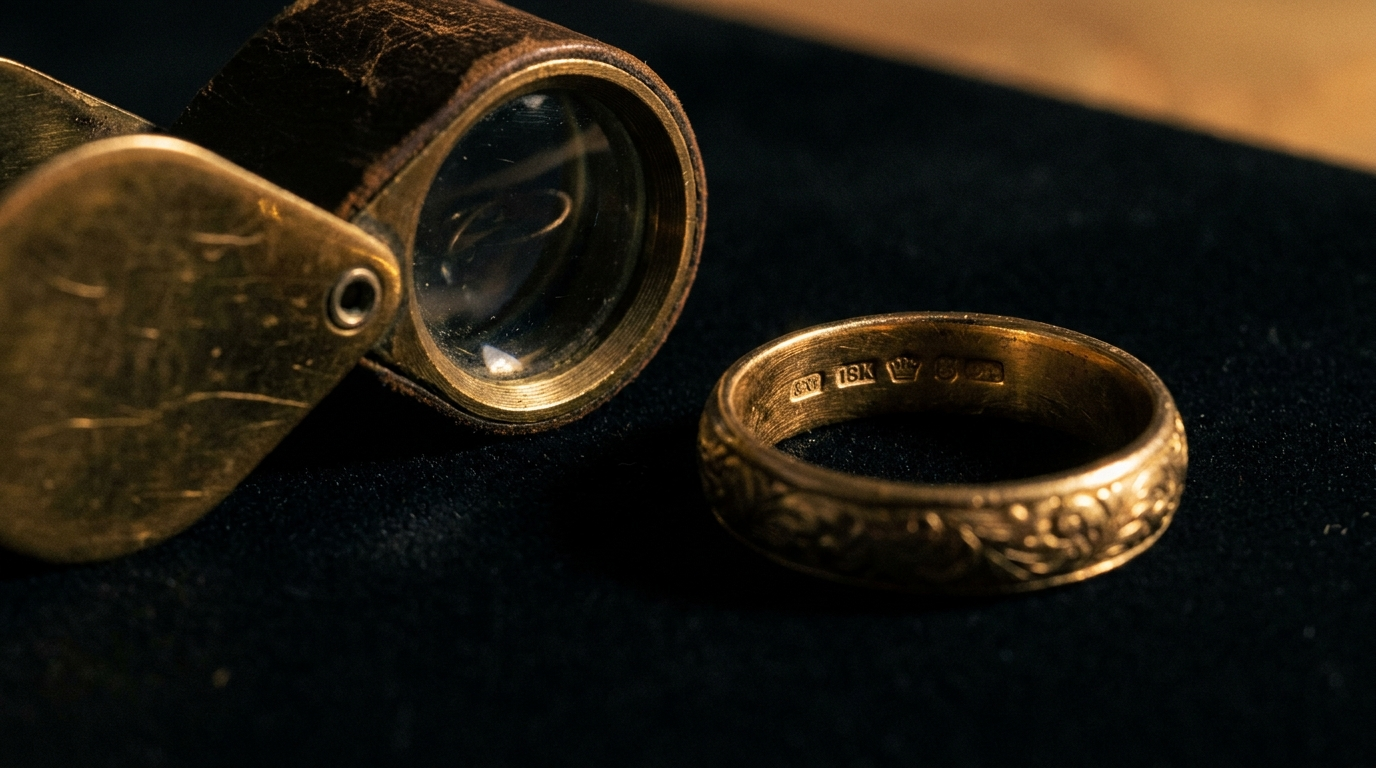
Those tiny stamped marks on the inner band of a ring, the clasp of a bracelet, or the reverse of a brooch are not incidental. They are a piece's biography rendered in metal — recording who made it, where it was tested, when it was made, and to what standard of purity. Once you know how to read jewelry hallmarks, you will never look at an estate piece in quite the same way. Each stamp becomes a sentence, and a set of stamps becomes a short history of a singular object.
The knowledge is not arcane. It is, in fact, one of the most reliable instruments a collector has — more objective than a dealer's word, more legible than patina, more precise than style alone. This guide will walk you through the major systems: British assay marks with their date letters and town symbols, French poinçons, Continental millesimal fineness numbers, and the signatures of the great houses.
The Origin of Hallmarking — and What the Word Actually Means
The word itself tells you where to begin. In 1300, King Edward I of England passed a statute requiring that all gold and silver wares meet a minimum standard of purity before they could be sold. To enforce this, pieces were brought to Goldsmiths' Hall in London — the guild's home and the country's first official testing body — where, once approved, they received a mark. That mark, struck at the Hall, became the hallmark.
The practice spread and deepened over the following centuries. By 1477, the London assay office had introduced the date letter — a single letter of the alphabet, changed annually, pressed into the metal alongside the fineness and town marks. The intent was accountability: if a piece later proved to be below standard, the date letter told the authorities exactly when it had been tested and by whose hand it had passed.
The institution proved durable. Today, four British assay offices remain active — London, Birmingham, Sheffield, and Edinburgh — each applying the same essential suite of marks that have been in continuous use for over seven centuries.
Assay Office Marks — The Four Town Symbols
Every piece tested and approved by a British assay office carries that office's own symbol. These are among the most recognizable marks in the collecting world, and learning to place them is the first step in reading any British piece.
London uses the leopard's head — more accurately described as a lion's face viewed full-on, though collectors have called it a leopard since the medieval period. It is the oldest of the four marks, and it carries with it the full weight of Goldsmiths' Hall's seven-hundred-year history.
Birmingham uses an anchor. The story most often told is that the symbol was chosen at a tavern meeting in 1773, when the founders of the new Birmingham office drew the anchor from the London docks as a reference point. Whether or not the story is precisely true, the anchor has been Birmingham's mark ever since, and Birmingham silver and gold — the city produced an enormous volume of both — is among the most consistently stamped in the world.
Sheffield used a crown from its founding in 1773 until 1974, when the mark shifted to a Yorkshire rose. Both symbols appear in the collector's market, so the date of a piece matters when identifying it. Pre-1974 Sheffield work bears the crown; post-1974 work bears the rose.
Edinburgh uses a three-towered castle, a symbol drawn from the city's coat of arms and from Edinburgh Castle itself. Scottish silver marked in Edinburgh carries this castle clearly on its surface, and the mark is one of the most visually distinct in the British system.

Date Letters — Reading the Alphabet in Metal
Alongside the assay office mark, most British pieces hallmarked before 1999 carry a date letter: a single alphabetic character set within a shaped cartouche — a shield, an oval, a square, or other forms that themselves changed with each new cycle. The combination of the letter, its case (upper or lower), its typeface, and the shape of its surrounding cartouche identifies both the year and the assay office, since each office ran its own cycle on its own schedule until the Hallmarking Act of 1973 standardized the system.
From 1975 onward, all four British offices have used the same date letter, changed each January. Before that, London changed its letter in May; Birmingham changed in July. This means that a piece struck in June 1920, for example, would carry London's letter for the 1919–1920 cycle, while a Birmingham piece from the same month would already be into its new cycle. For collectors of Victorian and Edwardian pieces in particular, a good British date letter table is an indispensable tool.
What the date letter gives you is not a birth certificate — it is an assay date. The piece may have been made weeks or months before it was submitted for testing. But in practice, most pieces were hallmarked shortly after manufacture, and the date letter is, for most collecting purposes, close enough to be treated as the date of making.
Gold Fineness Stamps — Karats and Millesimal Numbers
The third element of any British (or Continental) hallmark suite is the fineness mark — the declaration of how much pure gold or silver the piece actually contains. Two systems exist side by side in the estate market, and understanding both prevents confusion when reading pieces from different eras and origins.
The karat system, used in the United States and historically in Britain, divides purity into 24 parts. Pure gold is 24 karats. An 18-karat piece contains 18 parts gold and 6 parts other metals — 75% gold by weight, which makes it both rich in color and durable enough for set jewelry. Fourteen-karat gold (14K) is 58.5% pure; nine-karat (9K) is 37.5% pure and is the minimum standard for gold in the United Kingdom.
The millesimal fineness system, standard across Continental Europe, states purity as parts per thousand. The numbers you will encounter on estate pieces are: 999 (fine gold, almost never seen in jewelry), 750 (18 karat), 585 (14 karat), 417 (10 karat), and 375 (9 karat). For silver, 925 denotes sterling — 92.5% pure silver — while 950 indicates the higher standard used in French silversmithing.
A piece stamped 750 and a piece stamped 18K are chemically identical. The difference is simply national convention: European makers stamp the number; American and older British makers stamp the letter. On a piece with both — as is common on items imported and re-assayed in Britain — you may find the karat mark alongside a British assay office stamp and date letter, creating a small palimpsest of the piece's commercial history.

French Poinçons — The Eagle and the Minerva
France developed its own hallmarking system independently, and it is, in several ways, even older than England's — French goldsmiths' guilds were applying marks from as early as 1275. The system was nationalized and standardized in the nineteenth century, and the marks introduced in 1838 remain in use today.
On French 18-karat gold, the guarantee mark is the eagle's head (tête d'aigle) — a small profile of an eagle pressed into the metal. It is one of the most beautiful marks in the collecting world, and it appears on some of the most significant pieces in the estate Cartier market: a Cartier brooch from the 1920s, for example, would carry the eagle's head for gold, the maker's poinçon de maître (maker's mark) — a lozenge with Cartier's initials and a symbol — and sometimes the French import mark, a poinçon de garantie applied when pieces crossed into France from abroad.
For silver, the equivalent is the Minerva head — the Roman goddess of craftsmanship, profiled in a small oval stamp — denoting 950/1000 purity. The Minerva mark signals not just the metal's quality but the entire tradition of French silversmithing from which it descends.
The maker's poinçon on a French piece takes the form of a lozenge (diamond-shaped cartouche) enclosing the maker's initials and a symbol. Louis Cartier's early pieces bear LC within their lozenge; later pieces bear the house's own registered mark. For collectors of estate jewelry from the Belle Époque and Art Deco periods, learning to read French poinçons opens an entire vocabulary of Parisian goldsmithing.
Maker's Marks and Signatures — The Houses That Left Their Names
Beyond the assay and fineness marks, the maker's mark — called the sponsor's mark in British parlance — identifies the individual craftsman or firm who submitted the piece for hallmarking. In the British system, this is the first mark in the sequence: two or more letters within a cartouche, registered with the assay office. In the French system, it is the lozenge poinçon de maître.
The great houses added a further layer: their own engraved or stamped signature. A genuine Cartier piece — whether from Paris, London, or New York — is engraved with CARTIER in clean, evenly spaced capital letters, typically on the inner surface of a ring or the reverse of a brooch, accompanied by a unique serial number. No two Cartier pieces share a serial number; the number, cross-referenced with Cartier's archives, can be used to establish provenance with precision — though, as we explain in our guide to spotting a fake signed piece, a matching serial number alone is never proof on its own.
Tiffany & Co. pieces in sterling silver carry the 925 stamp alongside the house signature — either TIFFANY & CO. in full or T & CO. in the abbreviated form used on smaller surfaces. Vintage Tiffany jewelry from the mid-twentieth century often shows both the house name and a maker's workshop mark, reflecting the studio-partner relationships through which Tiffany produced its work — nowhere more distinctly than on the designer pieces stamped simply ELSA PERETTI, TIFFANY & CO., a signature combination collectors learn to recognize on sight, as we explore in our profile of Elsa Peretti.
For earlier American pieces, the maker's mark may take the form of an eagle (a private, non-governmental use of the symbol, distinct from the French assay mark) alongside the karat stamp and the maker's initials. The eagle in an American context is not a guarantee of government assay — it is a maker's signal of quality, self-declared.
How to Examine a Piece
A jeweler's loupe — typically 10x magnification — is the collector's essential instrument for hallmark reading. The marks are pressed into the metal and may be shallow, worn by decades of wear, or partially obscured by a setting. Good light and patience matter as much as the loupe itself.
On a ring, begin at the inner band, working around its circumference. On a bracelet, check the clasp and its inner surfaces. Brooches carry their marks on the reverse, sometimes near the pin mechanism. Necklace clasps are the usual location for chains; pendants may be marked at the bail or on the reverse of the mount. On a pair of earrings, both pieces are typically marked, though they may carry slightly different stamps if they were made by different workshops and assembled later.
Read the marks in sequence. In the British system, the conventional order from left to right is: maker's mark, standard (fineness) mark, assay office mark, date letter. Not every piece will show all four — older pieces may predate certain requirements, import marks may replace some standard marks, and worn surfaces may have softened or obscured individual stamps. But even a partial suite tells you something: an anchor alone tells you Birmingham; an eagle's head alone tells you French 18-karat gold.
Cross-reference what you find with a reliable date letter table. The Goldsmiths' Company's Assay Office in London maintains a trace-a-hallmark service for pieces where the marks are uncertain, and there are several well-regarded printed references — Bradbury's Book of Hallmarks being the most widely used in the British market — that present every date letter cycle from 1300 to the present.
The marks will not always answer every question. But they will anchor the piece in time and place, and they will tell you, with the authority of centuries, what the metal is. That is the beginning of knowing what you have — and what it is worth carrying forward.
A Note on Unmarked and Lightly Marked Pieces
Not every estate piece carries a full hallmark suite. American jewelry was not subject to mandatory government assay throughout most of the twentieth century; marks were self-applied by manufacturers, and the conventions varied by era and region. Some fine pieces — particularly those produced by studio jewelers or in traditions that predated formal hallmarking — carry only the maker's signature or a fineness number, with no assay office mark.
The absence of marks does not disqualify a piece. It shifts the burden of authentication to other evidence: provenance documents, maker's archives, stylistic analysis, and metallurgical testing. For the collector, it is simply a different kind of reading — slower, more interpretive, but no less rewarding. What estate jewelry offers, with or without its stamps, is the opportunity to enter a history. The hallmarks, when present, are simply the shortest path in.
If a piece you are considering carries marks you cannot place — or if you want a second expert opinion on what the marks are telling you — browse our estate rings and Art Deco jewelry for examples of fully documented pieces, or request a private viewing with our curatorial team. Every piece at VERANE is offered with its marks read and its provenance stated as clearly as the record permits.