How to Spot a Fake Signed Piece: A Collector's Guide to Cartier, Van Cleef & Arpels, and Tiffany Signatures
A collector's guide to authenticating signed Cartier, Van Cleef & Arpels, and Tiffany & Co. jewelry — what a genuine signature, serial number, and hallmark should look like, and the tells that reveal a forgery.
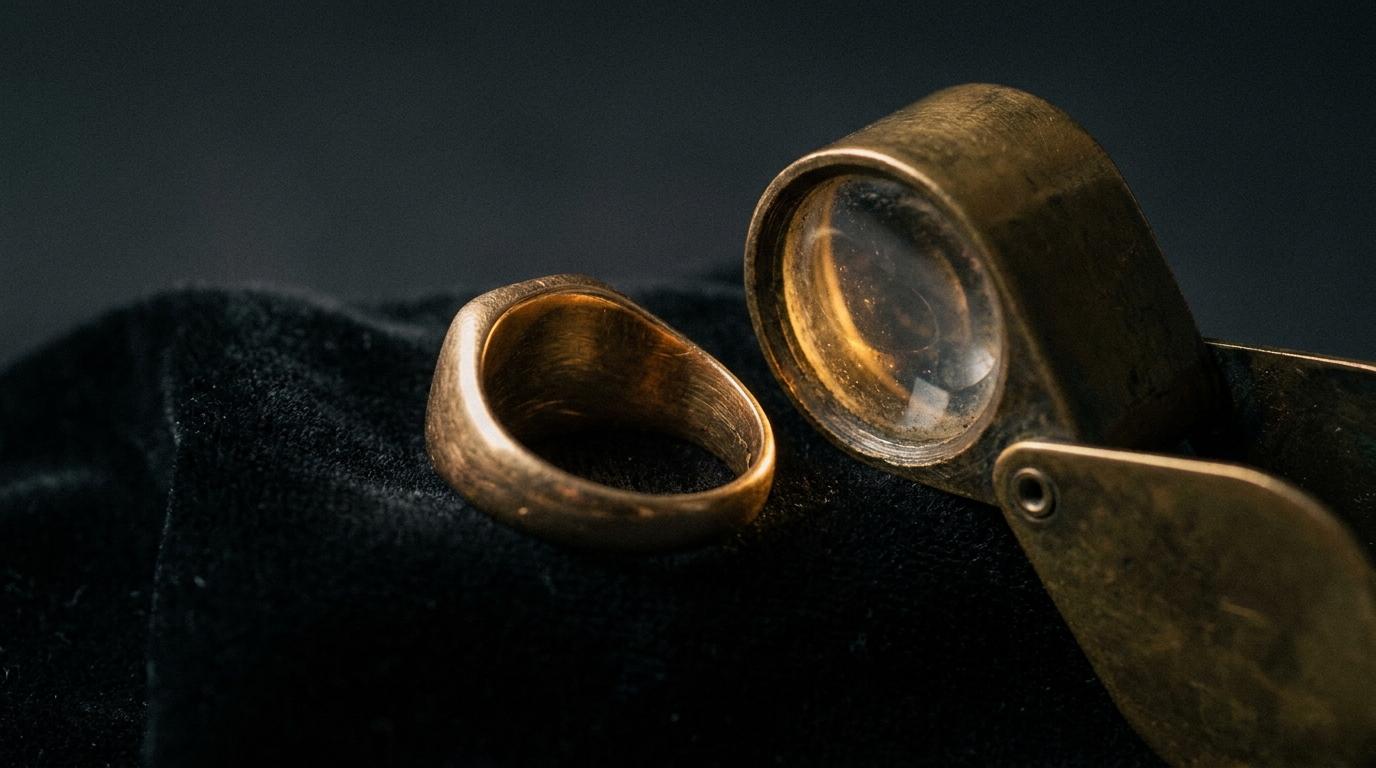
Every great signature is, in one sense, a promise. When Cartier engraves its name inside a ring's shank, when Van Cleef & Arpels stamps its trademark beside a clover motif, when Tiffany & Co. presses its mark into the reverse of a brooch, the house is vouching for what lies beneath: the karat, the workshop, the standard of hand that made it. That promise has real value — which is precisely why it has always been forged. The signature on a signed piece is both the easiest thing about it to fake and, done properly, one of the hardest things to fake well. Learning to tell the difference is not an academic exercise for collectors of estate and vintage jewelry. It is the single most useful skill in the trade.
Counterfeit signed jewelry is not a fringe problem. Jewelry and watches are consistently among the top categories seized at the U.S. border for intellectual-property violations, and individual seizures of fake signed pieces routinely run into the millions of dollars in claimed retail value — a 2024 Indianapolis shipment of counterfeit Cartier watches alone was valued at more than $4 million had the goods been genuine. Most of that volume never reaches a showroom; it is sold directly to buyers who have no easy way to check what they are holding. The good news is that the tells are consistent, learnable, and — with patience and a loupe — visible to anyone willing to look closely.
The Anatomy of a Genuine Signature
Before examining any particular house, it helps to understand what a real engraved signature actually is: a mechanical or laser-cut mark, applied by trained hands or calibrated equipment, to a tolerance the maison itself controls. That control is what counterfeiters struggle to replicate. A genuine signature is consistent in depth across every letter — the engraving tool does not slow down or speed up mid-word. It is evenly spaced, without the crowding or straggling that comes from an unpracticed hand copying a reference photo letter by letter. And it sits precisely where the house has always placed it: a specific location on the inner band, the reverse of a brooch, or the clasp of a bracelet, chosen generations ago and rarely varied since.
Counterfeiters, by contrast, are usually working from a photograph rather than a house's own tooling, and it shows. Letters drift out of alignment. Serifs blur or double-strike. The metal around the mark shows tool chatter — small stray scratches from a hand-held engraver correcting its path — where an authentic piece shows none. None of these flaws are visible to the naked eye at a glance. All of them are visible under 10x magnification, which is why the loupe, not the naked eye, is the collector's real authentication tool.
Cartier: The Engraved Serial, the Eagle's Head, and the Archives That Remember
A genuine Cartier piece carries the house name in clean, evenly weighted capital letters, engraved — never stamped in a way that distorts the surrounding metal — on the inner surface of a ring or the reverse of a brooch or bracelet clasp. Modern pieces pair that signature with a unique alphanumeric serial number, typically two letters followed by a string of digits, along with a metal-purity mark such as Au 750 for 18-karat gold. No two Cartier serials are alike, and the house's own Heritage department — the internal archive that major auction houses routinely consult before cataloguing a significant lot — can, in favorable cases, confirm a piece's production history against that number.
Vintage pieces complicate the picture in an interesting way. The earliest Cartier Love bracelets, designed by Aldo Cipullo in 1969, were not serialized at all — a detail that makes early examples both more collectible and more vulnerable to convincing fakes, since the absence of a serial number cannot itself be treated as a red flag on pre-1970s work. Cartier's own signature style has shifted subtly across the decades as well, so a 1930s Paris-made brooch and a 1980s New York piece will not share identical letterforms. The house's French workshops historically added the eagle's head poinçon for 18-karat gold and a maker's lozenge bearing the founder's initials — marks discussed at length in our guide to reading jewelry hallmarks — and a genuine period piece should show marks consistent with its claimed decade, not a signature borrowed from a different era entirely.
Cartier's own verification service is not a guarantee available on demand. The Heritage archive's digitized inventory is incomplete, particularly for jewelry sold before mid-century, and the house is under no obligation to authenticate a piece for a private seller. What Cartier's records can do, when a serial happens to be documented, is corroborate a piece a specialist dealer has already examined closely — which is why serious buyers of estate Cartier jewelry lean on connoisseurship first and archival confirmation as a welcome bonus, not a substitute.
Van Cleef & Arpels: Hand-Set Clovers and a Signature That Cannot Wobble
Van Cleef & Arpels marks its jewelry with the full house name or the initials VCA, a serial number, and an 18-karat gold purity stamp of 750 — the maison works almost exclusively in that standard. As with Cartier, the engraving quality is the real tell: genuine Van Cleef marks are fine, shallow, and evenly etched, while counterfeit stamps tend to look pressed rather than engraved, with a thicker, cruder line that reads as mechanical rather than handworked.
The Alhambra collection, the house's best-known and most-forged design, offers a subtler and more delightful authentication clue that has nothing to do with the signature at all. Each four-leaf clover motif is set by hand, one at a time, and the prongs holding the center stone or mother-of-pearl inlay are not perfectly symmetrical — one side is typically rounder, the other slightly more elongated, the honest signature of a human setter's hand. Counterfeit Alhambra pieces, produced by machine or by a setter working from a template rather than the house's own methods, tend toward an unnatural, mirror-image symmetry that a trained eye catches instantly. It is a rare case where a flaw, not a perfection, is the mark of authenticity.
As with every maison, a serial number alone proves little; the number can simply be copied from a genuine piece onto a fake one. What Van Cleef & Arpels shares with Cartier is a heritage department capable of researching significant pieces, and a design vocabulary — the Mystery Set invisible mounting, the clover's specific proportions — developed and refined over decades in ways a casual copyist rarely gets quite right. Collectors drawn to the house's estate Van Cleef & Arpels pieces are, in effect, buying into that vocabulary as much as the metal itself.
Tiffany & Co.: The Bevel, the Weight, and the Word "Sterling"
Tiffany & Co. jewelry is marked with the full house name or the abbreviation T & CO., paired with a metal designation — 925 for sterling silver, 750 for 18-karat gold, or the full word STERLING spelled out on many silver pieces. One detail specific to the house is the beveled edge Tiffany applies to its stamps: examined under magnification, a genuine Tiffany mark shows a crisp, slightly angled border around the lettering, where counterfeit stamps frequently show a rounded, softened edge — a small difference in tooling that is nonetheless one of the more reliable tells available to a collector without specialized equipment.
Vintage Tiffany complicates matters in its own way, much as vintage Cartier does. Mid-century pieces sometimes carry only TIFFANY & CO. and a karat mark with no additional workshop signature, since Tiffany produced substantial work through studio-partner relationships rather than a single centralized atelier — a history that follows directly from the maker's-mark conventions of the era. A genuine period piece from this era will feel correct in the hand as much as under the loupe: sterling silver has a particular density, and a suspiciously light-feeling bracelet claiming to be solid sterling is worth weighing on a scale before it is worth trusting. Fakes are frequently underweight because base-metal cores or thin plating are cheaper to produce than solid silver or gold. Buyers considering a piece of vintage Tiffany jewelry should treat an unusually light example, however crisp its stamp looks, with real caution.
It bears repeating, because it is the single most common misunderstanding among newer collectors: a serial number that "checks out" is not proof of authenticity on its own. Serial numbers can be copied wholesale from a genuine piece — engraved onto a fake in the exact sequence used by a real one — which is why a matching number, absent everything else discussed here, tells you almost nothing. What actually matters is whether the number is engraved with the same tooling quality as the signature around it, whether it sits where the house has always placed it, and whether it is consistent with the piece's claimed era and construction. A serial number is a single sentence in a much longer paragraph of evidence; read alone, it can mislead as easily as it can confirm.
This is also why reputable dealers rarely rest a case for authenticity on any single mark. A hallmark, a serial number, a signature's letterforms, the weight of the metal, and the construction of the setting are five separate lines of evidence that should all agree. When they do, confidence is well founded. When even one disagrees with the others — a serial number from the wrong decade, a signature in the wrong typeface for its claimed year — that discrepancy deserves an explanation before a purchase, not after one.

Serial Numbers, Loupes, and How to Examine a Piece Yourself
A 10x jeweler's loupe is the one piece of equipment worth owning before buying any signed estate jewelry, and it costs a fraction of the mistake it can prevent. Good, even, raking light matters nearly as much as the loupe itself — a mark that looks crisp under a single overhead bulb can look shallow and inconsistent once examined from a low angle that catches every scratch and tool mark. Magnification and light have been the collector's real instruments for as long as marks have existed to be read; the loupe has simply replaced the naked eye as the trade's standard of care.

Begin at the location the house itself uses: the inner band of a ring, worked around its full circumference since marks are sometimes split across the shank; the reverse of a brooch, near the pin mechanism; the clasp and its inner surfaces on a bracelet or necklace; the bail or mount reverse on a pendant. Read every mark present — signature, serial, purity stamp, and, where relevant, an assay office or poinçon — and check that each is internally consistent with the others in tooling quality, depth, and era. A lozenge-shaped maker's mark, the French convention for identifying an individual workshop, is a useful comparison point: genuine examples, like the maker's mark below used by the nineteenth-century Parisian house Falize, show fine, confident engraving with no wavering in the letterforms, the standard against which a suspect mark should be measured.

When the Marks Aren't Enough — Provenance and Expert Verification
Some pieces resist quick judgment even under a loupe, particularly those altered over decades of wear, resizing, or repair — a resized ring, for instance, may show a signature slightly distorted by the very craftsman who legitimately resized it, which is not itself evidence of forgery. In these cases, the marks are one part of a larger case, not the whole of it. Provenance — a bill of sale, a prior appraisal, a family history that can be checked against dates and places — carries real weight. So does a specialist's eye: an experienced estate jeweler who has handled hundreds of genuine examples of a given house's work develops a feel for it that no checklist fully replaces, and it is worth paying for that judgment on any significant purchase.
None of this is meant to make signed jewelry sound perilous to buy. It is meant to make the case for buying it carefully, and from a source that has already done the close looking on your behalf. Understanding estate jewelry as a category means understanding that its value rests on exactly this kind of documentation and scrutiny — the paper trail and the physical evidence together, not either alone.
Every piece we offer at VERANE has had its marks read, its proportions checked against the house's own conventions, and its condition assessed before it ever reaches a private client — the same discipline described here, applied in advance so you do not have to reach for a loupe on our account. If you are considering a signed piece and would like a second, expert opinion on what its marks are telling you, browse our estate rings or explore why estate jewelry holds its value in the first place, and request a private viewing with our curatorial team.