Hand Engraving and Milgrain: How Antique Handwork Differs From Modern Casting
The tiny beaded borders of milgrain and the bright-cut lines of hand engraving are the clearest signs of antique handwork, and they say a great deal about why pre-war jewelry feels different and endures.
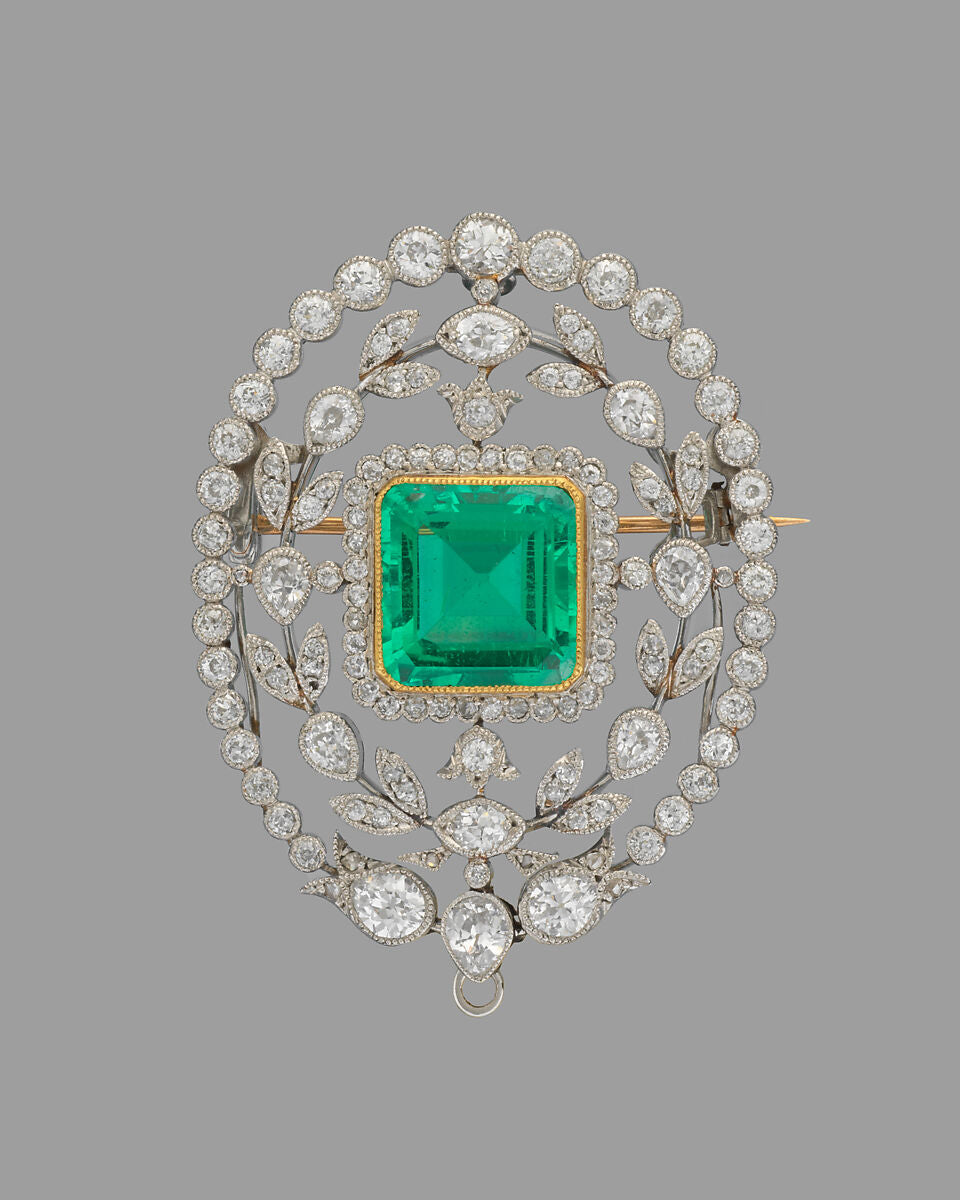
Turn an Edwardian brooch under a loupe and the first thing you notice may not be the diamonds. It is the edge. Around each stone runs a hairline ribbon of beads, so fine that the naked eye reads it as a texture rather than a row, and so even that you could mistake it for something poured. It was not poured. In much fine antique jewelry, the beads were rolled into the metal by hand, one steady pass at a time, and the sparkle in the surrounding metalwork was cut there by a person pushing a steel tool. That is the quiet difference between antique handwork and most modern casting, and it explains a great deal about why pre-war pieces feel the way they do in the hand.
What Hand Engraving Really Is: The Bright-Cut Line
Engraving, at its simplest, is cutting. A hardened steel tool called a graver is pushed by hand through the surface of the metal, lifting out a sliver and leaving a groove. Everything else about the craft is control: the angle of the tool, the pressure of the hand, the decision about where a line should swell and where it should taper to nothing.
Bright-cut engraving is the variation that matters most to jewelry collectors. Britannica describes it as a decorative engraving made from a series of short cuts, worked with a polished tool so that the exposed surfaces reflect light and give an impression of brightness. Each cut is a tiny angled facet, and as the piece moves in the light the facets flicker on and off like cut stones in miniature. The technique is most closely associated with English silversmiths of the late eighteenth and early nineteenth centuries; the Victoria and Albert Museum holds an Adam-style cream jug from 1790–91 that Britannica uses to illustrate it. The same reference notes that bright-cut work is sometimes used in diamond settings to make the stones appear larger, which is exactly where a collector is most likely to meet it.
A finer cousin is bulino, from the Italian word for a burin, in which very fine lines and tiny dots are built up to suggest shading and depth. What unites all of it is that no machine decides where the line goes. Every stroke is a small judgment by one hand on one afternoon, and it shows: lines thicken and thin, borders turn corners with a slight individual character, and no two leaves in a scroll are quite twins. The same spirit of hand-controlled surface runs through engine-turned guilloché enamel, where a machine is guided by a craftsman rather than replacing one. The same discipline of cutting by hand defines signet rings and heraldic engraving, where the design is cut in reverse so that it reads true when pressed into wax.
Milgrain: A Thousand Grains Along the Edge
Milgrain, also spelled millegrain or millgrain, is the beaded border that runs along the edge of a ring, bezel, or pierced setting. The word is French and means “a thousand grains.” The British Antique Dealers’ Association defines it as a fine beaded decoration applied to the outer edge of a ring or used to form the setting for a gemstone, and notes that the idea is old: ancient examples were made by forming each tiny bead by hand and soldering it on, a process that could take many hours for a simple border.
By the nineteenth century the work had been mechanized in a small and very human way. The BADA describes a handheld knurling tool, a small roller mounted on a handle and indented with the reverse of the pattern, which the jeweler presses firmly along the edge so that the beads are impressed into the metal itself. Trade sources often call the roller a molette. The beads are not added; they are raised by displacing the metal that was already there, row after row, at whatever pace and pressure the jeweler’s hand allows. There is a plausible, if unprovable, optical logic to it as well: the BADA notes that it is said to enhance the sparkle of a diamond because the beaded edging prevents light bouncing off a smooth metal rim and competing with the stone.
A fine example sits in the Metropolitan Museum of Art: a brooch of about 1900, catalogued as probably by Tiffany & Co., with a step-cut emerald framed by two oval rings of diamonds. The Met’s own catalogue entry says the gems are arranged like garlands in thin platinum bezels with millegrain detailing, and that the delicate look of such garland-style pieces relied on the then newly accessible metal. (The Metropolitan Museum of Art, Gift of Susan Dwight Bliss, 1953, 53.153.1; public domain, Met Open Access. It is the image at the top of this article, and it is a museum piece, not VERANE stock.)
Platinum and the Edwardian White-on-White Look
Milgrain existed before platinum, but platinum is what made it famous. The BADA credits the metal’s strength and malleability, greater than silver’s, with giving more consistent and well-defined beads, and ties its early-twentieth-century popularity to the rise of platinum jewelry. The same source points to the invention of the acetylene torch in 1903, which freed jewelers from some of the limits of traditional tools and encouraged more elaborate work. The Met’s catalogue entry for a ca. 1905 necklace by Dreicer & Co. makes a related point: the firm’s designs evoke eighteenth-century court styles, but their execution relied on state-of-the-art technology and an advanced use of platinum.
The result is the look we associate with Edwardian jewelry: white metal, white diamonds, and a lace-like edge that makes a thin platinum frame read as ribbon or filigree rather than structure. Earlier Victorian milgrain, particularly in silver-topped gold, is generally described by dealers as coarser, with larger and less uniform beads, though we would treat that as a tendency rather than a rule.
Milgrain did not vanish with the First World War. The BADA lists it among the signatures of both the Edwardian and Art Deco periods, and in Art Deco jewelry it often turns up as a crisp geometric accent, tracing the channel of a calibré stone or the outline of a rectilinear motif rather than softening an entire setting. Dealers frequently observe that Deco beads read as slightly bolder; again, a pattern worth noticing, not a test.

Hand Engraving Versus Modern Casting: What the Metal Remembers
Modern jewelry is very often made by lost-wax casting. A model, carved in wax by hand or generated on a computer, is surrounded by a heat-resistant investment; the wax is burned out; molten metal fills the cavity. It is a remarkable process, able to record fine surface information and produce complex three-dimensional forms that would be slow or impractical to build by hand. We have no quarrel with it, and excellent work is made this way every day.
The difference lies in where the detail comes from. In a cast piece, the detail is only as sharp as the model and the mold, and the surface then passes through finishing and polishing, which tends to soften fine edges. In a piece worked by hand, the detail is cut or rolled into the metal after the form exists, so the last and finest decisions are made by the craftsman at the bench with the object in front of him. Bench jewelers generally say that milgrain cast along with the ring from a wax model is more uniform and not as fine as milgrain rolled by hand. That squares with what the process would predict, though it is the experience of the trade rather than a laboratory finding, and a skilled maker working in modern materials can narrow the gap considerably.
So the useful distinctions are tendencies, never verdicts:
- Crispness. Hand-cut lines and hand-rolled beads usually have clean, definite edges. Cast detail can look slightly rounded, as if seen through a thin veil.
- Individual variation. Hand work is regular but not identical. Beads vary subtly where the roller met a corner; engraved scrolls differ from one to the next. Perfect, mechanical sameness is as much a clue as visible flaws.
- Undercuts and depth. Pierced galleries and sharply cut recesses are made with saws and gravers; a cast approximates them.
- Wear that makes sense. Beads are the highest points of the surface, so they flatten first. A century-old border with softly rounded bead crowns is behaving the way old metal should.
Why Pre-War Pieces Feel Different, and Why They Last
The sense that an antique piece is better made is partly craft and partly arithmetic. Much antique platinum and gold work was built from fabricated parts, cut, pierced, soldered, and finished one piece at a time, so the settings were often fitted to the stones rather than approximating them. That hand-fitting is why an old brooch can feel oddly balanced and why a ring can sit so comfortably on a finger after a hundred years.
We should add the honest counterweight: some of the apparent quality of antique jewelry is survival. A century of wear has quietly retired the weak pieces, and what reaches us is the sturdy, well-made remainder. Even so, the well-made remainder is real, and its endurance rests on a few durable facts. Platinum is a strong metal that holds fine settings, hand-fitted claws and bezels can be re-tightened and repaired, and the signs of age, including softened bead crowns, are signs of use rather than failure.
The same reasoning applies to restoration. Milgrain is formed by displacing metal rather than adding it, so damaged beads cannot simply be soldered back, and restorers generally weigh any re-rolling against the loss of the original maker’s hand. We would rather document honest wear than polish it into something that looks new and says less.
How to Look at Milgrain and Engraving Under a Loupe
A ten-power loupe is enough. Run your eye along a milgrain border and ask whether the beads are even but alive, with tiny irregularities at turns and corners, or flawlessly identical and slightly soft. Look at engraved lines for tapered ends and brightness in the cut, and at the metal around them for the gentle rounding that comes from decades of wear rather than from a polishing wheel. Check that the age signals agree with one another: the cut of the stones (see how antique diamond cuts were shaped for candlelight), the way the piece is constructed, the marks it carries. Our guide to reading jewelry hallmarks covers the last of these, and an independent opinion from a trusted dealer or gemological laboratory is worth the small cost on any significant purchase.
None of this makes a piece less beautiful if it turns out to be a later reproduction. It simply makes it a different thing, and VERANE describes each piece for what it is.
If this kind of close looking appeals, our collection of estate diamond rings includes pieces where platinum, milgrain, and hand finishing are visible at a glance, and each is documented as carefully as the record allows. We would be glad to place one in your hand, loupe included; you can request a private viewing whenever it suits you.