Guilloché Enamel Jewelry: The Engine-Turned Shimmer Behind Fabergé's Glow
The engine-turned engraving beneath translucent enamel that gave Fabergé's Imperial Eggs their glow — and the small number of workshops still practicing the craft today.
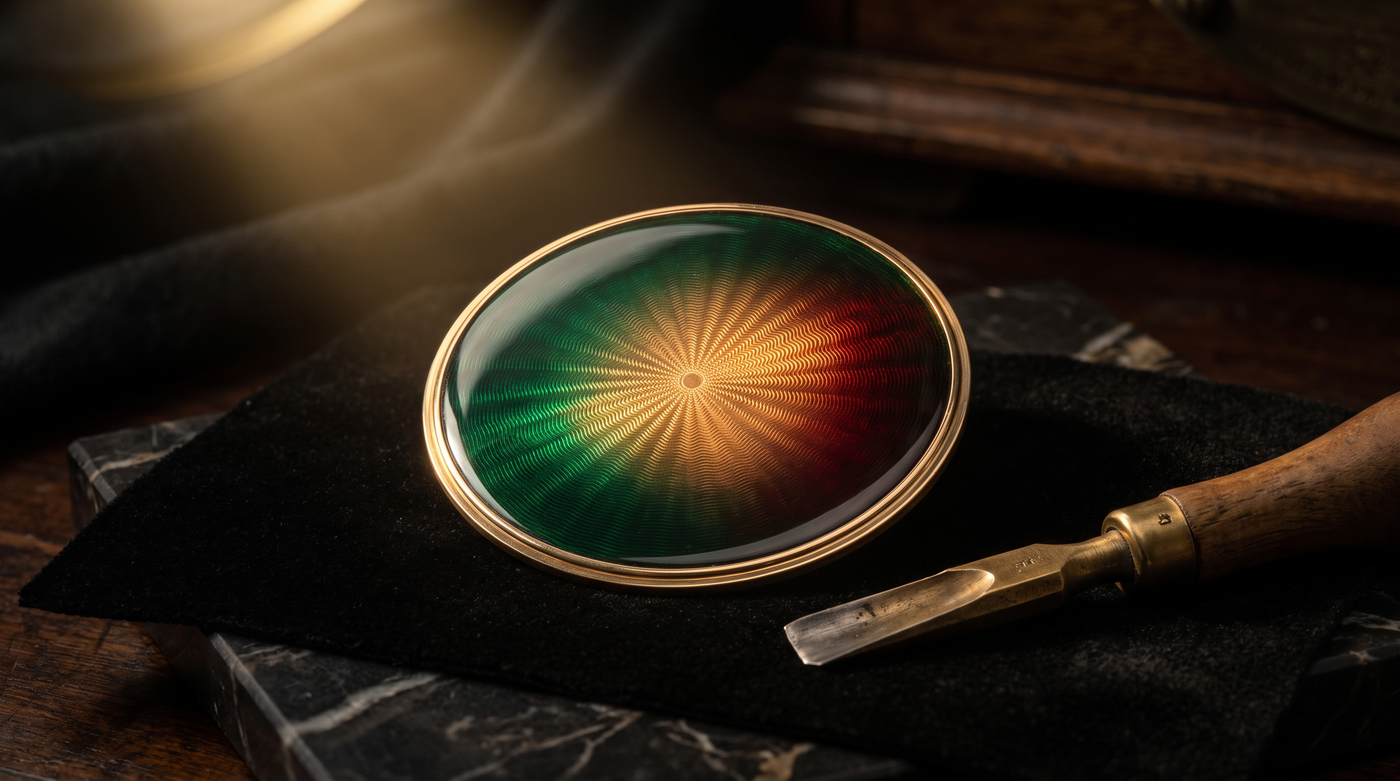
Hold a Fabergé egg to candlelight, as its first owners would have, and the shell seems to breathe. The color is not painted on the surface. It floats a fraction of a millimeter above a field of engraved gold, so that light passes through the enamel, strikes the metal beneath, and returns to the eye twice over — once as color, once as pattern. That double effect has a French name and a history considerably older than the House of Fabergé: guilloché enamel, the engine-turned shimmer beneath translucent glaze that gave the Imperial Easter Eggs their glow, and that a small number of workshops still practice today.
What Guilloché Enamel Actually Is
Guilloché describes a pattern mechanically engraved into metal by a machine, rather than cut by hand — a fine, repeating sequence of waves, sunbursts, or basketweave, so precise and so evenly spaced that no engraver's hand could match it freehand. The word is French, in use since at least the 1770s. One popular account credits its invention to a French engineer named "Guillot," but no first name, date, or record of this figure survives, and dictionaries treat the story as legend rather than history. What is documented is the machine itself: an ornamental turning device already in use on ivory and wood by the 1500s, adapted by goldsmiths and watchmakers for gold and silver over the two centuries that followed.
Enamel is the second half of the equation, and the harder one to get right. Powdered colored glass is dusted over the engraved metal and fired at high heat until it fuses to the surface — then fired again, and often again, in successive thin coats, each one ground flat and polished before the next goes on. Because the enamel is translucent rather than opaque, it behaves like stained glass laid over a mirror: light passes down through the color, strikes the machine-turned pattern beneath, and bounces back up through the glaze. An opaque enamel, sitting flat over plain metal, could never produce that particular depth. It took the pairing of the two — the engraving and the glass — to make the surface glow rather than simply shine.
The Rose-Engine Lathe
The machine responsible for the engraving is generally called a rose engine lathe, though metalworkers also knew it as a tour à guilloché or decoration lathe. Built of cast iron and precision-machined brass, it holds the workpiece against a rotating cam — the "rosette" that gives the machine its name — while a fixed cutting tool traces the cam's profile into the metal as it turns. Shift the rosette, adjust the eccentricity, and the machine produces an entirely different pattern: a basketweave, a sunburst, a wave. The results are so exact and so repeatable that the same design can be reproduced within fractions of a millimeter, piece after piece — a precision no hand engraver, however skilled, can sustain over an extended run.
The rose engine had been in use in European courts for over a century, mostly on watch cases, snuffboxes, and small precious objects, by the time it reached St. Petersburg in the late nineteenth century. What changed there was not the machine. It was what one workshop chose to put over it.
Fabergé's Workshop and the Imperial Eggs
Peter Carl Fabergé did not invent guilloché, and he did not invent translucent enamel. What his St. Petersburg workshop perfected, beginning in the 1880s, was the marriage of the two — engraving a surface specifically to be seen through color, rather than engraving it to be admired on its own. The firm's two principal workmasters carried the technique through the decades that followed: Mikhail Perkhin, head workmaster from 1886 until his death in 1903, and his former chief assistant, the Finnish-born goldsmith Henrik Wigström, who succeeded him and led the atelier until the Russian Revolution brought the Imperial commissions to a close in 1917. Between them, Perkhin and Wigström's workshops produced nearly all of the fifty-odd Imperial Easter eggs commissioned by Alexander III and Nicholas II. Overseeing the design of about half of those eggs personally was Franz Birbaum, the Swiss-born artist who served as Fabergé's chief designer from 1893 to 1918 — a separate role from the workmasters, who ran their own ateliers under contract and stamped each finished piece with their own hallmark alongside Fabergé's.
The 1895 Rosebud Egg, made in Perkhin's workshop and presented by Nicholas II to his new wife, Empress Alexandra Feodorovna, is among the clearest early examples: a wave-patterned guilloché ground in gold, covered in translucent strawberry-red enamel, quartered by lines of rose-cut diamonds, opening to reveal a yellow-enameled rosebud concealing a miniature of the Imperial Crown. It was the first Easter egg Nicholas gave his wife, commissioned in haste after his father's death left barely weeks to prepare a gift for their first Easter as Emperor and Empress.

The technique extended well beyond the eggs. Fabergé's workshop produced a wide range of smaller presentation objects — cigarette cases, boxes, frames — finished in the same engraved-and-glazed technique, often set with a portrait miniature and intended as gifts from the Tsar to visiting dignitaries and heads of state. A two-colour gold guilloché enamel presentation box from 1916, now in the Royal Collection, sets a portrait miniature of Nicholas II by the artist Vassily Zuiev into a lid of engine-turned, enameled gold, ringed with diamonds — evidence that the craft Perkhin and Wigström perfected for the eggs was, in practice, the house's everyday vocabulary for anything meant to impress.

Reading the Craft: What to Look For
Guilloché enamel rewards the kind of looking that a phone screen discourages. Held still and tilted slowly under a single light source, a genuine piece shows the engraved pattern shifting beneath the color — brighter where the light catches a ridge, darker in the grooves — because the pattern is physically present under the glass, not printed onto it. The color itself should have depth rather than flatness: several thin, evenly fired coats read as a pool rather than a film, with no visible bubbling, crazing, or cloudiness at the edges where enamel meets metal. On period pieces, the guilloché pattern is also a dating clue of sorts — the sunburst and moiré patterns fashionable in the Belle Époque give way to the bolder, more geometric engravings of the Art Deco years, when guilloché enamel found a second life on cigarette cases, vanity compacts, and small gold jewelry far from St. Petersburg.
It is worth distinguishing guilloché enamel from its closest technical cousin, plique-à-jour, an entirely different translucent enamel method that suspends color in open cells with no metal backing at all, so that light passes fully through the piece rather than bouncing back off a hidden ground — a technique we trace in our look at plique-à-jour enamel. Where plique-à-jour is the enamelist working alone, guilloché enamel is a collaboration — the machinist's precision handed to the enamelist's fire, each one meaningless to the effect without the other.

A Revival in Fine Jewelry and Watchmaking
The craft nearly disappeared. The 1917 Revolution closed Fabergé's workshops, scattered its workmasters, and ended the imperial commissions that had sustained guilloché enamel at its highest level for three decades. It survived in smaller pockets — a handful of European ateliers, a few remaining rose-engine lathes passed down or rebuilt by hand — through most of the twentieth century, kept alive less by demand than by stubbornness. The mechanical watchmaking renaissance of the 1980s brought it back into view, as brands and independent makers rediscovered engine-turned dials as a mark of the hand-finished, non-industrial object a mechanical watch was meant to represent. That same renewed appetite for visible, unautomatable craft has carried guilloché back into fine jewelry — cigarette cases and vanity boxes of the kind once associated with Art Deco jewelry, and small runs of new work from the handful of ateliers, mostly in Europe and increasingly in Asia, still willing to apprentice for years on a machine most jewelers have never touched.
What makes it durable, more than fashion, is the arithmetic of scarcity. A rose engine lathe cannot be rushed, cannot be substituted with a laser or a stamp without losing the very unevenness of hand-adjustment that gives each pattern its particular character, and cannot be operated by anyone without years at the machine. Fabergé's own Imperial Eggs remain the technique's most famous showcase, but the smaller guilloché enamel objects — cases, boxes, parasol handles, and jewelry — were always the more common expression of the craft, made in far greater numbers and, today, far more likely to survive intact and findable.
Pieces that carry genuine guilloché enamel work — a compact from the height of the Art Deco years, a small gold box with its enamel still sound after a century — are not common in the estate market, and rarely last long once found. We keep a close eye on the vintage Tiffany jewelry and other fine enamel pieces that pass through our hands for exactly this reason: the craft is unmistakable once you know to look for it, and there is no substitute for seeing it catch the light in person. If you would like to request a private viewing of a piece with fine enamel work, we would be glad to show it to you.