The Fabergé Egg: Eight Missing, One Found at a Flea Market — The Greatest Treasure Hunt in History
Eight Imperial Fabergé Eggs remain missing to this day. The story of a lost treasure bought for scrap at a US flea market — and what it tells us about one of history's greatest royal art commissions.
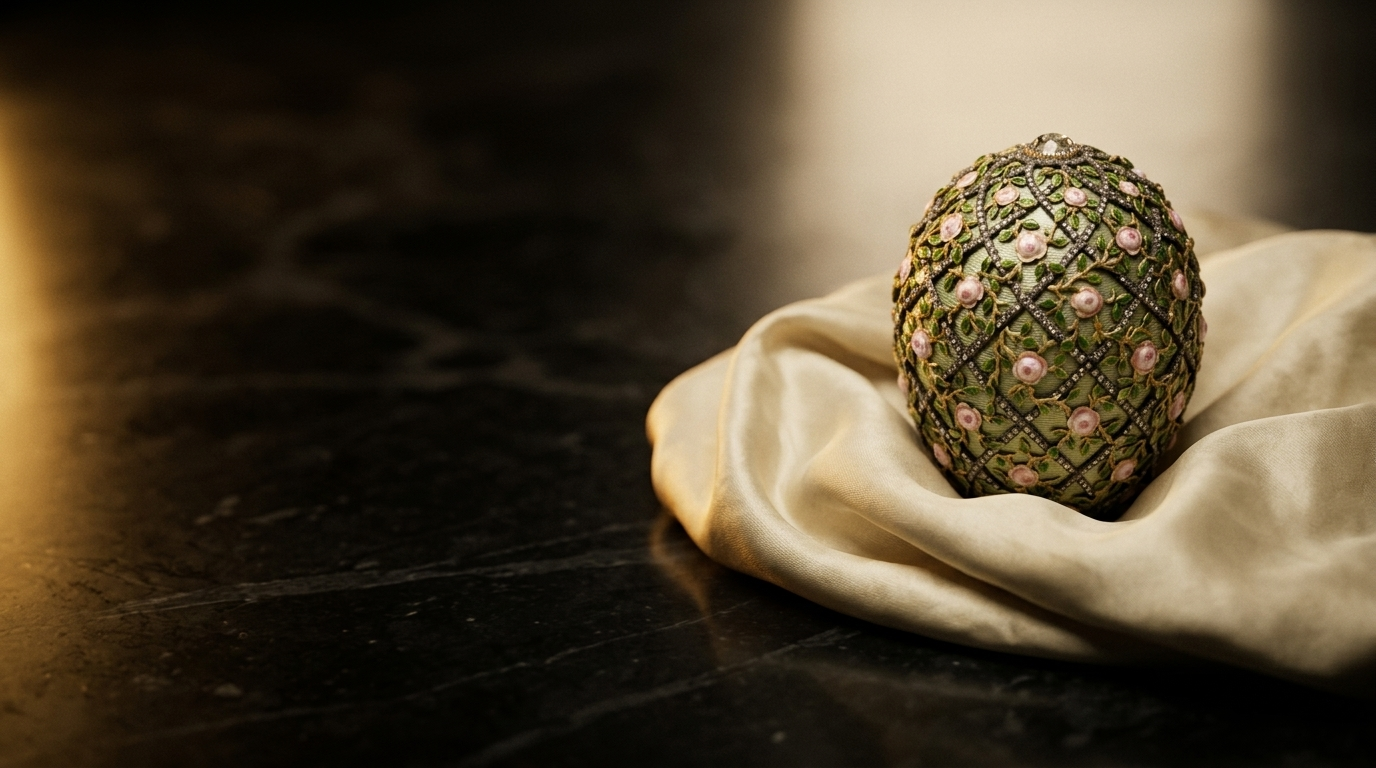
Somewhere in the American Midwest, a man walked away from a flea market table having spent $13,302 on what he believed was a decorative gold trinket, something to melt down for scrap if the resale market proved disappointing. The object was small — a jeweled egg of yellow and rose gold, set with diamonds and sapphires, the top opening to reveal a tiny lady's watch by Vacheron Constantin. It sat in his garage. It sat there for years.
In 2012, unable to find a buyer willing to pay his asking price, he typed a description of the piece into a search engine. What came back changed everything. The egg he had carried home for scrap was the Third Imperial Fabérgé Egg — a commission of Tsar Alexander III, gifted to Empress Maria Feodorovna at Easter 1887, missing from the historical record for more than a century, and worth, by credible estimate, somewhere in the region of $33 million.
It is one of the great accidental discoveries in the history of decorative arts. And it is inseparable from a larger story — of a goldsmith of near-mythological skill, of a dynasty destroyed, of treasures scattered to the four winds, and of seven Imperial Eggs that remain missing to this day.
Peter Carl Fabérgé and the Commission That Became a Legend
Peter Carl Fabérgé was born in St. Petersburg in 1846 to a family of jewelers. Trained across Europe — in Dresden, Frankfurt, Florence, Paris, London — he returned to Russia to take over his father's firm and transformed it into one of the most celebrated ateliers in the world. By the 1880s the House of Fabérgé employed hundreds of craftsmen, many of them specialists: enamellers, goldsmiths, engravers, miniaturists. The firm did not merely make jewelry. It made objects of the imagination rendered in gold and stone.
In 1885, Tsar Alexander III commissioned Fabérgé to create an Easter gift for his wife, the Danish-born Empress Maria Feodorovna. The result — now known as the First Imperial Hen Egg — was a white-enameled shell that opened to reveal a golden yolk, inside which sat a multicolored gold hen, inside which sat a miniature diamond replica of the imperial crown, inside which hung a ruby pendant. Nested surprises within nested surprises: the logic of a Russian doll elevated to the register of high art.
The Empress was enchanted. Alexander placed a standing order: one egg every Easter, each unique, each containing a hidden surprise. The only rule was that Fabérgé himself set the design, with no interference from the court. It was, in effect, a commission given on absolute trust.
When Alexander died in 1894, his son Nicholas II continued the tradition — commissioning two eggs each year, one for his mother and one for his wife, Empress Alexandra. Between 1885 and 1916, the House of Fabérgé produced fifty-two Imperial Easter Eggs in total. Each was a small world unto itself: some contained miniature paintings, some unfolded into golden trains or carriages, some concealed portraits of the imperial children behind panels of translucent enamel. The Coronation Egg of 1897 — made to commemorate the coronation of Nicholas and Alexandra — opened to reveal a perfect scale replica of the imperial coach in which Alexandra had ridden to the ceremony, rendered in gold and set with tiny rubies and diamonds. It remains among the most technically extraordinary objects ever made.
Craftsmanship at the Limits of the Possible
The technical achievement of the Imperial Eggs is difficult to overstate. Fabérgé's workmasters — among them Michael Perkhin and Henrik Wigström — worked with guilloéché enamel, a process in which translucent enamel is applied over an engraved metal surface, the pattern beneath creating the impression of depth and shimmer from within. The colors Fabérgé's enamellers achieved — oyster whites, dawn pinks, the specific blue of a northern twilight — have never been fully reproduced.

Inside each egg, the hidden "surprise" was engineered with the same obsessive precision as the exterior. Miniature portraits were painted on ivory panels no larger than a postage stamp. Mechanical flowers bloomed on springs. Tiny carriages rolled on functioning wheels. The craft traditions that fed into each piece — Swiss watchmaking, French enamel techniques, Russian goldsmithing — were synthesized into objects that belonged to no single tradition and exceeded all of them.
Collectors who have handled the eggs often remark on the same quality: that they feel more real in the hand than in any photograph. The weight, the precision of the hinges, the way light moves across a guilloéché surface — these are sensory experiences that no reproduction captures. To hold a Fabérgé Imperial Egg is to hold a concentrated argument for the idea that applied art can be as serious, as meaningful, and as permanent as any other form.
If you are drawn to the extraordinary craft of storied gemstone history or the provenance-rich narratives that surround the Romanov court and its legacy, these eggs sit at the intersection of both — objects whose histories are inseparable from their beauty.
The Revolution and the Dispersal
In March 1917, Nicholas II abdicated. By July 1918, the entire imperial family had been executed at Yekaterinburg. The Russian Revolution did not merely end the Romanov dynasty — it ended the world that had produced and sustained the Imperial Eggs.
The Bolshevik government nationalized the imperial collections. A 1917 inventory found eight of the Imperial Eggs at Fabérgé's own premises; others were located in various palaces across Russia. In the years that followed, the Soviet government sold substantial portions of the imperial collections to raise foreign currency. Dealers from Europe and America arrived at state warehouses to buy treasures that the new government regarded as bourgeois relics.
It was through this mechanism that the Imperial Eggs dispersed. Some passed through a series of private hands so rapidly that their provenance became obscured. Some were catalogued under generic descriptions — "gold egg" or "jeweled Easter ornament" — that gave no indication of their origin. A 1964 auction at the New York house of Parke-Bernet included a lot described simply as "a goldwatch in egg form case" that sold for $2,450. It was the Third Imperial Egg. No one at the auction knew what they were selling.

The Missing Eggs: Seven Treasures the World Cannot Find
Of the fifty-two Imperial Eggs, forty-six have now been accounted for — their locations documented, their provenance reconstructed. Seven remain missing as of the most recent scholarly consensus, their whereabouts unknown, their fates unverified. (The Third Imperial Egg, recovered in 2012, reduced the number from what had previously been counted as eight.) The missing eggs span the years 1886, 1888, 1889, 1897, 1902, 1903, and 1909 — all of them originally Maria Feodorovna's gifts, which experts note is unlikely to be a coincidence.
Their names read like an elegiac roll call: the Cherub with Chariot Egg of 1888, the Nécessaire Egg of 1889, the Empire Nephrite Egg of 1902, the Royal Danish Egg of 1903, the Alexander III Commemorative Egg of 1909. Three are known from period photographs. One is documented by a single drawing. Of some, only the name and year survive.
Where are they? The honest answer is: no one knows with certainty. Theories range from private collections whose owners have chosen silence, to attics and storage rooms where they sit unrecognized — as the Third Imperial Egg sat in a Midwestern garage — to destruction, either accidental or deliberate, during the upheavals of the twentieth century. Fabérgé researchers have combed auction records, estate inventories, and diplomatic correspondence across a dozen countries. New leads emerge occasionally; most dissolve on examination.
The hunt is genuine and ongoing. Wartski, the London jewelers who ultimately handled the Third Imperial Egg's sale, have published research on individual missing eggs, including analysis of the Nécessaire Egg. The Fabérgé Research Site maintains a continuously updated database of known locations. The eggs are not merely valuable — though they are extraordinarily so — they are irreplaceable records of a specific moment in the history of applied art, and of a dynasty whose story still captures the imagination more than a century after its end.
The Third Imperial Egg: A Discovery Story for the Ages
The full story of the Third Imperial Egg's recovery is worth telling in detail, because it illuminates how these objects can move through history in plain sight, their identity obscured by nothing more than incomplete information.
The egg was made in 1887, the third in Fabérgé's sequence of Imperial commissions. Of yellow and rose gold, it stands approximately nine centimeters tall. Its exterior is set with diamonds and sapphires in a swirling foliate pattern; the top opens on a concealed hinge to reveal a small Vacheron Constantin pocket watch — the surprise within. It was presented by Alexander III to Maria Feodorovna at Easter 1887.
After the Revolution, the egg passed through the Soviet state collections and into the international market. The 1964 Parke-Bernet sale in New York offered it as a curiosity — a gold egg with a watch inside, origin unspecified. It sold for $2,450 and disappeared again into private hands.
Approximately forty years later, an American dealer — his identity has never been publicly confirmed — acquired the egg at a Midwestern flea market for $13,302. He believed he was buying a decorative gold object, perhaps worth melting. He was not, as far as is known, a specialist in Russian imperial decorative arts.
For years, the egg sat. He attempted to sell it and could not find buyers willing to pay what he wanted. In 2012, he turned to the internet and searched for the combination of features — the gold egg, the hidden watch, the specific style of the goldwork. He found a 2002 book about Fabérgé by Géza von Habsburg, which included an archival photograph taken in 1902 of the Imperial Eggs on display. The egg in the photograph matched the object in his possession exactly.
He contacted Wartski in London, the specialist jewelers who have dealt in Fabérgé for generations. A Wartski expert flew to the Midwest, examined the egg, and confirmed the identification. The Third Imperial Fabérgé Egg — missing for over a century, catalogued under a generic description at a 1964 auction, purchased as potential scrap — had been found.
In April 2014, Wartski displayed the egg publicly in London for four days — the first time in 112 years it had been seen by the public. It was then sold in a private transaction to an anonymous buyer. Reports, including accounts published by CNN, estimated the sale price at as much as $33 million. The buyer's identity has never been disclosed.
The Collector Market: What Fabérgé Commands Today
The story of the Forbes collection provides the clearest benchmark for what Imperial Eggs command at the highest level of the market. Malcolm Forbes spent decades assembling nine Imperial Eggs — the largest private collection in the world outside Russia. When the Forbes family prepared to auction them at Sotheby's New York in April 2004, pre-sale estimates for the nine eggs alone reached as high as $94 million. Before the auction took place, the Russian industrialist Viktor Vekselberg stepped in and purchased the entire collection privately, along with more than 180 additional Fabérgé objects, for a reported sum approaching $100 million. The eggs have since been repatriated to Russia and are displayed at the Fabérgé Museum in St. Petersburg — returning, at last, to the country that made them.
Individual Imperial Eggs that do reach auction command exceptional prices. The general market for Fabérgé objects — not the Imperial Eggs themselves, but pieces from the House's broader production — remains active, with significant pieces regularly appearing at the major London and New York auction houses. Non-Imperial Fabérgé eggs, made for wealthy private clients rather than the Tsar, sell in ranges from the tens of thousands to the low millions depending on complexity, condition, and provenance.
The appetite for objects in the Fabérgé tradition — for the enameling techniques, the hidden-surprise logic, the exquisite miniaturism — extends naturally to period Russian jewelry more broadly. Late nineteenth and early twentieth-century Russian pieces, particularly those using similar guilloéché enamel and fine goldwork, carry the aesthetic DNA of the imperial commissions. They are, for collectors who cannot access the Imperial Eggs themselves, the closest available point of contact with that extraordinary tradition.
What Collectors Seek — and What We Carry
At VERANE, we are not in the business of Imperial Easter Eggs — there are, as this article makes clear, only fifty-two of them, and forty-six have known owners. But we understand the sensibility that draws collectors to Fabérgé and to the Russian imperial tradition: the belief that exceptional craft is a form of permanence, that an object made with extraordinary care carries something of its maker and its moment forward through time.
That belief animates everything we bring to our new acquisitions. Estate jewelry from the late Victorian and Edwardian periods — the decades that overlap precisely with Fabérgé's great commissions — often reflects the same aesthetic priorities: fine enamelwork, concealed mechanisms, layered craftsmanship that reveals itself slowly to the attentive eye. Brooches and clips from this period, in particular, were made by workshops that shared technical traditions with the Fabérgé atelier, if not its specific genius. You will find exceptional examples among our estate brooches and clips.
For collectors with a specific interest in Edwardian and Belle Époque pieces, or in Russian-influenced jewelry from the imperial period, we welcome private conversations. The best acquisitions in this field are rarely made at speed — they require the kind of sustained attention that is, itself, a form of respect for the objects. We invite you to request a private viewing at your convenience.
The Third Imperial Egg sat in a garage for years because no one knew what it was. In the world of estate jewelry, the inverse happens too — pieces of genuine distinction, properly understood, are recognized and valued by those who take the time to look carefully. That careful attention is what we bring to every piece that passes through VERANE.
Browse our current acquisitions, or reach out to begin a conversation about what you are looking for. The history of extraordinary objects is, in the end, a history of the people who cared enough to preserve them.