The House of Fabergé: Goldsmith to the Tsars, Undone by an Empire's Fall
How a St. Petersburg workshop became Goldsmith to the Tsars, was seized by the Revolution in 1918, and spent nearly a century as a name without a house before its 2007 reunion with the Fabergé family.
On Easter morning in 1885, a small gold egg no larger than a thumb was carried into the private apartments of Tsar Alexander III. Inside its plain white enamel shell sat a matte-gold yolk; inside that, a tiny gold hen; and folded inside the hen, smaller still, a diamond replica of the Imperial crown and a ruby pendant. The Tsarina Maria Feodorovna was so delighted by the gift that the Tsar, within days, named the maker Goldsmith by Special Appointment to the Imperial Crown — and a St. Petersburg workshop that had, until that morning, been a respectable but unremarkable family firm became, almost overnight, the most famous jeweler on earth.
A Petersburg Workshop Finds Its Sovereign
The House had existed for decades before that Easter egg made it a legend. Gustav Fabergé, a goldsmith of Baltic-German and Huguenot descent, opened the original shop on Bolshaya Morskaya Street in St. Petersburg in 1842. His son, Peter Carl Fabergé, was sent on the traditional grand tour of Europe's ateliers — Frankfurt, Florence, Paris, London — before returning home to take over the family business in 1882, working alongside his younger brother Agathon. Carl was not, by most accounts, the most gifted hand in the workshop. His genius was different: he understood that a great jeweler's real material was trust, and he built a house that could be trusted absolutely, by a court that trusted almost no one.

The Workmasters Who Made the Name
What is often missed about the House of Fabergé is that Carl himself rarely lifted a tool. He was the designer of the enterprise, not of any single piece. The actual making was done under a guild-like system of independent workmasters — master craftsmen who ran their own small workshops under the Fabergé roof and struck each finished piece with their own initials alongside the house's mark. Michael Perkhin led the principal workshop from 1886 until his death in 1903, presiding over the most inventive years of the firm's output. His chief assistant, the Finnish silversmith Henrik Wigström, succeeded him and held the post until the Revolution silenced the workshops for good in 1917. Between them, Perkhin and Wigström oversaw nearly every object that left the House bearing the Imperial warrant.
Around them worked dozens more named masters — Nevalainen, Wäkevä, Rappoport, Holmström — each responsible for a category of object: cigarette cases, picture frames, table silver, the hardstone carvings of flowers and animals that collectors now hunt as avidly as the eggs. By 1900 the House employed several hundred craftsmen across workshops in St. Petersburg and Moscow, with branches as far afield as Kiev, Odessa, and London. It was, in effect, a federation of ateliers operating under one exacting standard and one famous name.

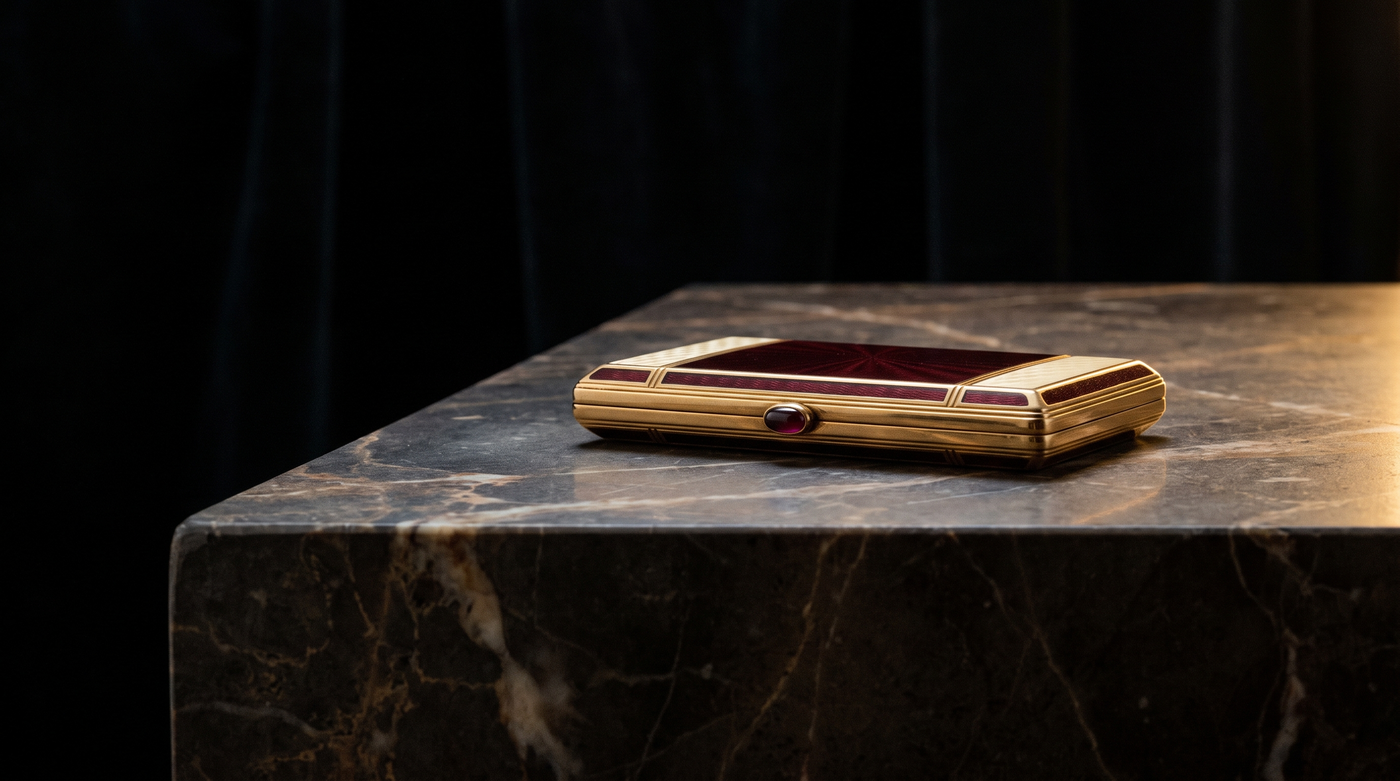
The eggs are what the world remembers, and rightly — the House of Fabergé made the Imperial Easter eggs a form unto themselves, one delivered privately to the Tsar's household every spring for over thirty years. But the workshops' everyday output tells the fuller story: hardstone figures carved from jasper and nephrite with the patient realism of a naturalist, gold cigarette cases finished in translucent guilloché enamel over a machine-engraved ground, picture frames, parasol handles, a menagerie of small animals in agate and rock crystal. A Russian peasant girl carved from jasper, sapphire, and nephrite — the kind of piece a Grand Duchess might have kept on a writing desk — survives today in the Forbes collection at the Metropolitan Museum, a quiet reminder that Fabergé's real trade was in objects of everyday luxury, not only in Easter miracles.

1917: The Empire and the House Fall Together
Nothing in the House's forty years of Imperial favor prepared it for what came after October 1917. The Bolshevik government moved quickly against symbols of the old regime, and few symbols were more legible than a firm whose sole reputation rested on serving the Tsar. In 1918, the workshops on Bolshaya Morskaya Street were seized and nationalized outright; production stopped, stock was confiscated, and the House that had outfitted three generations of Romanovs ceased to exist as a private enterprise in a matter of months. Carl Fabergé, then seventy-two, left St. Petersburg on the last diplomatic train permitted out of the country, bound for Riga and, eventually, exile in Switzerland. By most accounts he never recovered from the blow — at seventy-two, watching a lifetime's work dismantled within months was not a setback he had the years left to absorb. Carl Fabergé died in Lausanne on September 24, 1920, not quite two years after the workshops he built were taken from his family.
His sons scattered. Eugène and Alexander Fabergé eventually settled in Paris and opened a modest workshop trading as Fabergé et Cie — a name, by then, more than a business, since it dealt largely in repairing and restoring older pieces rather than making new ones. The great federation of St. Petersburg ateliers, the workmasters and their marks, the branch houses in Moscow and Kiev, were gone for good.
A Name Without a House
What happened to the Fabergé name afterward is, in its own way, as strange a story as the Revolution that caused it. Because the family had no funds to defend the trademark and no functioning business to attach it to, the name drifted for decades into hands that had nothing to do with jewelry at all. In 1937 an American businessman named Samuel Rubin, on the advice of his friend Armand Hammer — who had bought Fabergé stock directly from the cash-strapped Soviet government years earlier — registered a new cosmetics company as Fabergé Inc. and began selling perfume under the name. When the surviving Fabergé sons in Paris learned of it after the Second World War, a legal fight followed; in 1951 the family settled out of court for a reported twenty-five thousand dollars, surrendering the name for cosmetic use. Unbeknown to them, Rubin had already registered "Fabergé" for jewelry as well, in 1946.
The trademark then changed hands again and again, entirely apart from any Fabergé descendant: Rubin sold his company in 1964 for a reported twenty-six million dollars; it passed through several conglomerates before Unilever acquired it in 1989 and licensed the name across a wide range of consumer goods that had nothing to do with the St. Petersburg ateliers. Only in 2007 did the story turn back toward its origin, when the South African businessman Brian Gilbertson acquired the global rights to the Fabergé name and, working with descendants including Carl's great-granddaughter Tatiana Fabergé, relaunched the House as a fine jewelry maker in its own right — the first time in ninety years that the Fabergé name and the Fabergé family stood on the same side of the counter again.
What Survives, and Why It Matters to a Collector
For the estate market, the practical consequence of this history is scarcity of an unusually absolute kind. Production simply stopped in 1918 and never resumed under the original workshops, which means every genuine pre-Revolutionary Fabergé object — an egg, a cigarette case, a hardstone flower — is by definition a fixed and shrinking population, not a category that can ever be replenished. Authenticating one means reading a workmaster's hallmark the way a paleographer reads a signature: knowing which master worked which years, which mark belongs to which atelier, and how those marks were struck. It is a discipline unto itself, and one worth taking seriously before any piece described as "Fabergé" is taken at its word.
Most collectors will never own an object that passed through those St. Petersburg workshops, and that is precisely the point of the story rather than a disappointment in it. What the House of Fabergé demonstrates, in its rise and its sudden, total unmaking, is how thin the line runs between a great house's permanence and its fragility — how a name built over decades can survive an empire's collapse only as a trademark, stripped for a time of the family and the craft that first gave it meaning. It is a lesson estate jewelry collectors know instinctively about every signed and hallmarked piece in this wider world of estate jewelry: provenance is not a footnote. It is the whole of what a piece has managed, against considerable odds, to keep.
VERANE's own collection holds no piece from the House of Fabergé — objects of that rarity belong, almost without exception, to institutions and a handful of private collections that rarely sell. But the era it defined, the fin-de-siècle craftsmanship of gold, enamel, and hardstone made for a court on the edge of catastrophe, runs directly through our own Belle Époque jewelry. We would be glad to show you a piece from that world, and to talk through what survives of it and why. Request a private viewing at your convenience.