Elsa Peretti: The Woman Who Taught Tiffany to Feel
From runway model to Tiffany's most transformative designer — how Elsa Peretti's Bone cuff, Diamonds by the Yard, and Open Heart reshaped what fine jewelry could be.
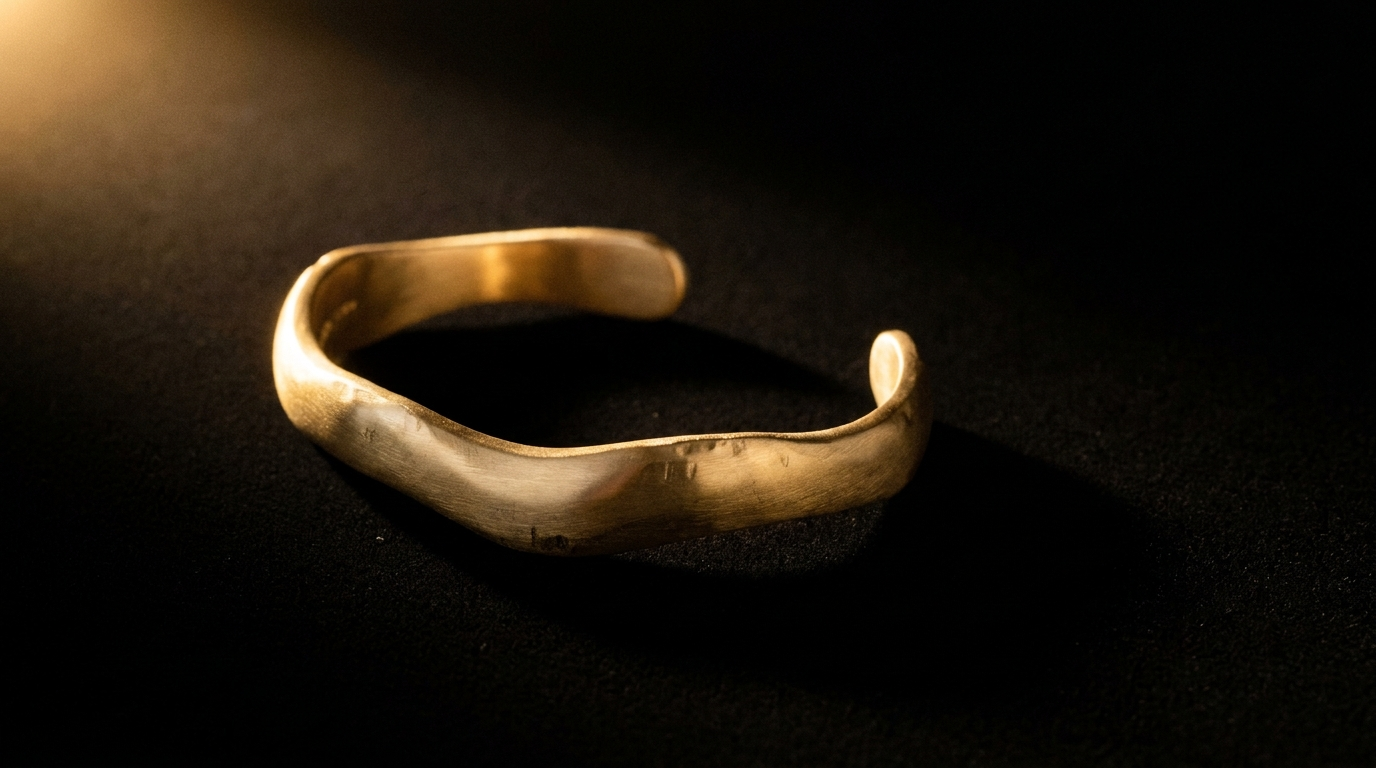
In the autumn of 1974, a young woman walked into Tiffany & Co. on Fifth Avenue carrying a small sterling silver cuff shaped like bone. She was not a jeweler by training. She had spent the previous years as a model — runway work for Halston, editorial shoots for the glossy magazines, dinner parties with Andy Warhol and Giorgio di Sant'Angelo. But what she carried in her hand was something Tiffany had not seen before: a piece of jewelry that felt less like an object placed upon the body and more like something the body had grown.
Her name was Elsa Peretti. Within fifteen minutes of her meeting with Tiffany's chairman Walter Hoving — a meeting arranged through a chain of introductions that ran through Carrie Donovan at Harper's Bazaar to Halston himself — she had a contract. The opening was an event: on September 25, 1974, more than two thousand people attended her first personal appearance at the store. Over the following fifty years, Peretti's work would account for as much as ten percent of Tiffany's annual revenue, making her arguably the most commercially successful jewelry designer in the house's long history. More than that, she had remade what fine jewelry could mean: not a trophy, not a token of status, but a second skin.
The question of how a model with no formal training in metalwork came to define the sensibility of one of the world's great jewelry houses is worth sitting with. The answer lies less in the usual biographical narrative of talent discovered and nurtured than in a set of convictions about the body that Peretti had formed well before she ever designed anything — convictions about how objects should feel to live in, about the dishonesty of decoration that asks to be noticed rather than experienced, about what a piece of jewelry actually does when it is worn rather than merely displayed. She did not arrive at Tiffany with technique. She arrived with a philosophy, and the pieces she showed were its proof.
The Unlikely Education of a Jeweler
Elsa Peretti was born on May 1, 1940, in Florence, into a world of deliberate elegance. Her father, Ferdinando Peretti, had founded Anonima Petroli Italiana, one of Italy's great oil concerns, and raised his family in a palazzo in Rome. It was a life of formal dinners, Swiss schooling, and expectations as precisely calibrated as the silver on the table. Elsa found it suffocating.
At twenty-one, she wrote her father a letter stating her intention to live independently. His response was to cut off both contact and money. The rupture, painful as it was, proved to be the founding act of her creative life. Necessity sharpened her eye. She studied interior design in Rome, then moved to Barcelona in 1964, drawn by the city's sinuous modernist architecture — the Gaudí buildings she would later name as a formative influence on her visual thinking. The way a Gaudí column resolved itself, organic and structural at once, load-bearing yet alive, described exactly what she was reaching for. She spent four years in that city, moving through the worlds of fashion and art, learning to look at surfaces as though they were bodies and bodies as though they were surfaces.
After Barcelona she moved to New York, signing with the Wilhelmina Cooper modeling agency in 1968. She was beautiful in an unconventional way — angular, self-possessed, foreign in a city that rewarded exactly that combination. She moved quickly into the circle around Halston, the American designer who had built his atelier on a philosophy of fluid, body-conscious simplicity that was almost Japanese in its restraint. The women who wore Halston lived in those clothes; the jewelry Peretti was beginning to conceive would need to live in the same way. It would need to feel continuous with the wearer's body rather than ornamental to it.
Her first design came in 1969: a two-inch bud vase made of sterling silver worn as a pendant, the vase itself functional, capable of holding a single fresh flower against the collarbone. It appeared on one of Giorgio di Sant'Angelo's runway models and stopped the room. Here was jewelry that told a story rather than declared a price — that proposed a relationship between wearer and object rather than merely asking to be admired. Within two years she was designing regularly for Halston and his circle. By 1974, she had arrived at Tiffany's door with the Bone cuff in hand and a bottle pendant under her arm, and Walter Hoving recognized immediately that what he was looking at was not merely interesting work but a fully formed point of view.
The Bone Cuff: Fifty Years of a Single Form
The Bone cuff had its origin in a childhood memory: the Capuchin crypt near the church of Santa Maria della Concezione in Rome, where the bones of four thousand friars had been arranged by anonymous hands into elaborate devotional patterns — garlands of vertebrae, arches of femurs, chandeliers assembled from skulls. It was morbid and magnificent, an exercise in seeing the body's structure as beautiful rather than shameful, in finding that the scaffolding of human life, stripped of its flesh, had a formal dignity that flesh itself conceals. For the young Peretti, the visit lodged itself somewhere permanent.
She returned to those bones when she began to design. The cuff she brought to Tiffany in 1974 was first conceived in 1970, four years before the house's contract: each piece hand-formed in sterling silver, its silhouette following the inner curve of the wrist the way armor once followed the contours of the knight who wore it. There were no stones, no filigree, no historical reference to signal its value. Its authority came from form alone, from the correctness with which its curve corresponded to the curve of human anatomy. To wear it was to find the fit so exact that it felt like discovery rather than decoration.
Tiffany had not sold silver jewelry in twenty-five years. The material was considered a lesser register, fine enough for flatware but beneath the house's positioning at the top of the American luxury market. Peretti changed the calculation not by arguing for silver's merit but by making something in it that was immediately, undeniably desirable. The Bone cuff became — and remains — one of the most studied objects in twentieth-century American jewelry design. It celebrated its fiftieth anniversary in 2020 without any of the patina of period pieces: it simply looks like itself, as complete and unimprovable as the anatomy that inspired it.
What the cuff established, and what all of Peretti's major works would reaffirm, was a specific theory of adornment. Jewelry, in her view, should enhance the body's natural geometry rather than competing with it. It should move when the wearer moves, settle when she settles, feel warm from human heat, not cold from the velvet of a display case. This was not minimalism as abstraction — it was minimalism as intimacy. The difference matters, because it explains why her work continues to read as personal rather than merely clean. A piece that reads as clean can be placed in many contexts, adapted, made current. A piece that reads as intimate belongs to its wearer in a way that resists being generalized.
Diamonds by the Yard: Democratizing the Fine-Jewelry Counter
Among Peretti's earliest works for Tiffany was a piece that would reshape the American market for diamonds. Diamonds by the Yard was introduced in the mid-1970s, almost simultaneously with the Bone cuff: a fine chain — originally gold — with small, round, bezel-set diamonds spaced at irregular intervals along its length. A customer could purchase a single stone on a chain, or accumulate length over years, layering chains or wearing one long in the sautoir tradition. The piece was deliberately casual in its manner of wearing, intended to be thrown on rather than carefully arranged, and that casualness was itself the message.
The cultural effect was considerable. Fine diamond jewelry in 1974 still carried the freight of occasion — reserved for engagements, anniversaries, gifts of substantial ceremony. Diamonds by the Yard suggested a different relationship: diamonds as daily companions, worn to work, worn to dinner, worn in the bath if you pleased. The bezel setting that enclosed each stone, rather than raising it on prongs, was essential to this proposition. It lay flat against the skin. It would not catch on fabric. It was built for contact, for the friction of an ordinary day, in a way that traditional fine-jewelry settings definitively were not.
Peretti had been a model who wore her own jewelry constantly, unselfconsciously, and she designed for the same ease of inhabitation. The pieces that came out of her studio were not designed in the abstract — they were designed on the body, tested against the specific realities of how a woman actually moved through her life. Diamonds by the Yard could be pulled on in thirty seconds. It could go from the office to the opera without any adjustment other than the wearer's intention. It occupied exactly the gap between everyday and extraordinary that postwar American women were increasingly inhabiting, as the formal and the casual blurred in ways that the old categories of jewelry — costume versus fine, daytime versus evening — had not anticipated.
The commercial result validated the idea entirely. The piece became one of Tiffany's perennial best-sellers, and its influence on the broader jewelry market — on the thousands of fine-chain diamond designs that followed across every price point — is difficult to overstate. When collectors and dealers encounter early Diamonds by the Yard pieces today, they carry an additional weight: they are the original articulation of an idea that has since become an orthodoxy. To hold an early example is to handle the source of something that has proliferated into near-invisibility, which is one useful definition of a genuinely influential design.
For those with an interest in estate Tiffany & Co. pieces, early Diamonds by the Yard necklaces represent a particularly interesting category of acquisition. The hand-set bezels of the original production runs differ subtly from later versions, and the chains themselves have a specific character — their drape, their fineness, the weight of the gold — that collectors have learned to recognize and value. What was democratized in concept remains, in its earliest iterations, quite particular in execution.
The Open Heart: Negative Space as Design Language
The Open Heart pendant, introduced in 1974, is Peretti's most formally audacious major work. It is a heart that removes everything commonly associated with the heart motif — the symmetry, the sentimentality, the closed contour — and offers instead a tilted, open form through which the chain passes freely. The pendant does not sit fixed against the skin; it moves, swivels, rides the chain. It is a symbol of affection redesigned as a kinetic object, a declaration of feeling reimagined as an experience of motion.
Peretti cited Alexander Calder and Henry Moore as influences, specifically Moore's use of negative space — the holes and voids that appear in his large bronze figures, which give the surrounding air as much presence as the bronze itself. The Open Heart works on the same principle. The empty interior of the form is as much the design as the gold or silver outline that defines it. She was thinking, she said, about what was absent, about the emotional aperture that true openness requires. To make the hole as important as the material was an act of sculpture dressed as jewelry.
The design was recognized immediately. It appeared on the cover of Newsweek, an unusually prominent cultural placement for a single piece of jewelry, and it became one of Tiffany's best-selling designs of all time. It also launched a sustained creative investigation: Peretti continued to work with the heart form across her career, in different scales and materials, finding new possibilities in the same essential question about open and closed form. The later Open Heart collection — in different metals, with diamonds, in variations from small to large — is one of the most consistent sustained bodies of work in the history of commercial jewelry design.
The Open Heart sits interestingly in the history of the Tiffany & Co. canon precisely because it seems so unlikely. Tiffany had always been expert at the knowing deployment of traditional symbols — the diamond solitaire, the blue box, the heritage of Louis Comfort Tiffany's naturalist designs. What Peretti offered was a traditional symbol so radically reinterpreted that it became something genuinely new. The house was wise enough to recognize the difference, and to understand that what she was doing was not a departure from Tiffany's identity but an extension of it into new territory.
The Designer as Sculptor: What Peretti's Method Reveals
Peretti was not trained in goldsmithing, and she approached design accordingly: not from the bench outward, but from the body inward. She worked with wax, with clay, with found forms — shells, seeds, vertebrae, stones worn smooth by water. Her studio practice was closer to that of a sculptor than a jeweler, and it showed in the result. There is a quality in her best work that trained jewelers rarely achieve, which is the quality of inevitability: the sense that the form could not have been otherwise, that it arrived rather than was made.
The Bean, introduced in the late 1970s, illustrates this. It is literally a kidney-bean shape, carried out in silver or gold, its surface polished to a mirror that reflects the wearer's face in miniature. The design is so elementally simple that it seems obvious in retrospect — a shape from nature, a material from craft, a connection to the body built in through reflection. And yet no one had done it before, because arriving at the obvious requires a kind of original vision that training can occlude as easily as it enables. The trained jeweler looks at a bean and thinks about setting. Peretti looked at it and thought about what it would mean to carry a small mirror of this particular shape against the skin.
The Thumbprint bowl and the Mesh collection show the same sensibility extended into different registers. The bowl carries the literal impression of a human thumb, making the maker permanently present in the object's surface — a quiet, profound act of inscription that turns the utilitarian object into a continuous record of human touch. The Mesh pieces — bracelets and neckpieces of articulated silver links — move with the body's movement, pooling and flowing in ways that feel liquid rather than metallic. In each case the design begins not with decoration but with body and material in direct relationship, and the design question is always the same: how can these two things be more fully continuous with each other?
This approach was not universally welcomed in the trade. There were jewelers and critics in the 1970s who questioned whether what Peretti was doing constituted jewelry design in any traditional sense. She had arrived at one of America's most established fine-jewelry houses without credentials, without apprenticeship, without the lineage that the trade had always used to validate its practitioners. What she had instead was a set of eyes trained by architecture and fashion and the daily experience of wearing, and the combination proved more productive than the inherited craft knowledge it replaced. Her work was her argument, and over time the argument won on its merits.
In 1968 — the same year she arrived in New York — Peretti purchased a house in Sant Martí Vell, a largely abandoned village in the Catalan countryside west of Girona. Over the following decades, the restoration of that village became a parallel vocation to her design work. She rebuilt her own house first, working through years of rough conditions, then bought adjacent structures and began restoring the village's medieval church and communal buildings, bringing in craftsmen and overseeing the work herself. By 2017, roughly half the village had been rebuilt through her investment and personal involvement.
The project was not purely philanthropic, though the philanthropic dimension was genuine and significant. It was continuous with her design practice in ways she articulated clearly and practiced consistently. The stone walls of the Catalan countryside, the organic irregularity of vernacular architecture, the way centuries of use had smoothed and worn and shaped human-made things toward something that looked natural — all of this she found in Sant Martí Vell with the same quality of inevitability she was reaching for in her jewelry. The village was a medium. Working in it taught her what working in silver taught her: that the best forms are those which reveal the conditions of their own making.
She divided her time between New York and Catalonia for decades, working at Tiffany while maintaining the village restoration. When Tiffany and Peretti extended their agreement in 2012 — a new twenty-year contract paid up front for $47 million — it reflected a relationship that had long since transcended the transactional. She was not simply a vendor of designs. She was the clearest embodiment of an aesthetic position that the house had made central to its modern identity, and the contract's structure — long-term, substantial, personal — matched the permanence of what she had built.
Elsa Peretti died on March 18, 2021, at her home in Sant Martí Vell, at the age of eighty. The village she had spent five decades rebuilding was her final address. It was, characteristically, a home that looked as though it had always been there.
What Estate Peretti Reveals
The secondary market for Elsa Peretti's Tiffany work is a study in the durability of a single design intelligence. Unlike many designer collaborations — where pieces date themselves quickly, tied to the fashions of their decade — the core Peretti vocabulary has shown remarkable temporal indifference. A Bone cuff from 1975 and one from 2005 share the same fundamental authority, which is part of why the earlier pieces trade at premiums that reflect rarity of production run rather than any stylistic superiority of the design. The design does not age. The earlier examples simply exist in smaller numbers.
What the estate market adds to Peretti's work is the dimension of use. A Bone cuff worn by a specific woman over thirty years carries the subtle evidence of that wearing — the places where silver has acquired the patina of contact, the particular way the form has settled into its shape under the influence of warmth and time. Peretti designed for exactly this accumulation. Her pieces were meant to be worn, not preserved. The estate examples that show their history are, in her own aesthetic logic, the most complete: they have been carried through the life they were made for, and they are better for it.
Collectors approaching estate diamond jewelry of this period sometimes encounter the Diamonds by the Yard question in a useful form: what is the difference between an original 1970s run and a contemporary version? Beyond the hallmarking and documentation that authenticate period production, there is the matter of the chain itself — its weight, its drape, the specific fineness of the gold, the character of the bezel work. These are qualities that photographs flatten and that handling resolves immediately. It is another instance of Peretti's design philosophy operating at the level of material truth: the piece must be worn to be understood.
For those drawn to the estate Tiffany & Co. collection, Peretti's designs represent a particular entry point: accessible in scale and concept, historically significant, and available across a range of price points that reflect production volume rather than the scarcity of high-gem-weight estate pieces. A single-stone Diamonds by the Yard pendant and a multi-strand Bone cuff occupy the same design universe while inhabiting very different registers of acquisition. Both reward the same quality of attention: the willingness to hold the piece and feel, rather than merely look.
A Legacy Written in Silver and Gold
Elsa Peretti was not the first designer to work in organic form, and she was not the first to challenge the prevailing language of fine jewelry in the postwar period. Alexander Calder had made jewelry as sculpture since the 1930s. Giorgio di Sant'Angelo and others in the New York avant-garde had pushed at the conventions of adornment. In New York's own postwar jewelry trade, David Webb had already staked out the opposite extreme — bold enamel and gold cocktail rings built for maximum presence — proof that the same mid-century city could sustain two entirely opposite theories of adornment at once. The adjacent story of the Cartier Love bracelet — another piece that redefined its category through radical simplicity, stripping away ornament to reveal the force of a single idea — ran in parallel through exactly these same years. The 1970s were, in retrospect, a decade of remarkable concentration in the history of fine jewelry design, and Peretti was its central figure.
What Peretti brought that was genuinely singular was the combination of mass-market distribution with sculptural integrity. She did not make art jewelry for galleries. She made pieces that a woman could buy at Tiffany, wear every day, and find undiminished twenty years later. The democratization was real — Diamonds by the Yard made fine diamond jewelry available at price points that the traditional market had not offered — without being a dilution. The quality of the thinking was consistent whether the piece cost two hundred dollars or twenty thousand. The same formal intelligence, the same commitment to the body as the design's first reference, operated at every scale.
Vogue called her "arguably the most successful woman ever to work in the jewelry field," which is a statement with real content. Commercial success and design integrity have not always kept the same company in the history of fine jewelry. Designers who achieve Peretti's sales figures typically do so by accommodating the market's prevailing tastes rather than forming them. Peretti's work was formed by no prevailing taste except her own, and the market followed. The reason the pieces sold was the reason they endured, and the reason they endured was the reason they sold. She had found, and maintained for fifty years, a position from which the market and the eye were in agreement.
The pieces she left behind — in museum collections at the Metropolitan Museum of Art, in private collections on five continents, in the estate market where her work continues to change hands with the quiet regularity of true classics — are the evidence of that agreement. They do not ask to be admired from a distance. They ask to be worn, and in wearing, completed. It is the oldest test of a piece of jewelry, and it is the test that Peretti's work passes with the most consistent ease.
VERANE holds a considered selection of estate Tiffany & Co. pieces, including examples from the period of Peretti's most significant early production. Each piece carries its own provenance and is available for private review. Inquiries are welcome through our private viewing service.