David Webb: The Maximalist Jeweler of Mid-Century New York
The self-taught North Carolina metalworker who became mid-century New York's boldest jeweler — enamel zebra bangles, hammered-gold Maltese crosses, and a client list that ran from Jackie Kennedy to Elizabeth Taylor.
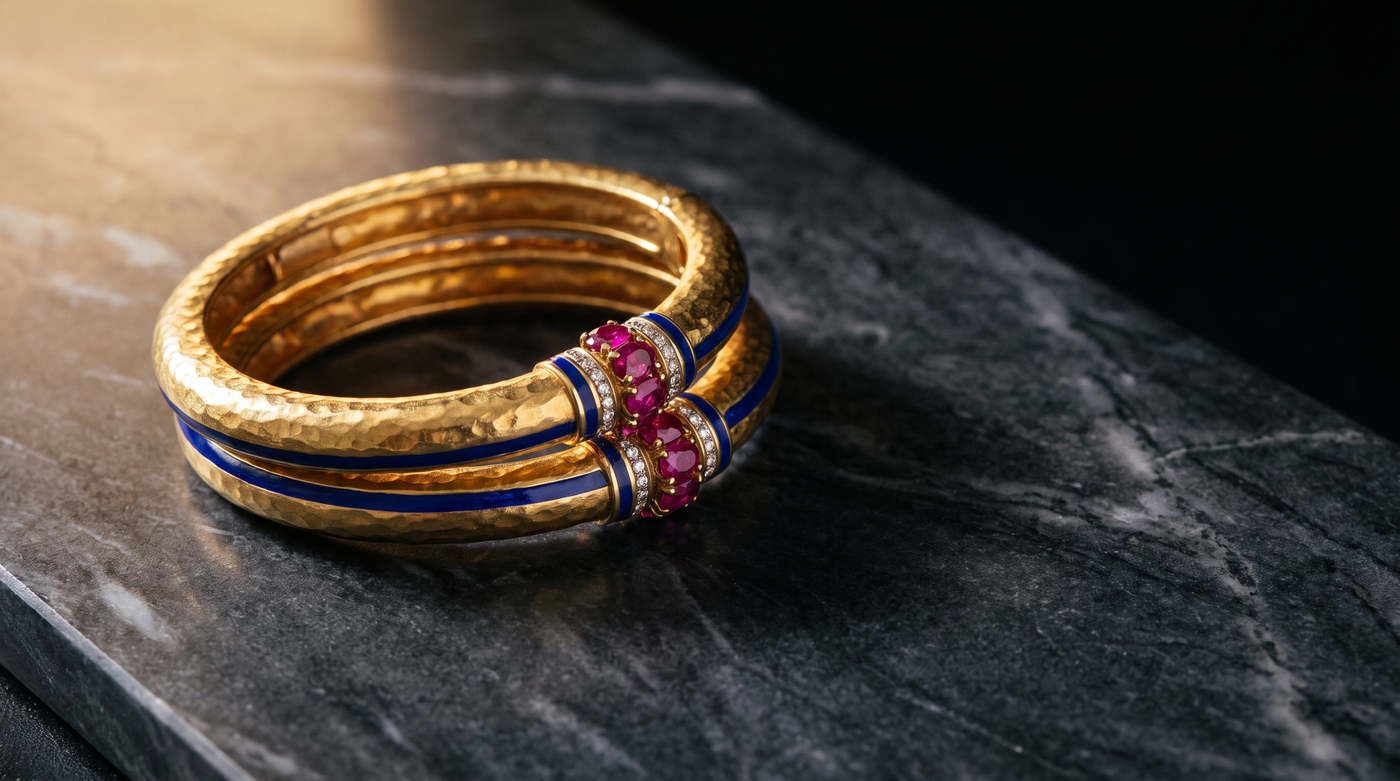
A bracelet coiled twice around the wrist, its enamel stripes catching the light like something alive. A cross, hammered in gold thick enough to cast its own shadow, set with a cabochon sapphire the size of a knuckle. In the middle of the twentieth century, one American jeweler decided that fine jewelry did not have to whisper. David Webb built a house on that conviction, and for nearly thirty years he dressed the most photographed women in America in gold that behaved like sculpture.
A Spider's Web, Stamped in Copper
David Webb was born on July 2, 1925, in Asheville, North Carolina, and came to jewelry sideways, the way most self-taught masters do. As a boy he worked alongside an uncle who was a metalworker, hammering souvenir copper ashtrays stamped with a small spider's web — an early, unwitting signature. He studied at the Penland School of Craft in the Blue Ridge Mountains, learning to move metal by hand rather than by formula, and then, still in his early twenties, he did what ambitious Southern craftsmen of his generation did: he went to New York.
Two West Forty-Sixth Street, 1948
On July 28, 1948, at twenty-three years old, Webb opened his own house at 2 West 46th Street, in partnership with Nina Silberstein, who would remain his closest collaborator and, after his death, the steward of his archive. He had no formal design training and no family jewelry pedigree behind him — only an eye, a willingness to work the metal himself, and an appetite for scale that Fifth Avenue's older houses did not share. Where the establishment favored discretion, Webb favored presence. It made him, within a decade, one of the most sought-after names on the block.
The Menagerie: Zebras, Frogs, and a Maltese Cross
Webb's signature was maximalism with a point of view. He produced his first animal bracelet in 1957 — a hinged cuff built like a piece of armor, its surface given over entirely to enamel and gemstones. Frogs, tigers, and dragons followed, each rendered with the hammered-gold texture that became a house fingerprint, but it was the zebra, designed in 1963, that made his name. Its black-and-white enamel stripes, wrapped in a coiling hinged cuff, turned out to be one of the great graphic statements in twentieth-century jewelry — bold enough for the Pop and Op Art moment it arrived in, and elegant enough to outlast it. Alongside the animals, Webb built an equally recognizable language in hammered 18-karat gold and the Maltese cross, a motif he returned to again and again in cuffs and brooches, its four broad arms set with a single commanding cabochon. Where a Retro-era cocktail ring might announce itself with one great stone, a Webb cuff announced itself with architecture — mass, texture, and color working together rather than a lone gem carrying the piece alone.

Jackie, Diana, and the Women Who Wore Him
A house is remembered as much by who wore it as by who made it, and Webb's client list reads like a mid-century masthead. Diana Vreeland, the editor who shaped Harper's Bazaar and then Vogue before overseeing the Costume Institute at the Met, was rarely photographed in the 1960s and '70s without her zebra bangle — the piece became so associated with her that it is difficult, now, to describe one without the other. Elizabeth Taylor, whose appetite for serious jewelry needs no introduction, bought Webb's very first animal bracelet in 1957 and remained a devoted client for years afterward; her taste for scale and color found an obvious match in his workshop, in the same era that would later give the world the Taylor-Burton diamond, a stone Taylor wore with the same unapologetic confidence Webb built into his cuffs. And in 1962, Jacqueline Kennedy — already a private client — began commissioning Webb to design the White House's official Gifts of State, a role that placed his work, briefly, at the center of American diplomacy. Doris Duke, Wallis Simpson, Gloria Vanderbilt, and Lee Radziwill filled out a client roster that made Webb, by the mid-1960s, one of the defining jewelers of American high society.

A Workshop, Not a Studio
Webb thought of himself as a craftsman before he thought of himself as a designer, and the house he built reflected it. Rather than sketch a piece and hand it off, he worked the metal himself in the early years, and the workshop he assembled above his boutique kept that hands-on discipline long after his death. The zebra bracelet, in particular, became something of a workshop rite of passage: its intricate enameling and stone-setting were executed by a single master metalsmith, who in time trained his own son to carry the technique forward — a lineage of skill passed hand to hand rather than written down. That same insistence on domestic, in-house craftsmanship survives at the house today, where master jewelers still work above the Madison Avenue boutique rather than outsourcing production, making David Webb one of the few American high-jewelry houses that can claim its pieces are conceived and made entirely at home. It is a philosophy that estate and vintage collectors recognize instantly: the difference between a piece that was assembled and one that was made, by hand, by someone who intended it to outlast them.
Fifty Years On: A House Revived, Twice
Webb died suddenly of pancreatic cancer on December 12, 1975, at fifty, leaving behind more than fifty thousand original drawings, designs, and molds — an archive so complete that it has powered the house's revivals ever since. Nina Silberstein and her family kept the name alive through the following decades, and in 2010 the company found new stewardship under Mark Emanuel and partners, who moved the house into a 1920s bank building at 942 Madison Avenue and set master jewelers, some of whom had trained under Webb himself, to work from the original archive. That renaissance carried the house through 2024; in early 2025, David Webb entered its next chapter when it was acquired by the investment group Middle West Partners, with jewelry industry veteran James Weiss named CEO — the latest sign that the appetite for Webb's particular brand of maximalism, seven decades on, shows no sign of fading.
Wearing the Legend at Home
What makes Webb's work endure is not novelty but nerve — the willingness to let a piece take up room on the hand or the wrist rather than apologize for itself. It is a sensibility that runs through the whole of mid-century American jewelry, even outside his own workshop: in the same years Webb was hammering gold into zebras, Elsa Peretti was pursuing the opposite instinct at Tiffany, paring a bean or a teardrop down to its purest line. Between those two poles — Webb's maximalism and Peretti's restraint — sits most of what collectors prize about the era. At VERANE, that appetite for mid-century confidence shows up most often in our vintage cocktail rings, where a single commanding stone still does the work a Webb cuff did with color and texture, and in the Retro jewelry we carry more broadly, pieces built in the same postwar decades on the same belief that jewelry could be sculpture first and ornament second. It is also, simply, part of why we do this work: the same conviction that draws collectors to vintage and estate jewelry as a category — that a piece with a history behind it says something a new one cannot.
We do not currently hold a signed David Webb piece, but our collection of estate diamond bracelets includes work from the same postwar decades, built by hand in the same spirit of scale and confidence. If a Webb-caliber piece is what you are after, we would be glad to help you look — request a private viewing and we will walk you through what we have, and what we can help you find.