The Taylor-Burton Diamond: The Stone That Started a Bidding War on Live Television
In 1969, a 69-carat pear-shaped diamond became the first gem sold at public auction for over a million dollars — and Richard Burton bought it for Elizabeth Taylor the next morning.
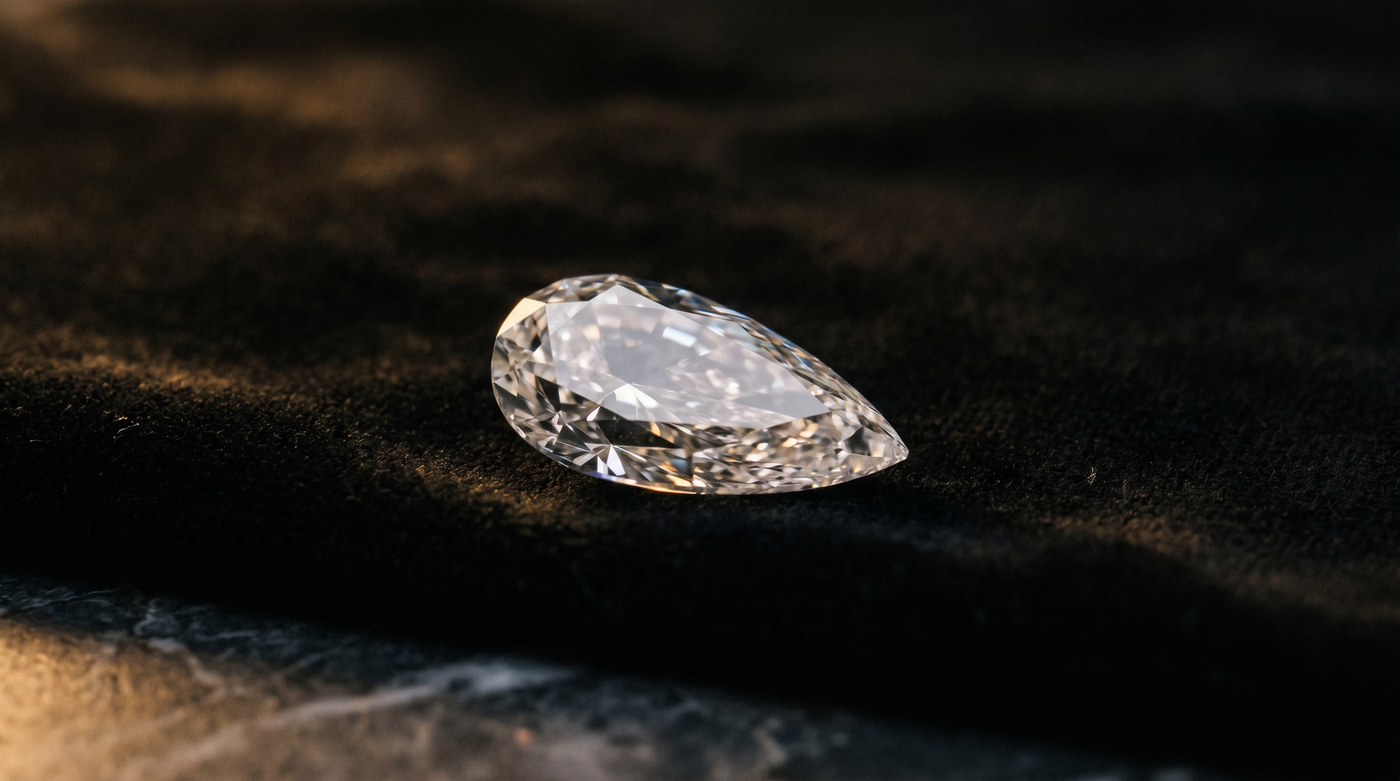
The room at Parke-Bernet Galleries on Madison Avenue filled early that October morning in 1969. Dealers, journalists, and the simply curious pressed in together, the kind of crowd that assembles when money and legend share the same floor. Lot 133 was a pear-shaped diamond of 69.42 carats — no provenance name attached, only the stone itself, its cut precise, its color exceptional. The auctioneer opened the bidding at $200,000, and the room answered with a collective shout of assent. By $500,000, nine bidders remained. By $650,000, two. At one million dollars exactly, the representative bidding on behalf of Richard Burton and Elizabeth Taylor withdrew from the contest. The hammer fell shortly after for $1,050,000 — the highest price ever paid at public auction for a single jewel.
The buyer was Robert Kenmore of the Kenmore Corporation, parent company of Cartier. The diamond was theirs, at least for the moment. What happened in the twenty-four hours that followed would write itself into the permanent mythology of jewelry, celebrity, and romantic excess.

A Collector Unlike Any Other
To understand what the Taylor-Burton Diamond meant, it helps to understand what Elizabeth Taylor was by 1969. She was not simply a film star who wore jewels. She was, by most serious accounts, the greatest private collector of gemstones of the twentieth century — a woman who understood the provenance, the cut, the geological biography of the stones she acquired with the same attention she gave to a script or a performance. Her collection would eventually include the 33.19-carat Krupp Diamond (now known as the Elizabeth Taylor Diamond), a 50-carat pearl known as La Peregrina with a lineage tracing back to Spanish royalty, and dozens of pieces that would later command extraordinary prices at Christie's.
Taylor had not always been a collector of this magnitude. Her early jewelry, gifts from husbands and suitors, was significant but not systematic. It was Richard Burton — a man who, by his own account, preferred the company of books and rugby but understood that Taylor's pleasure in beautiful things was inseparable from who she was — who began escalating the scale. Each acquisition was both a gift and a statement. The Taylor-Burton Diamond was the statement that exceeded all previous ones.
Pieces of comparable provenance and exceptional cut are occasionally available through estate diamond necklaces at VERANE — stones with documented histories and the kind of presence that outlasts any single moment of ownership.
From Premier Mine to Parke-Bernet: The Diamond's Origins
The rough diamond was discovered in 1966 at the Premier Mine in South Africa — the same storied formation that had earlier yielded the Cullinan Diamond, the largest gem-quality rough diamond ever found. (For the full story of that extraordinary stone, see our account of the Cullinan Diamond.) The Premier Mine had a particular genius for producing stones of unusual size and character, and the 241-carat rough that would become the Taylor-Burton Diamond was no exception.
Harry Winston acquired the rough stone and assigned the cutting to a master craftsman who spent six months studying its internal structure before making the first incision. The result was a pear-shaped brilliant of 69.42 carats — elongated, tapered to a clean point at one end and sweeping to a generous rounded shoulder at the other, the proportions that give pear-cut diamonds their quality of poised motion, as if the stone were always on the verge of becoming a pendant. The color and clarity were exceptional. The stone was sold to Harriet Annenberg Ames, sister of the publisher Walter Annenberg, who found it too magnificent to wear in New York — too conspicuous, too large for the private life she led. It sat in a bank vault, she later said, for years. In 1969 she consigned it to Parke-Bernet.
The Auction and What Followed
Richard Burton had set a ceiling of one million dollars. His lawyer Aaron Frosch was on the telephone from London; his agent Al Yugler was bidding in the room. Aristotle Onassis — who may have intended the stone for Jacqueline Kennedy Onassis — dropped out at $700,000. The Sultan of Brunei withdrew. Harry Winston himself, who had cut the original rough, was among the underbidders. At exactly one million dollars, Burton's representatives stepped back, and Cartier took the lot for $1,050,000, breaking the previous record for a publicly auctioned diamond — set in 1957 at $305,000 — by a factor of more than three.
The diamond was promptly named the Cartier Diamond and put on display at Cartier's Fifth Avenue flagship. An estimated six thousand people queued each day to see it. The stone briefly became a public spectacle in a way that few objects ever do — the subject of editorial outrage in The New York Times, which wrote with carefully calibrated censure about the purchasing of baubles while war and poverty persisted elsewhere.
Burton was at The Bell Inn in Buckinghamshire when his lawyer telephoned to say he had been outbid. His diary entry describing that moment has become one of the more vivid records of what it felt like to want something with irrational intensity. He wrote that he "turned into a raving maniac" and instructed his lawyer to buy the diamond from Cartier regardless of the price. Elizabeth Taylor reportedly told him it didn't matter, that there was more to life than baubles, that she would manage without it — which Burton later described, with characteristic wryness, as a suggestion that "she would make do."
The following day, Burton negotiated directly with Cartier and purchased the stone for a reported $1.1 million. As part of the agreement, Cartier retained the right to exhibit it briefly in Chicago before delivery. The diamond was renamed the Taylor-Burton Diamond. The stone also made a memorable guest appearance on The Ed Sullivan Show before it left public hands entirely.

Life with the Diamond: Monaco, the Academy Awards, and Lloyd's of London
Taylor found the diamond too heavy to wear comfortably as a ring — it had originally been set in platinum with two flanking stones — and commissioned Cartier to design a necklace for it at a cost of $80,000. The design placed the pendant so that it sat directly over her tracheotomy scar, a remnant of the near-fatal pneumonia she had survived in 1961. The stone thus became, among other things, a form of autobiography worn at the throat.
The diamond made its social debut at Princess Grace of Monaco's fortieth birthday gala at the Hôtel Hermitage in Monte Carlo, in November 1969 — the so-called Scorpio Ball. Grace Kelly had by then spent more than a decade as a royal, but her identity as a jewel-wearer had been sealed long before the principality: her Cartier engagement ring, a 10.47-carat emerald-cut diamond presented by Prince Rainier in 1956, had made her perhaps the most photographed wearer of a Cartier diamond in history. Taylor arrived at the Scorpio Ball wearing the Taylor-Burton alongside the Krupp Diamond and a third stone: a 1/8-carat diamond that Burton had purchased for fourteen dollars after losing a ping-pong match. When guests admired the arrangement, Taylor would gesture toward the tiny stone and pretend that was the one drawing all the attention. The wit of the gesture — a jewel worth over a million dollars worn with deliberate irony — was characteristic of Taylor at her most self-aware. The three-stone ensemble became one of the most photographed displays of personal jewelry of the late twentieth century.
She wore the Taylor-Burton Diamond again at the 42nd Academy Awards in April 1970, where she presented the Award for Best Picture to Midnight Cowboy. Lloyd's of London, which had insured the stone for one million dollars, stipulated that it could be publicly worn for no more than thirty days in any calendar year and that Taylor must be accompanied by armed guards whenever she wore it in public. She later had a replica made, at a cost of $2,800, for occasions when the terms of the insurance policy made wearing the original impractical.
For collectors interested in the tradition of significant estate diamond pendants worn at the neckline, our estate diamond necklace collection represents that same understanding — that a stone worn at the throat carries a particular weight of personal declaration. Our estate diamond ring collection similarly offers pieces of genuine provenance for those drawn to stones with documented histories.
The Sale: Botswana, 1979
Taylor and Burton divorced for the second time in 1978, their two marriages having traced an arc of spectacular mutual intensity that no other public relationship of the era quite matched. In June 1979, Taylor sold the Taylor-Burton Diamond to Henry Lambert, a New York jeweler, for a figure reported variously as $3 to $5 million. She stated publicly that part of the proceeds would be used to fund the construction of a hospital in Botswana — a country to which she had a particular connection, having married Burton there for the second time in 1975.
Lambert sold the diamond in December of the same year to Robert Mouawad of the jewelers Mouawad. In 1980, Mouawad had the stone recut, reducing it from 69.42 to 68.0 carats. It remains in the Mouawad collection to this day, occasionally exhibited but not publicly for sale. The Taylor-Burton Diamond has not appeared at auction since 1969.
What a Diamond Tells Us About the Person Who Wore It
The Hope Diamond is famous because it is the Hope Diamond — a stone so historically embedded as to carry its own gravity, its own mythology of misfortune and royal custody. The Taylor-Burton Diamond is famous for a different reason: because of the specific, documented, fully human transaction that brought it to Elizabeth Taylor's throat. We know what Burton wrote in his diary. We know the telephone call at the Bell Inn, the instruction to buy it regardless of cost, Taylor's ironic deflection at the Scorpio Ball, the eventual decision to sell it and build something useful with the proceeds in a country eight thousand miles from Fifth Avenue.
This is what makes the Taylor-Burton Diamond an enduring subject of interest to anyone who thinks seriously about jewelry as biography. The stone itself is extraordinary — the cut, the clarity, the scale. But the reason it still matters is that it carries the record of a particular kind of devotion and a particular kind of person: a woman who collected beautiful things with rigorous taste and ultimate detachment, who could wear a million-dollar diamond and then point at the fourteen-dollar one and say, with complete composure, isn't it perfect?
The tradition of understanding jewelry as biography — as objects that carry the specific emotional and material history of the people who wore them — is central to the estate jewelry market and to what we do at VERANE. For those interested in exploring the broader context of famous diamonds and the collectors who shaped their histories, our account of the Hope Diamond offers a comparable study in how a stone accumulates meaning across centuries. The history of the Koh-i-Noor Diamond explores similar questions about how extraordinary stones become entangled with power, politics, and personal ambition.
Explore Estate Diamond Jewelry at VERANE
The Taylor-Burton Diamond is not available. But the sensibility it represents — stones of genuine provenance, worn with intention and understood as biography rather than decoration — is exactly what drives our curation at VERANE. We source estate diamond necklaces, rings, and pendant pieces with documented histories, offering each piece with the same attention to provenance that a serious collector brings to any significant acquisition.
Browse our estate diamond necklaces for pendants and necklace suites with verified histories, or request a private viewing if you are looking for a specific stone, period, or cut. Our team sources estate pieces continuously and welcomes inquiries from collectors at every stage of their collection.