The Cullinan Diamond: The Greatest Stone Ever Found and the Secret That Kept It Safe
The story of the 3,106-carat Cullinan Diamond — the largest gem-quality stone ever found — and the extraordinary decoy operation that brought it safely to England.
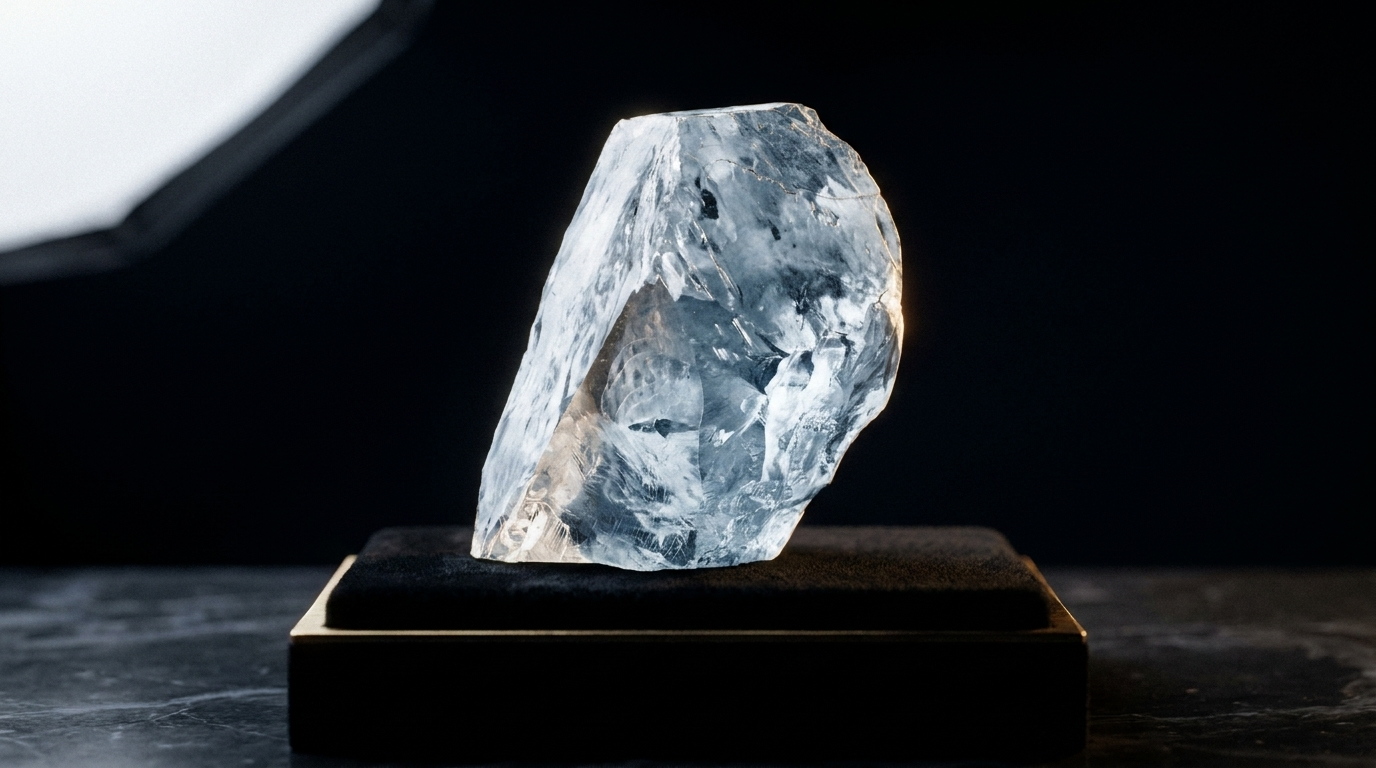
On the afternoon of January 26, 1905, Frederick Wells climbed down into the open workings of the Premier Mine near Pretoria, South Africa, and noticed something catching the last of the day's light along the mine wall. He pried it loose with his penknife. It was pale, almost colorless — a fragment of sky solidified into carbon — and it weighed, when the dust was cleared and the scales were consulted, 3,106.75 carats. No gem-quality rough diamond of such magnitude had ever been recorded. None has been found since.
The stone was named the Cullinan Diamond, after Sir Thomas Cullinan, the Johannesburg mining magnate who had established the Premier Mine just three years earlier. Its discovery made international headlines immediately, which would soon prove to be both a matter of pride and a serious problem.
A Stone Without Precedent
To understand the scale of the Cullinan is to run out of useful comparisons. At 3,106.75 carats — roughly 621 grams — it was more than three times the weight of any known gem diamond before it. The stone measured approximately 10.1 centimeters long, 6.35 centimeters wide, and 5.9 centimeters deep. It was a type IIa diamond: chemically pure, free of the nitrogen that tints most diamonds yellow, and possessed of an exceptional transparency that the cutters who would later examine it described as near-perfect.
There was one significant curiosity. One face of the Cullinan appeared to be a cleavage plane — a flat, smooth surface suggesting that the stone was not a complete crystal but a fragment of something far larger. If true, the original crystal may have weighed close to ten thousand carats. That parent stone has never been found.
The Transvaal government purchased the Cullinan in 1907 and presented it to King Edward VII on his sixty-sixth birthday — a diplomatic gesture from a territory only recently incorporated into the British Empire following the Anglo-Boer War. The king accepted with evident pleasure and the stone was dispatched to London. What happened next became one of the more celebrated stories in the history of precious stones.

The Decoy That Fooled the World
The discovery of the world's largest diamond had been exhaustively covered in the press, and the journey of so famous an object from South Africa to London was understood to carry real risk. Authorities arranged what appeared to be a heavily guarded transfer. A parcel was carried with great ceremony aboard the RMS Kenilworth Castle, placed in the captain's safe, and watched over by detectives for the duration of the voyage. Word spread, as intended, that the Cullinan was aboard.
It was not. According to accounts that have circulated widely since — though historians note the full record is difficult to verify — the real Cullinan Diamond was dispatched to London by registered post, in a plain parcel box, by ordinary parcel mail. The dummy aboard the ship was there to attract any thieves who might act on the publicly available information. The real stone arrived without incident.
Whether the full story is precisely as legend records it, the outcome is not in dispute: the Cullinan reached London safely, passed into the hands of the royal household, and awaited the cutters who alone could unlock what lay within it.
The Asscher Brothers and Eight Months of Work
The task of cutting the Cullinan was entrusted to I.J. Asscher & Co. of Amsterdam, then among the most respected diamond-cutting firms in the world. The Asscher brothers studied the stone for months before a single cut was attempted, mapping its internal grain, its inclusions, and the precise angles at which the cleavage planes ran.
On February 10, 1908, Joseph Asscher placed a specially made steel blade in a prepared groove on the stone's surface and struck it with a mallet. The blade broke. He struck again. The Cullinan cleaved along precisely the intended plane.
What followed was eight months of meticulous work by three polishers working fourteen-hour days. The result: nine major stones, ranging from the magnificent to the exceptional, and approximately ninety-six smaller brilliants and polished fragments. None of the resulting gems could be called anything but extraordinary. Together, they remade the landscape of the world's great diamond collections.
Nine Stones, Nine Lives in the Crown Jewels
The nine major Cullinan stones were eventually acquired by the British Crown and incorporated into the royal regalia and jewelry collection, where most remain today.
Cullinan I — the Great Star of Africa. Weighing 530.2 carats, Cullinan I is the largest colorless cut diamond in the world. It is a pear-shaped brilliant of exceptional clarity, set at the head of the Sovereign's Sceptre with Cross, part of the Crown Jewels displayed at the Tower of London. The sceptre is used at every coronation.

Cullinan II — the Second Star of Africa. At 317.4 carats, this cushion-shaped brilliant is set into the front band of the Imperial State Crown, worn by the sovereign at the State Opening of Parliament. It is the fourth-largest colorless cut diamond in the world.
Cullinan III and IV — the Lesser Stars of Africa. These two stones, weighing 94.4 and 63.6 carats respectively, were set into Queen Mary's coronation crown in 1911. They later became a pendant-and-brooch set, worn regularly by Queen Elizabeth II and referred to with characteristic understatement as "Granny's Chips."
Cullinan V through IX. The remaining major stones range from 18.8 carats (Cullinan V, a heart-shaped diamond set into a brooch that can also be mounted in a tiara) down to Cullinan IX, a pear-shaped stone of 4.39 carats sometimes worn on a ring. All remain in the royal collection.
Cullinan I and II can be removed from their settings and worn together as a brooch — a flexibility built in from the beginning, reflecting the practical wisdom that jewelry of this importance must have a life beyond ceremony. For collectors who think about provenance and purpose in fine stones, this interchangeability is a quietly instructive detail.
The story of the Cullinan Diamond has something in common with other storied gems explored in these pages. If you are interested in the history of stones that carry the weight of empire, you may find our account of the Hope Diamond equally absorbing — a blue stone with a very different kind of legend attached to it.
What the Cullinan Teaches the Estate Collector
The Cullinan Diamond is, in the most literal sense, irreplaceable. No stone of its scale or quality has appeared since 1905, and none of the nine great gems cut from it will ever enter the private market. But the Cullinan's history illuminates principles that run through every significant piece of estate diamond jewelry — principles that are very much alive in the stones we acquire and offer at VERANE.
The first is the primacy of provenance. A diamond without a story is merely carbon and light; a diamond whose history can be traced — whose previous owners, settings, and travels are documented — carries meaning that no newly mined stone can replicate. The Cullinan is the ultimate expression of this truth. Its value is inseparable from what it has witnessed.
The second is the intelligence of original craftsmanship. The Asscher brothers did not cut the Cullinan for maximum weight retention or minimum labor. They cut it to realize the potential within each fragment of the original rough, allowing the stone's own geometry to guide their decisions. The same sensibility is visible in the finest estate diamond rings of the Edwardian and Art Deco periods — those old mine cuts and rose cuts that reflect a philosophy of patient, hand-guided work rather than machine optimization.
The third lesson is rarity itself. The Edwardian period — the very years in which the Cullinan was discovered, dispatched to London, and cut in Amsterdam — produced some of the most refined diamond jewelry ever made. Those pieces exist in finite number. Their makers are long gone. The millegrain settings, the platinum filigree, the delicate knife-edge bands of that era cannot be replicated at scale. They can only be found. Our new acquisitions are sourced with precisely this in mind — period pieces whose quality speaks across a century.
On Wearing History
There is something worth sitting with in the image of the Cullinan Diamond traveling to London in a plain post box — the most valuable stone in the world wrapped in brown paper, moving through the ordinary mail system while a dummy was guarded on a ship with great ceremony. It is a story about the gap between appearance and reality, between the theatrical and the genuine.
The finest estate jewelry operates on the same principle. A piece worn without explanation, without a label or a provenance certificate visible, is simply beautiful — a well-made ring, a quietly exceptional necklace. Only on closer inspection, only when the story is known, does the full weight of the thing become apparent. The gold was worked by hands trained in a tradition now vanished. The stone was set in a decade that no living person remembers. The provenance, once understood, transforms the object entirely.
That transformation is what we look for when we source. It is what our clients tell us they feel when a piece from another era settles onto a finger or rests at a collarbone. Estate diamond necklaces from the Edwardian period carry something the Cullinan itself embodied: the sense that remarkable stones, and remarkable craft, have a way of persisting regardless of the circumstances arranged around them.
The Cullinan arrived safely. The stones it became have outlasted every monarch and minister who debated their acquisition. They will outlast the current age as well. The best estate pieces share this quality — a durability rooted not in hardness alone but in the integrity of the making.
An Invitation
If reading the history of the Cullinan Diamond has prompted a thought about the estate diamond pieces you may be looking for — whether a ring from the Edwardian period, a necklace in the Art Deco tradition, or a stone whose provenance you want to understand before you commit — we would welcome the conversation.
Browse our current selection of estate diamond rings, each sourced for period authenticity and documented provenance. Or, if you have something specific in mind — a stone of a particular cut or era, a piece that fits a particular occasion — request a private viewing and we will arrange a consultation at your convenience.
The greatest diamond ever found now rests in the Tower of London, removed from time and from ordinary life. The pieces we offer are meant to be worn. That is, in its own way, the higher honor.