The British Crown Jewels: Colonel Blood, the Cullinan and the Koh-i-Noor
A working regalia, a flattened crown and a pardoned thief: the documented history of the British Crown Jewels and their most famous stones, with legend marked as legend.
On the ninth of May, 1671, a man in a clergyman's cloak walked out of the Tower of London with a crown folded beneath his coat. He did not get far. That he got as far as he did is the reason the British Crown Jewels have been under armed guard ever since, and the reason their story reads less like a catalogue than a novel with a very long cast.
It is worth saying at the outset what the Crown Jewels are, because the name suggests a treasury and the reality is something more demanding. They are the regalia of the monarchy: more than a hundred objects, set with some twenty-three thousand stones, held by the sovereign for the nation rather than as private property, and still brought out when the constitution requires them. Historic Royal Palaces, which cares for them in the Jewel House, describes the coronation regalia as the only working set in Europe. These are not relics under glass. They are tools of a ceremony that has not ended.
St Edward's Crown and the regalia that survived 1649
Most of what visitors see dates from after 1660, and the reason is a matter of record. When Parliament abolished the monarchy in 1649, the medieval regalia was broken up, sold or melted for coin. Little survived; the twelfth-century Coronation Spoon is the great exception, kept back by a buyer who returned it at the Restoration. For the coronation of Charles II in 1661, goldsmiths made the regalia afresh.
The centerpiece was St Edward's Crown, of 22-carat gold, weighing about 2.23 kilograms and set with 444 stones under a purple velvet cap trimmed in ermine. It is the crown that is placed on a sovereign's head at the moment of crowning and, in the modern tradition, at no other time. Some historians have wondered whether gold from the older crown was reused; the record does not settle it. It was resized in December 2022 and used for Charles III on the sixth of May, 2023. Seen from a jeweler's side of the table, it is a useful reminder that a historic piece is rarely a single moment: it is a sequence of recuttings, resettings and repairs, each of which becomes part of its provenance.
Colonel Blood's 1671 theft
The new regalia was barely ten years old when Thomas Blood came for it. An Irish-born adventurer who styled himself "Colonel," Blood had a history of plots and was, by most accounts, a man of considerable charm. In the spring of 1671 he visited the Tower dressed as a parson, accompanied by a woman presented as his wife, and cultivated Talbot Edwards, the seventy-seven-year-old keeper of the Jewel House. The regalia was then kept in a basement beneath the keeper's lodgings in the Martin Tower.
On the morning of the ninth, Blood returned with companions and a story about a prospective marriage between his "nephew" and Edwards's daughter. Once the party was inside the Jewel House, Edwards was struck with a mallet, bound and gagged, and stabbed. Blood flattened St Edward's Crown with the mallet so that it would fit under his cloak; a companion filed through the Sceptre with the Cross; another tucked the Sovereign's Orb into his breeches.

The plot unraveled by accident. Edwards's son, a soldier lately back from Flanders, arrived at that moment, and Edwards worked his gag loose and raised the alarm. The thieves ran for their horses, dropping the sceptre and firing on the warders. Captain Martin Beckman gave chase and took Blood before he reached the Tower's gate. The crown fell from his cloak; it was bent, and some stones were missing or loose, but it was recovered and straightened.
What followed is stranger than the crime. Blood would speak only to the king, and was taken to the palace, where Charles II is said to have asked what he would do if his life were spared. Blood is reported to have answered that he would endeavor to deserve it. He was pardoned and granted Irish lands worth some five hundred pounds a year, while the Edwards family received considerably less, and never in full. Why the king was so merciful has never been established. Theories include that Blood was a government informer, that the king admired his nerve, or that the affair was somehow staged; none is proved, and each should be read as speculation.
The Imperial State Crown
The crown Blood took was not the one most people picture today. The Imperial State Crown, worn by the monarch on leaving Westminster Abbey after a coronation and at the State Opening of Parliament, descends from the crown Rundell and Bridge made for Queen Victoria in 1838. The current version was made by Garrard in 1937 for George VI as a lighter copy. It stands about 31.5 centimeters tall, weighs roughly 1.06 kilograms and carries over three thousand stones, among them diamonds, sapphires, emeralds, rubies and pearls.
Two stones draw the eye. At the front of the cross pattée sits the so-called Black Prince's Ruby, a large, polished, irregular red stone of about 170 carats, which is not a ruby but a spinel; until the late eighteenth century red gems were not distinguished. Tradition says Peter of Castile gave it to Edward, the Black Prince, in 1367, and that Henry V wore it at Agincourt. The first is a legend that appears centuries later; the second is likewise tradition rather than documented fact. What can be said is that a red stone of this kind has been in the English regalia for a very long time. Below it, at the front of the band, is the 317.4-carat Cullinan II. The 104-carat Stuart Sapphire, once at the front, was moved to the back in 1909, and the St Edward's Sapphire, said to come from the ring of Edward the Confessor, crowns the top cross.

The Cullinan diamonds
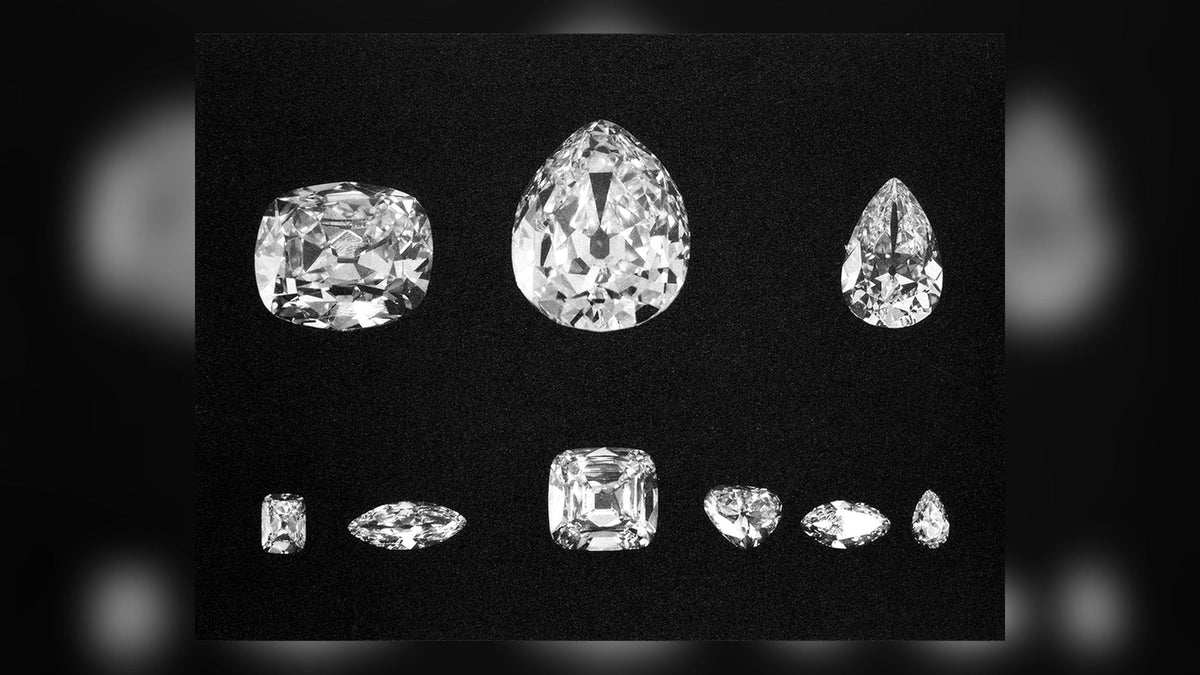
The largest gem-quality rough diamond ever found, of 3,106 carats, came out of the ground on the twenty-sixth of January, 1905, at the Premier Mine in the Transvaal, South Africa. The Transvaal government bought it in 1907 and presented it to Edward VII on his sixty-sixth birthday. Joseph Asscher of Amsterdam cleaved and cut it from February 1908, yielding nine major stones and ninety-six smaller brilliants. The cutting of the stone is itself a lesson in estate jewelry: the finished gems were distributed across crowns, brooches and sceptres, and several have since passed between generations of the royal family. Our own account of the Cullinan diamond follows its journey in greater detail.
The largest, Cullinan I, is a pear-shaped brilliant of roughly 530 carats, called the Great Star of Africa. It is mounted in the head of the Sovereign's Sceptre with the Cross, below an amethyst orb and cross, and was set there in the sceptre as remade in 1910. The second, Cullinan II, called the Second Star of Africa, is the cushion-cut stone in the front of the Imperial State Crown.

The Koh-i-Noor controversy
No stone in the collection is more contested than the Koh-i-Noor, which is not part of the Imperial State Crown but of a consort's crown. It was surrendered to Queen Victoria under the Treaty of Lahore of 1849, following the British annexation of the Punjab, and formally presented to her in 1850. Prince Albert had it recut in 1852, reducing it to its present 105.6 carats. It was later set in the crowns of Queen Alexandra, Queen Mary and, in 1937, Queen Elizabeth the Queen Mother, whose crown lay on her coffin in 2002. It was not used for the coronation of Queen Camilla in 2023.
India, Pakistan, Iran and Afghanistan have each at various times asked for its return, and the British government has declined, describing the question as non-negotiable. How a diamond passes between ruling houses by treaty, gift or conquest is a question every historic stone raises; we have set out the diamond's earlier history in our article on the Koh-i-Noor diamond.
The Jewel House today
Since Blood, the regalia has been guarded by soldiers. It remains in the Jewel House at the Tower, watched by armed guards, and travels under escort when needed, for instance to the Palace of Westminster for the State Opening. During the Second World War the jewels were moved to Windsor Castle for safe keeping. The nearest cousin in the annals of theft is a very different story, the vanishing of the Irish regalia from Dublin Castle in 1907, told in the theft of the Irish Crown Jewels, which has never been solved.
For those of us who handle historic jewelry, the national regalia is a quiet standard. It shows how a stone can outlast its settings, how a rumor can become provenance if no one checks it, and why documentation is worth more than a good story. The nineteenth-century taste for large, formally set diamonds, which Victoria's reign did so much to fix, still echoes in the pieces we place; those interested in that period may wish to browse our Victorian jewelry. To discuss a particular piece, or to see it in person, we would be glad to arrange a viewing at your convenience; you may request a private viewing here.