The Theft of the Irish Crown Jewels: The Scandal Dublin Castle Kept Secret for a Century
In July 1907, 394 precious stones vanished from Dublin Castle four days before King Edward VII arrived — and the truth about who took them was deliberately buried beneath a scandal that Edwardian power could not afford to expose.
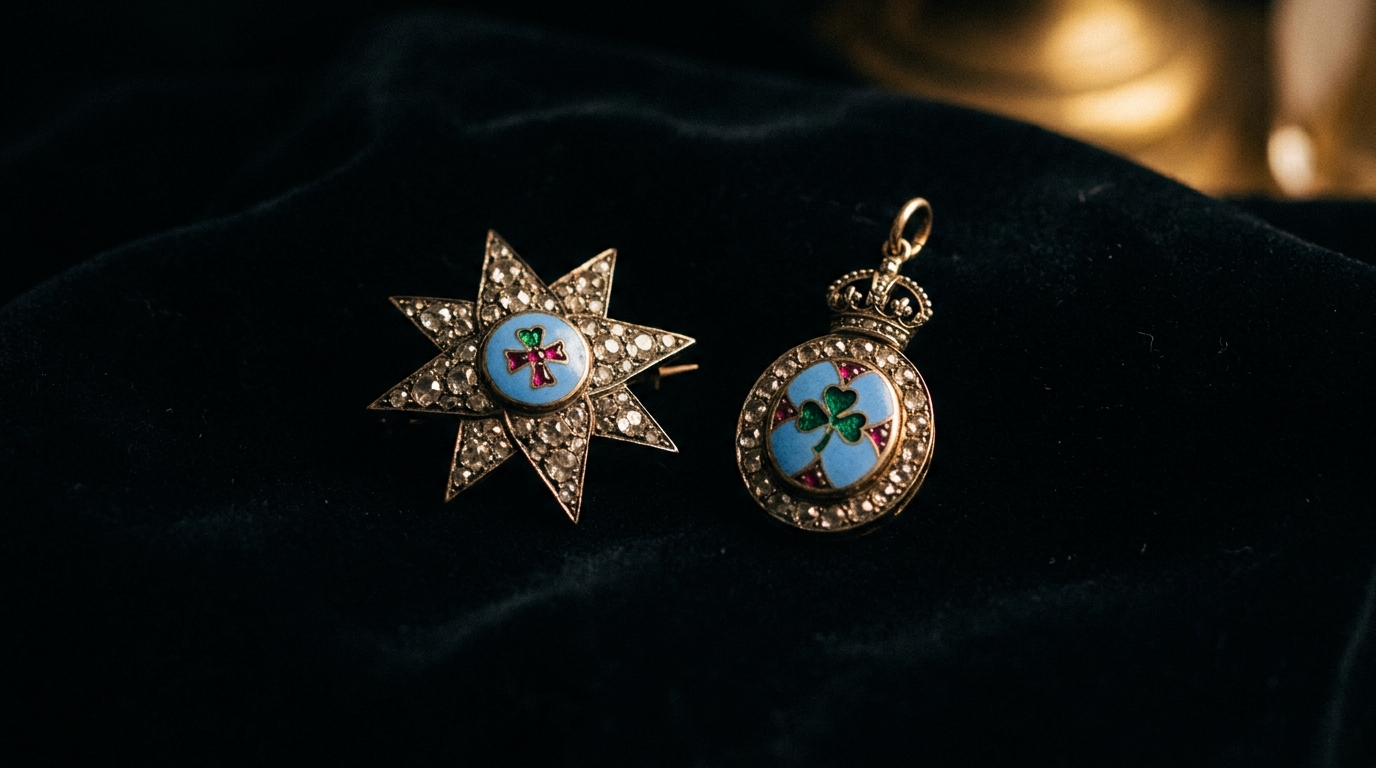
Somewhere beneath Dublin's streets — or perhaps across the Irish Sea, in Amsterdam or London — a star of Brazilian diamonds still catches the light that no one is permitted to see. It has been hidden for more than a century. The jewels of the Order of St Patrick, 394 precious stones set into regalia of extraordinary delicacy, vanished from Dublin Castle on a summer morning in 1907, four days before King Edward VII was due to arrive. They have never been found. The case has never been closed. And the truth, as best historians can reconstruct it, is more tangled — and more human — than any simple theft.
A Star Built for Ceremony, Not for Vaults
The Order of St Patrick was Ireland's answer to the Order of the Garter: a chivalric brotherhood founded in 1783 by George III, reserved for the island's highest nobility, with the Lord Lieutenant of Ireland as Grand Master. The order's regalia were not ancient heirlooms — they were relatively young, commissioned in 1831 by William IV from the London jewelers Rundell & Bridge, and fashioned from stones taken out of the English Crown Jewels of Queen Charlotte and from a star belonging to George III's Order of the Bath. What emerged from that reworking was something of quiet magnificence.
The star of the Grand Master was eight-pointed, the four cardinal points greater than the lesser four, the whole surface paved with Brazilian diamonds of the first water — stones selected for their exceptional clarity and brilliance by the standards of the day. At its center, a sky-blue enamel circle bore the order's motto, Quis Separabit — "Who Shall Separate Us?" — spelled out in rose diamonds, surrounding a cross of rubies and a trefoil of emeralds. The badge was a companion piece: an oval pendant set with the same shamrock of emeralds and saltire of rubies on St Patrick's blue enamel, the motto again in pink diamonds, the whole encrustation of Brazilian brilliants, and surmounting the oval, a crowned harp of diamonds on a loop of more diamonds. Together they measured over five inches high. Together they were valued at £30,000 in Edwardian money — the equivalent, conservatively, of several million pounds today.
These were not pieces made for daily admiration. They were worn once or twice a year at investiture ceremonies and royal occasions, then returned to a mahogany box in the custody of the Ulster King of Arms: the senior herald of Ireland, whose office sat inside the Bedford Tower of Dublin Castle. The custodian in 1907 was Sir Arthur Vicars — a genealogist of some distinction, a careful man in most respects, and a man who held both keys to the safe.
The Safe That Should Not Have Been There
In 1903, the Office of Arms relocated within the castle complex to the Bedford Tower. A new steel safe was ordered for the jewels. When it arrived, it was too large to fit through the doorway of the purpose-built strongroom. Rather than find a solution, Vicars had the safe installed instead in his own library — an arrangement that was never corrected. The jewels sat in a library, in a safe with keys that a handful of staff could plausibly access, in a building whose seven external latch-keys were distributed among Vicars and his deputies.
Among those deputies was Francis Richard Shackleton, the Dublin Herald of Arms — a charming, free-spending socialite and the younger brother of Ernest Shackleton, who was at that same moment planning his expeditions toward the poles. Frank Shackleton moved in circles well above his income. He had powerful friends: among them Lord Ronald Gower, sculptor and art connoisseur; the Duke of Argyll, the King's brother-in-law; various senior figures connected to Dublin Castle's Edwardian social world. He was also perpetually in debt.
The regalia were last confirmed present on June 11, 1907, when Vicars showed them to a visitor. On July 6, four days before King Edward VII and Queen Alexandra were due to arrive for the Irish International Exhibition — an occasion at which Lord Castletown was to have been invested into the order — they were discovered gone. A cleaning woman found the safe-room door unlocked, the inner door bolted, the keys still dangling in the lock. The jewels, the five gold collars of deceased and living knights, and some personal items belonging to Vicars were all missing. No safe had been broken. No window had been forced. Someone with key access had simply opened the safe and emptied it.
Scotland Yard Arrives, and the Truth Retreats
The Dublin Metropolitan Police investigated immediately. Detective Chief Inspector John Kane of Scotland Yard arrived twelve days later to assist. Posters were printed, distributed, displayed in railway stations across Ireland and Britain: detailed descriptions of the star (4⅝ by 4¼ inches), the badge (5⅝ inches high), and the five gold collars. No one came forward. No fence produced them. No customs officer stopped them at any port.
Kane's report named a culprit. The report was suppressed. By whom and on what authority has never been definitively established, though successive historians have pointed toward the Royal Irish Constabulary, the Viceroy's office, and — by implication — the court of Edward VII himself.
Vicars refused to resign. He was compelled to appear before a Viceregal Commission in January 1908, under Judge James Johnston Shaw, which found that he had failed to exercise "due vigilance or proper care" as custodian of the regalia. The commission exonerated Shackleton — the Scotland Yard inspector had explicitly denied Shackleton's involvement in testimony — and Vicars was dismissed. He contested the finding bitterly for the rest of his life, naming Shackleton publicly as the thief, and left a will that repeated the accusation. In April 1921, during the Irish War of Independence, the IRA shot him dead at his estate in County Kerry. He never learned what had truly happened to the jewels.
The Scandal Beneath the Scandal
The reason Kane's report may have been suppressed was not, most historians now believe, a simple desire to shield Shackleton from prosecution. It was the nature of what an open trial might have exposed. The commission and the subsequent parliamentary debates pointed toward a second, graver scandal: that among the circle gathered at Dublin Castle — including Shackleton, his associate Captain Richard Howard Gorges, and certain high-ranking visitors — there had been a pattern of homosexual conduct, at a time when such conduct was a criminal offense in Britain. The Dublin Castle homosexual scandals of 1884 were still a raw memory. Oscar Wilde's trials were within living recollection. The exposure of comparable conduct at the highest levels of the Irish administration — potentially touching men connected to the royal family — would have been a catastrophe.
The journalist Bulmer Hobson, writing for the American newspaper The Gaelic American in 1908 and again in a formal statement to Irish officials in 1955, set out what he understood to have happened: that Shackleton and Gorges had plied Vicars with whiskey until he fell unconscious on overnight duty, removed the key from his pocket, taken the jewels, and transported them to Amsterdam, where they were sold for £20,000 — approximately one-sixth of their insured value. The rapid, private disposal would explain why no fence ever surfaced; the stones, broken from their settings and sold as loose gems, would have been untraceable within weeks of the theft.
Hobson further claimed that Shackleton had leverage: the threat to name certain highly-placed individuals if he were prosecuted. Whether this is precisely what happened, or whether the authorities simply lacked sufficient evidence to convict, the outcome was the same. Shackleton was never charged with the theft. He was eventually imprisoned — but only in 1914, for defrauding an elderly friend of Lord Ronald Gower of a comparatively modest sum, a charge that deliberately avoided the larger financial crimes historians believe he committed. On his release, he changed his name to Mellor and became an antiques dealer in Chichester, where he died in 1941. Gorges, who had shot and killed a detective constable in 1915, died in 1944 beneath a London Underground train. The jewels were never mentioned in any court proceedings involving either man.
The Long Half-Life of a Locked File
Ireland kept asking. In Parliament at Westminster, Irish MPs raised the case year after year through the 1910s. Laurence Ginnell, MP, alleged in a December 1912 adjournment debate that the police had identified the thief and suppressed the finding to avoid what he called "criminal debauchery and sodomy being committed in the castle by officials, Army officers, and a couple of nondescripts." His speech was cut short when the chamber lost its quorum of forty members. The case was never fully debated on the floor of Parliament.
In 1927, a memo of the Executive Council of the Irish Free State — released only in the 1970s — recorded that President W. T. Cosgrave had heard the jewels might be for sale, for as little as £2,000 to £3,000. The memo is now believed to reflect an approach made by a Dublin jeweler who, in 1908, had been theoretically offered the stones by a man fitting Shackleton's description. Whether this was Shackleton himself, moving the jewels cautiously before sailing to Amsterdam, or someone else entirely, no sale was ever consummated with the Irish state.
In 1983, when the Genealogical Office vacated the structurally unsound Bedford Tower, Ireland's Chief Herald supervised the removal of walls and floorboards. There was a persistent piece of folklore within the office that the jewels had never left the building — that they had been hidden somewhere in the tower itself. The walls gave up nothing. The floors gave up nothing. The tower stands today as part of Dublin Castle's public tour, and the question mark above the strongroom has never been erased.
A 2023 study, A Secret Between Gentlemen by Peter Jordaan, drew on newly available archival material to argue that the British government's hesitancy in prosecuting Shackleton in 1913 was directly connected to his knowledge of compromising relationships involving Lord Gower and others whose names touched the fringes of the royal household. The suppression of the theft's investigation and the careful limits of the eventual prosecution were, in Jordaan's reading, of a piece: a sustained effort to ensure that whatever Frank Shackleton knew about Edwardian Dublin Castle stayed between gentlemen.
What 394 Stones Tell Us
The fate of those 394 gems — Brazilian diamonds "of the first water," emeralds, rubies, pink diamonds, rose-cut stones of exceptional provenance — is, from a collector's perspective, one of the great vanishing acts in the history of precious stones. They had been taken from Queen Charlotte's jewels and recut into regalia in 1831; they had spent seventy-six years in the ceremonial life of the Anglo-Irish establishment; they had been worn at least once — on St Patrick's Day, March 15, 1907 — before they disappeared. Their last appearance in the public record is in those police posters of July 1907, with their precise descriptions of weight and water and setting.
If Hobson's account is accurate and the stones were broken out of their settings in Amsterdam that summer, they entered the gem trade as anonymous brilliants. Old-cut estate diamond rings and pieces catalogued simply as early twentieth-century old-brilliant-cuts carry no memory of what they once were. Dispersed into the pre-war market, 394 stones of exceptional quality could be anywhere: in a brooch sold at a country-house auction, in a pendant that reached a collector's hands through three or four intermediate owners without the slightest trace of their origin. The Edwardian gem trade was not equipped to ask questions, and the questions, had anyone thought to ask them, would have had no convenient answers.
This is the quiet truth about the estate jewelry trade at its deepest level. Objects carry histories they cannot announce. A diamond does not remember that it once spelled out Quis Separabit in a circle of rose-cut fire. It simply sits, in whatever setting it currently occupies, and catches the light that falls on it — as it has always done, as it will continue to do, whoever holds it next. The same old-cut brilliants that moved through Edwardian Amsterdam in 1907 might today be described as "old European cut, early twentieth century, no known provenance" — which is simply another way of saying: the record ends here. It is the same vanishing that swallowed most of the haul from the modern Hatton Garden heist — loose stones, broken from their mounts, gone the moment they entered the market.
A Mystery Unsolved by Design
What makes the Irish Crown Jewels case distinctive — and what gives it a particular resonance for anyone who cares about the biography of fine jewelry — is that it was not merely unsolved. It was, by most historical readings, deliberately left unsolved. The machinery of Edwardian power — Scotland Yard's suppressed report, the limited Viceregal Commission, the parliamentary questions that ran out of quorum, the prosecution that carefully avoided the larger story — all moved in the same direction: toward a conclusion that would not be a conclusion. The jewels were the pretext. The secrets they might have unlocked were the point.
Arthur Vicars, who had done nothing worse than keep his safe in the wrong room and drink too freely on duty, paid with his career and eventually his life. Frank Shackleton, by the most credible reconstruction, walked out of the castle with a king's ransom in diamonds and spent the remainder of his life as a small-time swindler and antiques dealer, dying unindicted for the crime that defined him. The jewels — if the Amsterdam theory holds — were dispersed into the gem trade within weeks, and have been circulating in some form, somewhere, ever since.
It is worth noting, for the record, that this account of the theft draws on well-documented historical sources, including the parliamentary record, the Viceregal Commission report, and Bulmer Hobson's formal testimony. What Hobson reported as fact about Shackleton's involvement remains an allegation, not a conviction — no court ever made that finding. The cover-up is better documented than the crime itself. What actually happened in the Bedford Tower between June 11 and July 6, 1907, belongs to the category of things Edwardian Britain chose not to know.
At VERANE, we read provenance notes carefully. We know that the estate jewelry market is, among other things, a repository of stories that pieces cannot tell for themselves. Most of those stories are ordinary ones: an inheritance, a divorce, a collection wound down by an executor who did not share the original owner's passion. A few are not ordinary at all. The Irish Crown Jewels remind us that the most beautiful objects sometimes carry the most complicated histories — and that the question Quis Separabit is not always rhetorical.
The Order of St Patrick was never formally dissolved, though its last surviving knight died in 1974. The office of Ulster King of Arms merged with the Genealogical Office of the Irish Republic in 1943. The Bedford Tower still stands in Dublin Castle's Upper Yard, its clock keeping time above the room where the safe was too wide for the door. Somewhere, perhaps, 394 old-cut stones from Queen Charlotte's collection are still catching light. We simply do not know whose light.
If the history of jewelry at its finest has taught us anything, it is that provenance is not merely a record of ownership. It is a record of survival — and sometimes, of disappearance. The pieces we carry at VERANE come with the documentation we can provide and the stories the record will support. We will never pretend to more than that. But we will always believe that the story is worth telling — and worth asking for, piece by piece, by private appointment.
Explore our new acquisitions and estate diamond necklaces — each one with its own provenance, and its own share of the light.