The Koh-i-Noor Diamond: The Mountain of Light Four Nations Still Claim
The 300-year story of the Koh-i-Noor diamond — a stone looted, swapped, recut, and still claimed by four nations.
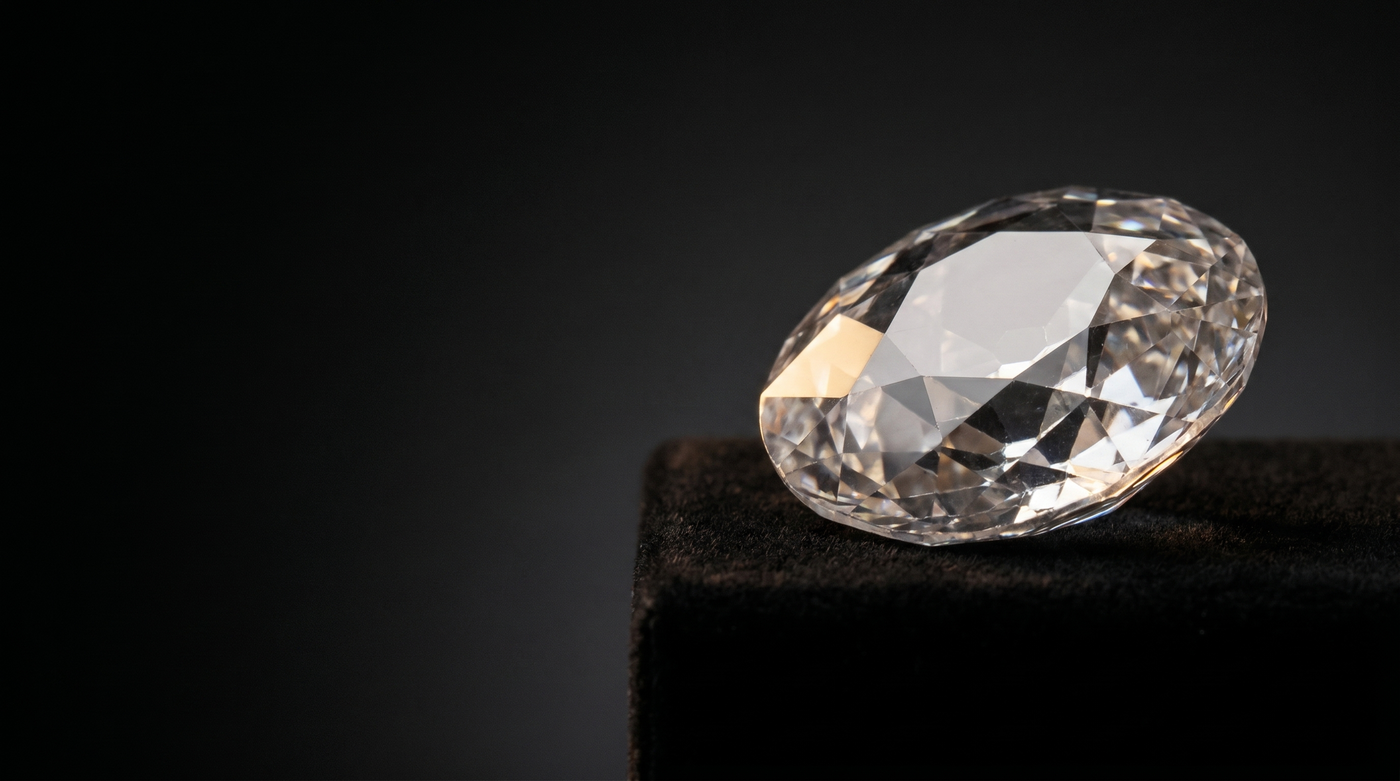
No stone has been crowned, looted, swapped, recut, and contested quite like the Koh-i-Noor. For three centuries it has traveled by conquest rather than by purchase, passing from a Mughal throne to a Persian saddlebag, from an Afghan armlet to a Sikh turban, and at last into the safest velvet in London. It is a diamond whose biography reads less like a gemological record than a chronicle of empires changing hands.
The Koh-i-Noor diamond — the name means Mountain of Light — today weighs 105.6 carats and sits in the Tower of London, set in the crown made for Queen Elizabeth The Queen Mother. It is colorless, of the rare Type IIa purity, and to look at it one would never guess how much of its story is missing. What follows is the part that can be documented, and the part that, by the honest reckoning of historians, can only be called legend.
A Mountain of Light, Said to Be Born in Golconda
The popular telling begins with an ancient sacred diamond prised from a Hindu idol, passed down through a thousand years of Indian kings. The record is far quieter. There is no account of the Koh-i-Noor's original weight, and the earliest attested figure is 186 old carats. Most Victorian writers identified it with a stone from the fabled Kollur Mine in the Golconda region of southern India, the source that also gave the world the Hope and the Regent. That attribution is plausible and often repeated — but it is attribution, not certainty.
Several romantic links to the stone belong to the same uncertain ground. A diamond seized by the Delhi sultan Alauddin Khalji around 1310, after his armies subjugated the Kakatiya dynasty; a great gem presented to the emperor Babur's son Humayun after the Battle of Panipat; the legendary Great Mogul Diamond that the French traveler Jean-Baptiste Tavernier saw in Aurangzeb's treasury in 1665. Each has, at one time or another, been called the Koh-i-Noor. The most careful modern scholarship — chiefly William Dalrymple and Anita Anand's 2017 history of the stone — treats these identifications as later embellishments rather than fact. Tavernier's Great Mogul, for instance, most experts now match to a different diamond entirely, the Orlov. As one colonial administrator admitted, the evidence for the diamond before the 1740s is "very meagre and imperfect." A house that prizes provenance is obliged to say so plainly: the Koh-i-Noor's first centuries are a beautiful story, not a verified one.
The Peacock Throne and the Conqueror Who Named It
The diamond steps into firm history with violence. Its first uncontested mention places it among the gems of the Mughal Peacock Throne, the jeweled seat commissioned by Shah Jahan, the emperor who built the Taj Mahal. In 1739 the Persian ruler Nader Shah swept into Delhi, sacked the city, and carried the throne and its stones back toward Persia. From that moment the Koh-i-Noor's whereabouts can be traced.
The naming itself is the stuff of legend. By one beloved account, Nader Shah learned that the defeated Mughal emperor had hidden the diamond in the folds of his turban, and proposed an exchange of turbans "as a token of friendship" — walking away with the prize and, on unwrapping it, exclaiming Koh-i-Noor, mountain of light. It is a marvelous scene. It is also, as historians note, unmentioned by any contemporary source and most likely a myth. The translation is sound; the turban trick is folklore.
From an Afghan Armlet to a Sikh Turban
Nader Shah was assassinated in 1747, and the diamond passed to one of his generals, Ahmad Shah, founder of the Durrani Empire of Afghanistan. It descended through his line to Shah Shuja Durrani, who was wearing the Koh-i-Noor set into a bracelet when a British envoy met him at Peshawar in 1808. Within a year Shah Shuja had lost his throne and fled, diamond and all, to Lahore and the protection of the Sikh Empire.
That protection came at the usual price. In 1813 Ranjit Singh, the one-eyed founder of the Sikh Empire, took possession of the stone from his exiled guest. One version has him simply insisting on the gem in return for his hospitality; Shah Shuja's own memoirs tell a darker story, of extortion and a son tortured within the father's sight. Ranjit Singh had the diamond examined for two days, settled a sum on Shah Shuja, and wore the Koh-i-Noor as a turban ornament and armlet on the great festival days. When he died in 1839, the stone entered a decade of palace coups, poisonings, and child kings — at one point fastened to the arm of the five-year-old Maharaja Duleep Singh, the boy who would unknowingly preside over its loss.

How the Koh-i-Noor Diamond Came to the British Crown
The end of the Sikh Empire was the beginning of the Koh-i-Noor's English chapter. After the Second Anglo-Sikh War, on 29 March 1849, the Punjab was annexed to British rule under the Last Treaty of Lahore. A single clause settled the diamond's fate, and it is worth reading in the cold language of the original: "The gem called the Koh-i-Noor … shall be surrendered by the Maharajah of Lahore to the Queen of England."
The Maharaja in question was the eleven-year-old Duleep Singh. The Governor-General, Lord Dalhousie, regarded the diamond as a spoil of war and treated it as such — a handling criticized even by some of his own countrymen at the time. The stone was sealed into an iron safe, shipped from Bombay aboard HMS Medea through a cholera scare and a gale, and presented to Queen Victoria at Buckingham Palace on 3 July 1850, a date chosen to fall on the 250th anniversary of the East India Company. The legality of that transfer, written into a treaty signed on behalf of a child, is precisely what four nations still dispute today.

The Great Exhibition and the Cut That Halved a Legend
Britain expected to be dazzled. At the 1851 Great Exhibition in Hyde Park, the Koh-i-Noor was given pride of place in the central gallery, advertised at a value of one to two million pounds and displayed first in a gilded birdcage, then behind black velvet under gas lamps to coax out its fire. The crowds came — and left unimpressed. In its Indian form the stone was a high-domed rosette of 169 facets with a flat base, just over an inch and a half long, cut by craftsmen who had been asked to preserve weight rather than throw light. To Victorian eyes accustomed to the new brilliant cuts, it looked flat, gray, and asymmetrical. Punch dryly rechristened it the "Mountain of Darkness."
Prince Albert resolved to fix the verdict of the public. With the government's consent and the advice of mineralogists, he engaged the Amsterdam firm of Coster, whose master cutter Levie Benjamin Voorzanger came to London. The work began on 17 July 1852 at the Garrard workshop, on a steam-driven mill built for the purpose, supervised by Albert and the Duke of Wellington. It took thirty-eight days and cost Albert eight thousand pounds. When it was done, the Koh-i-Noor had been reduced from 186 old carats to 105.6 — an oval brilliant of sixty-six facets, a little over an inch and a quarter long. Much of the lost weight had carried away genuine flaws, and most experts judged the cutting flawless work. Albert, who had hoped for less reduction, was not entirely pleased. When Victoria later showed the recut stone to Duleep Singh — its last non-British owner, by then a young man living in English exile — he was, by one account, unable to speak for several minutes.
Victoria's own feeling about the diamond was more complicated than triumph. In a letter to her daughter she wrote, with rare candor for a monarch, "You know also how I dislike wearing the Koh-i-Noor." Whatever unease the stone carried, it was guarded like a relic. During the Second World War the Crown Jewels were spirited to Windsor Castle, and the largest stones — the Koh-i-Noor among them — were reportedly hidden in a glass jar inside a biscuit tin, buried in a tunnel, ready to be moved at a moment's notice should the invasion come.
The Curse, and the Queens Who Wear It
There is a tradition, repeated wherever the stone is described, that the Koh-i-Noor brings ruin to any man who wears it and safety only to women. The historical record is more modest than the legend. A rumor of a curse appears to have begun in the Delhi Gazette, was picked up by The Illustrated London News, and reached the Queen herself, who voiced her unease. From that grew the counter-rumor that the danger applied only to male rulers — a tidy resolution that conveniently matched what then happened in practice.
For whatever reason — superstition, sentiment, or simple custom — the diamond has only ever adorned the women of the British royal family. After Victoria wore it as a brooch and circlet, it passed into the crown made for Queen Alexandra in 1902, then to the Crown of Queen Mary in 1911, and in 1937 into the Crown of Queen Elizabeth The Queen Mother for the coronation of George VI. When the Queen Mother died in 2002, that crown rested upon her coffin. The lethal-to-men legend is, by every careful account, a nineteenth-century invention. The custom of the queens is real.
Four Nations and One Diamond
The Koh-i-Noor is the rarest kind of object: one whose ownership is contested not by collectors but by countries. India, Pakistan, Iran, and Afghanistan have each, at various points, asked for its return — India first in 1947, on the morning of its independence, and again in 1953. Pakistan pressed its claim in 1976; Britain declined, citing the explicit transfer written into the 1849 treaty. The Taliban claimed it for Afghanistan in 2000, arguing the stone had been carried from Afghan to Indian to British hands. British prime ministers from James Callaghan to David Cameron have answered, in increasingly blunt terms, that the diamond will stay put. The Koh-i-Noor is not the only crown jewel whose custody has proven contentious closer to home — the theft of Ireland's own crown jewels from Dublin Castle in 1907 remains unsolved to this day, a reminder that even a nation's most guarded regalia is never entirely beyond loss.
The position from India has not always been one of demand. In 2016 the country's then-Solicitor General told its Supreme Court that the Koh-i-Noor "was given voluntarily by Ranjit Singh to the British … not a stolen object," and in 2018 the Archaeological Survey of India stated it was "neither stolen nor forcibly taken away." Historians have proposed compromises — dividing the claim four ways among Britain, India, Pakistan, and Afghanistan, or housing the diamond in a museum at the Wagah border between India and Pakistan — and Britain has rejected each in turn.
The most quietly telling decision came in 2023: for the coronation of King Charles III and Queen Camilla, it was decided that the Koh-i-Noor would not be used at all. Camilla was crowned with Queen Mary's Crown, the famous diamond conspicuously absent — a stone now so heavy with history that a monarchy chose to leave it in its case. There is a poignancy, too, in the figure of Duleep Singh, the boy maharaja who surrendered it. Raised in England under guardianship and a favorite at Victoria's court, he came in later years to regret the loss and to speak of the diamond as something taken rather than given — the first, in a sense, of all those who have asked for it back.
What a Contested Diamond Teaches a Collector
The Koh-i-Noor is not for sale, and never will be. Yet its story carries a lesson that runs through everything we offer at VERANE. A gem's worth is not only its weight or its water; it is the chain of hands it has passed through, and the honesty with which that chain is told. The Koh-i-Noor's greatest mystery is not its supposed curse but the simple fact that so much of its early history dissolves into legend — a reminder that provenance is the most precious and the most fragile thing a jewel can carry.
It is the principle that guides our own estate diamond rings and estate diamond necklaces: every piece documented to the limit of what can honestly be known, its era and origin stated plainly, its romance never allowed to outrun its record. If you are drawn to diamonds and gems with a history behind the brilliance, you may enjoy our accounts of the Hope Diamond, another Golconda stone wrapped in legend, of the Cullinan Diamond — the largest gem-quality stone ever found and the other great jewel of the British Crown Jewels collection — of the Patiala Necklace, Cartier's vanished commission for an Indian maharaja, and of the Star of India sapphire, another storied gem whose theft and recovery reads like its own chapter of contested ownership. Our latest acquisitions are added as they are authenticated, and we would be glad to show any of them to you privately.
One piece, one history, one owner at a time. To view a diamond from our collection in person, we invite you to request a private viewing.