The Star of India Sapphire: The 563-Carat Gem Stolen in the Heist That Stunned New York
The Star of India sapphire — a 563.35-carat cabochon from ancient Ceylon, donated to the American Museum of Natural History by J.P. Morgan in 1900, and stolen by Jack 'Murph the Surf' Murphy in 1964 — is among the most storied gems in the world.
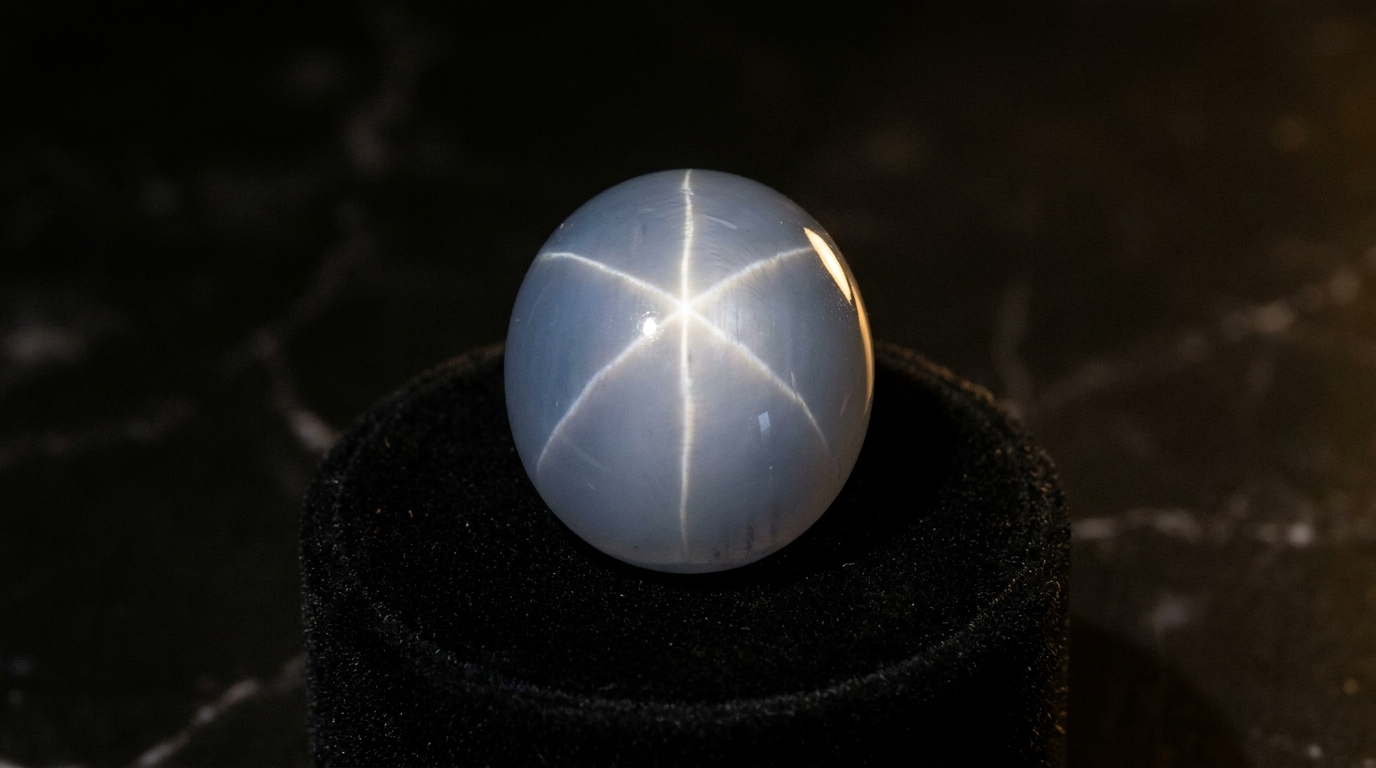
On the evening of October 29, 1964, three young men climbed through a bathroom window they had left unlatched earlier that day and found themselves alone in the J.P. Morgan Hall of Gems at the American Museum of Natural History. What followed was thirty minutes of unhurried work in the dark — a glasscutter, a squeegee to sweep the stones across the cases, a bag — and then they were gone. Among what they carried out was the Star of India sapphire, a grayish-blue cabochon the size of a golf ball, weighing 563.35 carats, and regarded as one of the finest star sapphires in the world. It had rested undisturbed in that hall for sixty-four years.
The Star of India sapphire is now back on display at the museum, where it has remained since its recovery in January 1965. The heist it survived — audacious, almost incomprehensibly casual in its execution — became one of the most discussed jewel thefts of the twentieth century. But the story of the stone itself runs considerably deeper than a single night in 1964. It begins in the ancient gem fields of Ceylon, passes through the hands of one of the most powerful financiers in American history, and ends, quietly, behind glass on the Upper West Side of Manhattan.
From the Ancient Fields of Ceylon: The Geology of Asterism
The Star of India was mined in Sri Lanka — the island known for centuries to the gem trade as Ceylon — where the world's finest star sapphires have been drawn from alluvial gravels and ancient river beds since antiquity. Sri Lanka's unique geology, shaped by Precambrian metamorphic rock and millions of years of tectonic pressure, produces corundum of exceptional purity and size. The Star of India formed, geologists believe, roughly a billion years ago.
What makes a star sapphire is not the color alone but the phenomenon known as asterism — the optical effect that produces a luminous six-rayed star on the surface of a polished cabochon. This effect is created by microscopic needles of rutile, a titanium dioxide mineral, that grow within the corundum crystal in three intersecting directions aligned to the crystal's internal structure. When light strikes the polished dome of the stone, each set of rutile fibers reflects it in a different direction, and the three bright lines cross at the center, producing a six-armed star that appears to float just beneath the surface and shift as the stone moves.
The Star of India is unusual even among fine star sapphires in that it displays a clear asterism on both faces — the top and the bottom of the stone — a rarity that speaks to the exceptional density and alignment of its rutile inclusions. Its color, a muted grayish-blue, is characteristic of the milky quality produced by those same inclusions. The stone is cut en cabochon, as all star sapphires must be: only the smooth, domed surface can gather the light in the way that reveals the star. A faceted stone would scatter it.

Prior to its acquisition for the Paris Exposition of 1900, the stone's history is largely undocumented. George Frederick Kunz — the Tiffany gemologist who assembled J.P. Morgan's collection — wrote in 1913 that the Star of India "has a more or less indefinite historic record of some three centuries," suggesting it had been known in the gem trade for generations. Whether that record reflects genuine provenance or the kind of polished legend that accumulates around famous stones is impossible now to verify. What is certain is that when Kunz found it, the stone was already exceptional.
J.P. Morgan and the Paris Exposition of 1900
In the closing years of the nineteenth century, J.P. Morgan — financier, collector, and arguably the most powerful private figure in American economic life — commissioned George Frederick Kunz to assemble a gem and mineral collection worthy of display at the Paris Exposition Universelle of 1900. Morgan's ambitions for the collection were characteristic: it was to be comprehensive, authoritative, and unmistakably American in its scale. Kunz, who served simultaneously as a senior gemologist at Tiffany & Co. and as one of the foremost mineralogists of his generation, traveled widely and spent freely.
The Star of India was among the centerpiece acquisitions. At 563.35 carats, it was then — and remains, among stones of documented origin — among the largest star sapphires in the world. After the Paris Exposition, Morgan donated the entire collection to the American Museum of Natural History, where it formed the nucleus of what became one of the finest gem collections in public hands. A British Army officer had brought the stone to London at some point, where it was cut by Albert Ramsay around 1905 to reveal the full asterism — the polished dome that had been latent in the rough.

The collection remained in the Morgan Memorial Hall of Gems for decades, largely undisturbed, visited by schoolchildren and gem enthusiasts in roughly equal numbers. The Star of India sat in an open case, its alarm battery long dead, while the city grew up around the museum on Central Park West.
The 1964 Heist: Murph the Surf and a Window Left Unlatched
Jack Roland Murphy was, by the autumn of 1964, a man of several careers. He had been a violinist of some talent, a champion surfer on the East Coast, a tennis player good enough for the college circuit, and — according to later accounts — among the first people to open a surf shop in Florida. He was also, by that point, a jewel thief. The heist he and his associates Allan Kuhn and Roger Clark executed on October 29, 1964, was not a sophisticated operation. It was, in retrospect, almost embarrassingly simple.
Murphy and Kuhn visited the museum during open hours, found the bathroom window in question, and left it unlatched. That night, they returned. The case containing the Star of India sapphire was the only one in the hall protected by an alarm — and the battery for that alarm was dead. They broke the cases with a glasscutter and tape, used a squeegee to gather the loose gems, and left with twenty-four stones including the Star of India, the Midnight Star (a 116-carat black sapphire), and the DeLong Star Ruby. The total value of what they took was estimated at more than $400,000.
They were arrested within two days — not because of any particular police work, but because Murphy and Kuhn had been rather publicly celebrating in Miami, and word had reached investigators. By then, the gems had already been passed along. The three men were charged and bail was eventually set at $100,000. It was only in January 1965, as Kuhn negotiated for a lesser sentence, that he led investigators to a bus locker in Miami where the Star of India and some of the other stones were recovered, wet and intact, from a leather pouch. Murphy and his accomplices were ultimately sentenced to three-year terms at Rikers Island.
For the collector and student of notable gems, the episode illuminates something about the nature of famous stones: their value, ultimately, is inseparable from their provenance and their public identity. The Star of India was uninsured. Its recovery depended not on financial leverage but on its own irreplaceability — on the fact that so singular an object could not simply be sold, melted down, or otherwise absorbed into the anonymous gem trade. It was too famous to fence.
What Remains: Asterism, Estate Sapphire Jewelry, and the Living Tradition
The Star of India sapphire returned to the American Museum of Natural History and has remained there since. It is displayed today in the Mignone Halls of Gems and Minerals — the same collection that J.P. Morgan's commission began, housed now in a facility worthy of its contents. The stone itself is unchanged: that same grayish-blue dome, that same six-armed star moving across its surface as the light shifts, exactly as it has for some three centuries of documented history and a billion years before that.
The tradition of estate sapphire rings and sapphire jewelry draws directly from the same geological and cultural history that produced the Star of India. Ceylon sapphires — today marketed under the country's modern name, Sri Lanka — have been the standard against which fine sapphires have been measured for as long as the gem trade has existed. Their combination of depth, clarity, and the specific quality of their blue has made them the preferred stone of royalty, collectors, and the finest jewelry houses for centuries. If the Star of India is the supreme expression of that tradition, its most celebrated modern chapter is arguably Princess Diana's engagement ring — a 12-carat Ceylon sapphire chosen from Garrard's catalog in 1981, now worn by Catherine, Princess of Wales. The estate sapphires that appear in the finest period jewelry represent the same tradition: the same geological source, the same ancestral craft, now available to a private collector.
The phenomenon of asterism itself — that floating star — appears across the range of star sapphires and star rubies that the gem trade produces, from modest cabochons to exceptional collector's pieces. Understanding it is part of understanding the broader world of colored gemstones: the way inclusions that a faceted stone would discard become, in the hands of a skilled cutter, the very source of the stone's character. For those interested in the broader tradition of Kashmir and Ceylon fine sapphires, our account of the Kashmir sapphire traces another branch of the same story — a different geography, an equally extraordinary result.
The Star of India's biography has something in common with other storied gems we have written about here. The Hope Diamond, like the Star of India, passed through private hands into public collection; both carry legends that are difficult to fully verify but impossible to ignore. The Cullinan Diamond, for its part, shares with the Star of India the quality of having been secured by an institution rather than a private collector — a reminder that the most important gems of any era tend, eventually, to become communal inheritance rather than personal property.
What sets estate jewelry apart from these institutional stones is precisely that it remains accessible. The sapphires and diamonds available in vintage cocktail rings and estate pieces from the Edwardian, Art Deco, and mid-century periods were set by hands working in the same tradition that cut and polished the Star of India — the same understanding of light, the same respect for the stone's natural character, the same refusal to let a gemstone be merely decorative when it could be genuinely extraordinary.
An Invitation
The Star of India sapphire will not leave the American Museum of Natural History. It is, in the most literal sense, beyond acquisition — a public treasure held in perpetuity. But the tradition it represents, and the period in which the finest sapphire jewelry was made, produced thousands of pieces that are very much available: estate rings, pendants, and suites in which Ceylon sapphires of genuine quality were set by craftsmen who understood exactly what they were working with.
If reading the history of the Star of India sapphire has prompted a thought about the sapphire pieces you may be looking for — whether an estate sapphire ring from the Edwardian or Art Deco period, or a piece whose provenance and stone quality you want to understand before you commit — we would welcome the conversation. Browse our current selections, or request a private viewing and we will arrange a consultation at your convenience.
The Star of India is the standard. The estate pieces we offer are the tradition it belongs to.