Princess Diana's Engagement Ring: The Ceylon Sapphire That Changed Royal Jewelry Forever
A 12-carat Ceylon sapphire, chosen from a jeweler’s catalog by a twenty-year-old woman who knew exactly which blue she wanted — and the four decades of royal history that followed.
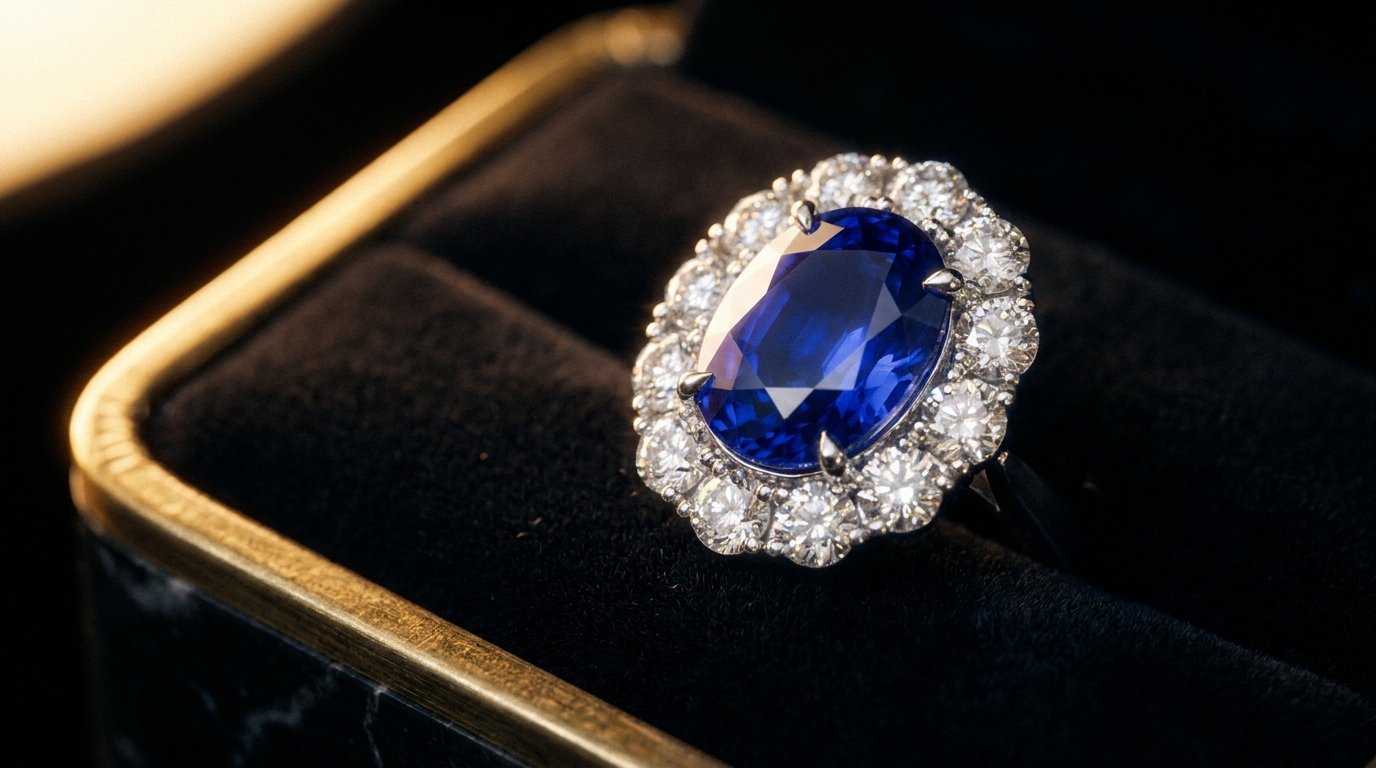
A 12-carat oval sapphire, the color of a clear autumn sky over Sri Lanka, set in a halo of fourteen round white diamonds and mounted in eighteen-karat white gold. On the morning of February 24, 1981, Lady Diana Spencer slipped that ring onto her finger and became, in a single gesture, the most watched woman on earth. More than four decades later, the ring sits on the hand of Catherine, Princess of Wales — and the two princesses who wore it have made it the most recognized piece of jewelry in the world.
Yet for all its fame, the story of how that ring was chosen, what it meant to the house that made it, why the royal family initially objected, and how it passed from mother to son to daughter-in-law is a quieter and stranger story than the mythology allows. It is, at its heart, a story about one young woman's instinct, one ancient trade, and the way a single object accumulates the weight of everything we ask it to carry.
The Jeweler at the Heart of the Matter
To understand the ring, you must first understand Garrard. Founded in London in 1735 by the goldsmith George Wickes, the house had served the British Crown for nearly 250 years by the time Charles and Diana walked through its doors. Queen Victoria appointed Garrard the first official Crown Jewellers in 1843, a position the house held for 164 years, until 2007. In that role, Garrard had cut and set stones for coronation regalia, reset inherited gems into new mounts for changing queens, and maintained the Crown Jewels in the Tower of London through more reigns than any other private firm.
The sapphire cluster ring that would become Diana's was already in Garrard's catalog — a ready-made piece available to any buyer of sufficient means. This, as we shall see, was the detail that would briefly scandalize the palace.
The cluster setting itself had a precedent that ran deeper than a commercial catalog. On the evening of February 9, 1840 — the night before her wedding to Prince Albert — Queen Victoria received a brooch from her future husband: a large oblong sapphire surrounded by diamonds, set in gold. She wore it the following morning, and the design passed into the language of royal jewelry as a template of fidelity and devotion. When Garrard's goldsmiths created their sapphire cluster ring more than a century later, the design they reached for carried that inherited resonance, whether consciously or not.

A Catalog, a Selection, and a Controversy
The proposal came in February 1981 at Windsor Castle. Prince Charles presented Lady Diana Spencer with a selection of rings from Garrard's collection. She was, by all accounts, invited to choose.
She chose the sapphire cluster. At the time, the ring was priced at £28,000 — with Garrard's retail catalog listing it at £47,000. It featured a 12-carat oval Ceylon sapphire: a stone of deep, saturated blue, quarried in the island then called Ceylon (now Sri Lanka) and long prized above sapphires from virtually every other deposit on earth for the particular richness of its color and the clarity of its light.
Surrounding that central stone were fourteen round brilliant-cut white diamonds, mounted in eighteen-karat white gold, with a claw setting that held each element in crisp relief. The composition was, in terms of the craft, a classic cluster — a form with roots deep in the Georgian and Victorian eras of jewelry design, where a central colored stone surrounded by a ring of diamonds served both to amplify the color of the sapphire and to frame it as an object worthy of sustained attention.
The royal family's discomfort with Diana's selection was, by several accounts, immediate and pointed. A stock piece from a commercial catalog was, in the estimation of the court, a "commoner's ring" — something anyone with sufficient funds could purchase, lacking the exclusivity that royal engagement rings had traditionally carried. Most of Diana's predecessors had received bespoke commissions, one-of-a-kind pieces created specifically for a royal bride. The Garrard ring could, in theory, be ordered by a merchant's daughter or an American heiress. That was held against it.
Diana kept it anyway. There is something characteristic in that — in her willingness to choose on instinct, to prefer a stone that spoke to her over a commission that would speak to protocol. The sapphire, she noted, matched the blue of her eyes.
The Stone from the Island That Gave Itself Once
Ceylon sapphires occupy a peculiar position in the hierarchy of fine gemstones. The island's deposits, concentrated in the Ratnapura district in the southwest, have produced sapphires continuously for more than two thousand years. They are not, as a category, the rarest sapphires — that distinction belongs to Kashmir, whose deposits yielded stones for only a handful of years in the 1880s before exhausting themselves, and whose gems we explored in our account of the Kashmir sapphire. But Ceylon sapphires have a quality that distinguishes them even from Kashmir in certain lights: a transparency, an inner luminosity, a blue that carries a faint violet register and shifts in warmth as the light changes through the day.
The trade term for the finest Ceylon sapphires is "cornflower blue", though gem dealers are quick to note that the best stones exceed the cornflower in depth and saturation. Diana's stone was by all accounts a fine example of its type: 12 carats, well-saturated, with a quality of color that photographs distinctly even in the slightly muted palettes of early-1980s documentary photography.
What most accounts of the ring omit is this: the stone's origin was itself a form of provenance. Ceylon sapphires had appeared in the crown jewels of multiple European courts. They had been set by Fabergé, by Cartier, by Chaumet. When Diana chose a Ceylon sapphire, she aligned herself — probably without knowing it, or caring if she did — with a centuries-long tradition of European royalty reaching toward the same island for the color they trusted most.
For collectors of estate sapphire rings, the Ceylon origin has always carried a premium. Stones whose certificates identify a Ceylon provenance — particularly pre-heated examples, unmodified by the heat treatments that have become standard since the 1980s — command prices that reflect both their geological rarity and the accumulated desire of buyers who have followed the same instinct as Diana: a preference for the blue that the trade has prized longest.
The Engagement Announcement and Its Aftermath
The public announcement of Charles and Diana's engagement came on February 24, 1981. The couple gave a televised interview, Diana wearing a cobalt blue suit that picked up the color of the ring with deliberate effect. Within weeks, the ring had been photographed from every angle by every major publication in the world. Within months, sapphire cluster rings of varying quality and price had appeared in jewelers' windows from London to Sydney.
The effect on the sapphire market was immediate and lasting. Ceylon sapphires, which had already commanded a premium among serious collectors, became suddenly desirable at every price point. The cluster setting — already a historic form, already respected — became the look that an entire generation of engaged women aspired to. Garrard, which had watched its most commercially significant piece become the most famous engagement ring in the world, saw a similar cluster design enter its own continuing collections.
The ring appeared on Diana's hand at every official engagement, every royal tour, every state event for the fifteen years of her marriage and the two years that followed. It was photographed in India, in Canada, in Australia, in Angola. It became so much a part of the visual record of her life that its physical presence — the particular blue of that sapphire, the geometry of those diamonds — became inseparable from her image.
The Ring After Diana
When Diana died in Paris on August 31, 1997, her personal jewelry passed to her sons. William and Harry each received portions of their mother's estate, and the sapphire ring — her most famous possession — went to Harry. He kept it for thirteen years.
In October 2010, William proposed to Catherine Middleton in Kenya, carrying the ring in his rucksack for three weeks before finding the right moment. He had chosen Kenya deliberately: it was the country to which his father had brought him and Harry shortly after their mother's death, a place associated with the most acute grief of his adolescence and, perhaps for that reason, with the feeling of what endures.
"It's my mother's engagement ring," William said at the engagement announcement, "so I thought it was quite nice because obviously she's not going to be around to share any of the fun and excitement of it all — this was my way of keeping her sort of close to it all."

The ring's reappearance in 2010 generated a second wave of sapphire-cluster enthusiasm that in many respects exceeded the first. Catherine Middleton was not a royal by birth, and the fact that she would wear Diana's ring — that the object would pass directly from one era's defining woman to another's — struck a chord across multiple countries. It was a gesture of continuity, of the transfer of affection through objects in the way that families have always passed meaningful things from hand to hand.
Jewelry dealers and gemologists who have examined photographs of the ring with sufficient precision note that it shows the natural wear of a piece worn regularly for decades: minor surface marks on the white gold shank, the kind of patina that accumulates on a ring worn on a living hand rather than locked in a vault. This is, in the language of vintage and estate jewelry, the best kind of provenance: not a paper trail, but a life visibly lived.
What the Ring Means to the Collector
The Princess Diana engagement ring occupies a peculiar position in the broader world of jewelry collecting — it is famous without being accessible, iconic without being reproducible in any meaningful sense. The actual ring has never been for sale. But the piece has shaped collector taste in ways that persist forty years after the engagement announcement.
The sapphire cluster form — a colored stone of significant carat weight surrounded by a halo of white diamonds — has become one of the defining configurations of the estate rings market. Buyers who grew up seeing that ring understand, at a level that precedes conscious analysis, what the form communicates: a colored stone taken seriously, diamonds deployed not as the main event but as a frame that intensifies what they surround. The setting places the sapphire at the center of attention and holds it there.
For a collector approaching the estate jewelry market for the first time, the cluster is an excellent introduction to the broader principles of period jewelry. Unlike solitaire settings, which concentrate attention on a single characteristic, the cluster requires an understanding of how components work together — the color of the center stone in relation to the color temperature of the accent diamonds, the proportions of the halo in relation to the face of the ring, the metal of the setting in relation to the skin tone of the wearer.
Ceylon sapphires in estate cluster settings — particularly examples from the 1950s through the 1980s, when heating treatments were less universal — now command significant premiums at auction and among private dealers. A fine unheated Ceylon sapphire of significant weight, in an original period setting, is the kind of piece that appears in major salesrooms only occasionally. It is worth reading about the 563-carat Star of India sapphire — itself a Ceylon stone — to understand just how far the desire for these gems has sometimes gone.
The Stone's Longer History
The sapphire in Diana's ring was not the first great Ceylon stone to reach a European royal house. The history of Ceylon sapphires and European courts is a long one, running through the gem trades of Venice and Antwerp and Amsterdam, through the coffers of the Spanish and Portuguese crowns, through the collections of the Medici and the Habsburgs and the Romanovs.
What the Diana ring did was collapse that long history into a single contemporary image. The sapphire, which had always been a stone associated with royalty, fidelity, and the particular hue of heaven in the Christian tradition, acquired a new and more personal set of associations. It became associated with one woman's instinct, one marriage's public beginning, one family's grief and continuity.
Sapphires accumulate stories the way diamonds accumulate light. The velvety blue of a Kashmir mine worked for only a few years in the 1880s, the Star of India, the great Ceylon stones of the Persian and Mughal courts — each carries a thread of that same desire: for a blue that is both rare and alive, both ancient and immediate. Diana's ring is the newest chapter in the long history of the engagement ring — a story far older than sapphires, older even than gold.
The Ring Today
Jewelry experts who have estimated the current value of Diana's engagement ring place it somewhere between £300,000 and £517,000 — a figure that reflects both the appreciated market value of a fine Ceylon sapphire and the incalculable premium that attaches to an object of such cultural resonance. One estimate holds that the ring has appreciated by more than 1,150 percent since the original 1981 purchase price — though such calculations are necessarily approximate: there is only one ring, and it has never been offered for sale.
Catherine, Princess of Wales, wears it as Diana wore it — on the fourth finger of the left hand, in the position the Romans called the vena amoris, the vein of love. The belief was a myth even in ancient Rome. But the placing of a ring on that finger has its own logic, independent of anatomy: it is the finger most naturally extended to display, most easily seen in a handshake, most present in the photographs that constitute the public record of a life.
If the story of Diana's ring has taught the jewelry world anything enduring, it is this: the most powerful piece is not always the most unique. Sometimes it is the piece selected from a catalog on an afternoon in 1981, by a twenty-year-old woman who knew exactly which blue she wanted, and held to her choice against all objections. The ring's authority comes not from Garrard's workmanship or the sapphire's origin, though both are worthy of respect. It comes from the hand that chose it, and the hands that have worn it since.
Explore the Estate Ring Tradition at VERANE
The cluster setting Diana popularized has its roots in centuries of European goldsmithing. At VERANE, we curate estate sapphire rings spanning the Georgian through the mid-century modern eras — pieces that carry the same design values Diana responded to in that Garrard catalog: a colored stone taken seriously, a setting built to serve it, and the particular beauty that accumulates only in jewelry made by hand and worn with intention.
Our collection also encompasses estate diamond rings from houses and ateliers across Europe and America. For a fascinating counterpoint in the tradition of iconic royal engagement rings, our account of Grace Kelly's Cartier engagement ring — a 10.47-carat emerald-cut diamond chosen by Prince Rainier in 1956 — traces how a different stone and a different house defined Hollywood royalty for a different generation. Each piece carries its own provenance; each arrives at our collection from a different corner of the estate market.
We are glad to discuss any piece in detail, provide additional photography, or arrange a private showing. Request a private viewing and let us introduce you to the pieces that deserve your sustained attention.