The History of the Engagement Ring: From Ancient Rome to the Diamond Solitaire
From an iron circlet exchanged in ancient Rome to the 1477 diamond ring Archduke Maximilian gave Mary of Burgundy, and through to De Beers' transformation of the solitaire into a modern promise — the history of the engagement ring is a biography of love, power, and the enduring human need to mark a commitment in gold.
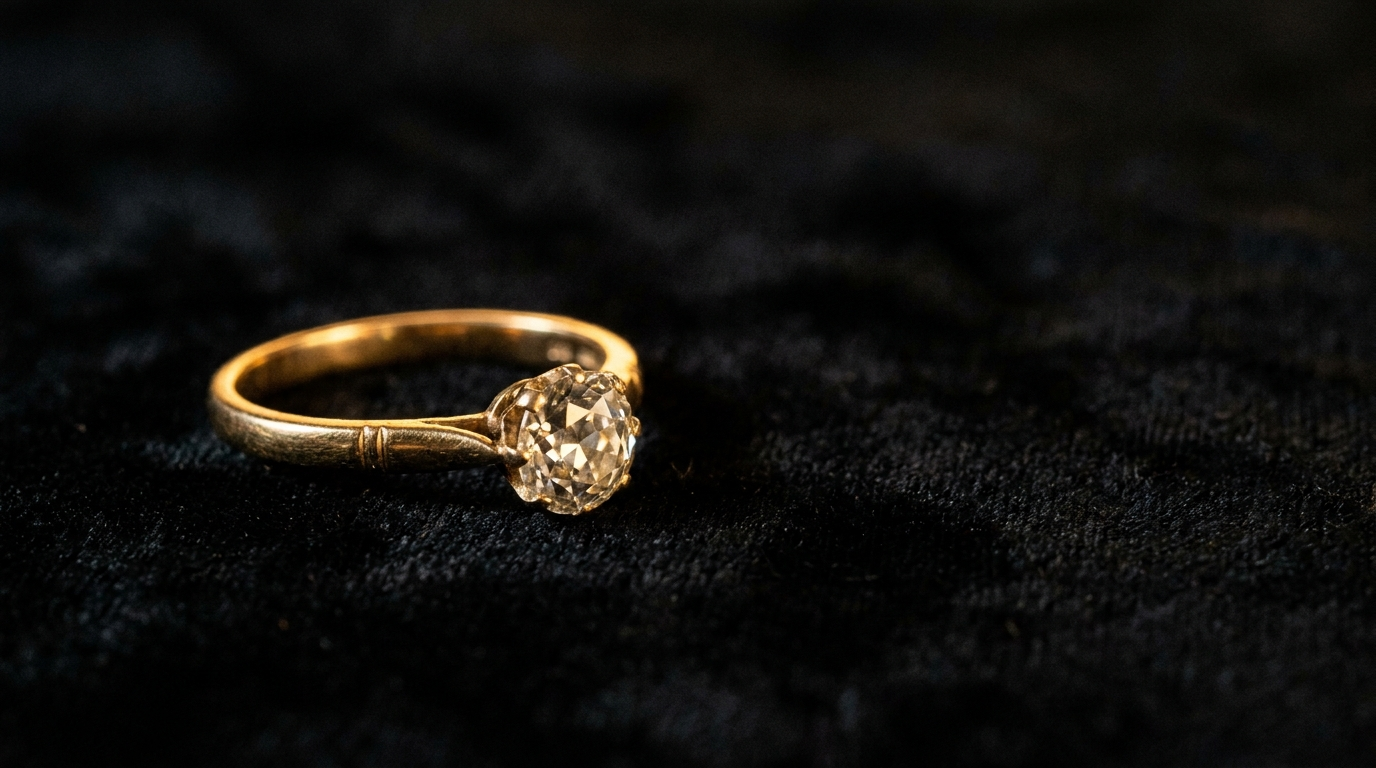
There is a moment, in any museum of decorative arts, when you find yourself before a small vitrine of rings and everything else falls away. A gold band set with a fragment of red garnet. A pair of interlocked hoops that separate and reunite. An iron circlet, plain as a nail, that once meant everything to the woman who wore it. The story of the engagement ring begins there — not with diamonds, but with intention.
Ancient Beginnings: Iron, Gold, and the Sponsalia
The Romans did not invent romantic love, but they did invent a great deal of the vocabulary around it. Among the customs they codified was the sponsalia — a betrothal ceremony at which a groom presented his future bride with a ring. The earliest of these were made of iron, a material chosen not for beauty but for meaning: iron signified permanence, strength, and the unbreakable nature of the contract being made. Roman women typically received two rings: an iron band for domestic wear, a gold one for public life. The gold ring, known as the annulus pronubus, carried status as much as sentiment.
From the beginning, the ring was placed on the fourth finger of the left hand. The 5th-century writer Macrobius recorded this practice, and the explanation that circulated — which would persist for centuries — was that a vein ran directly from that finger to the heart. The Romans called it the vena amoris: the vein of love.

The Vena Amoris: Myth, Meaning, and the Left Hand
The vena amoris is, we now know, anatomically false. Every finger connects to the heart through the same circulatory system; no vein singles out the fourth. William Harvey's 17th-century discoveries about blood circulation quietly put paid to the physiology, and modern anatomy has left no room for a love vein. Yet the custom it supposedly explained has outlasted every scientific correction. The engagement ring still rests on the fourth finger of the left hand in most of the Western world — not because the anatomy holds up, but because a tradition of sufficient beauty tends to outrun its origins.
It is worth noting, too, that the left-hand convention is not universal. In Russia, Germany, India, Greece, and several other cultures, the engagement or wedding ring is worn on the right hand, where it also carries centuries of unbroken meaning. The finger is secondary. The ring is the thing.
The Medieval Inheritance: Posy Rings and the Gimmel Band
Through the medieval period, the betrothal ring evolved from a legal token into something closer to a love letter you could wear. Posy rings — from poésie, the French for poem — were inscribed on the interior of the band with short verses or mottoes known only to the wearer: À ma vie (To my life); Mon coeur avez (You have my heart). Popular from the 15th through the 17th centuries, they belonged to a culture in which written declaration was rare and a hidden inscription carried enormous weight. The message was private by design: a secret between the ring and the finger that wore it.
The gimmel ring — from the Latin gemellus, meaning twin — took a different approach to the same idea. Two or three interlocking hoops, hinged on a shared axis, could be separated at the betrothal and reunited at the wedding. Each partner wore one hoop through the engagement period; at the ceremony, the bands were joined back into a single ring. The reunion of the hoops was the marriage, enacted in miniature. Some gimmel rings incorporated a clasped-hands motif on the bezel — the old fede tradition, from fede, the Italian for faith — which had its own lineage stretching back through the Renaissance to ancient Rome.

1477: The Diamond Enters the Story
The specific moment at which the diamond engagement ring enters the historical record is unusually well-documented. In 1477, Archduke Maximilian of Austria — the future Holy Roman Emperor — was negotiating an alliance of considerable political consequence with the Duchy of Burgundy. His instrument of proposal was a gold ring set with diamonds arranged in the shape of an M, sent to Mary of Burgundy along with a written marriage proposal. The diamonds spelled her name. The meaning was unmistakable.
Mary of Burgundy, known as Mary the Rich, reigned over the duchy from her father Charles the Bold's death in 1477 until her own in 1482. She was twenty years old when she received the ring. The union she accepted joined the Habsburg and Burgundian houses, reshaping European politics for generations. The ring itself now belongs to the Kunsthistorisches Museum in Vienna — a small object that has carried an enormous amount of history for more than five centuries.

Maximilian's gesture established a precedent, but it did not immediately democratize the diamond engagement ring. For the next four centuries, diamonds remained the province of royalty and the very highest nobility. The stones were exceptionally rare — the great Indian mines at Golconda supplied Europe with tightly controlled quantities — and the craft required to cut and set them was equally scarce. A betrothal ring among the gentry or the merchant class was more likely to feature a ruby, an emerald, or a sapphire than a diamond. The sapphire in particular carried associations with fidelity and the heavens; the emerald was said to change color in the presence of infidelity. Each stone told a story.
It is worth remembering that rings like the celebrated sapphire and diamond ring given to Lady Diana Spencer in 1981 — and now worn by the Princess of Wales — belong to a tradition far older than the modern diamond solitaire. The colored-stone betrothal ring is not a departure from tradition; it is, in many respects, the deeper tradition. Readers curious how these individual royal and celebrity stones compare across a fuller survey of famous hands may enjoy our roundup of celebrity engagement rings through history, from Grace Kelly's Cartier emerald cut to Elizabeth Taylor's diamonds.
The 19th Century: Sentiment, the Acrostic, and the Rise of the Solitaire
Acrostic rings, in which the first letters of each stone spelled a word — a ruby, an emerald, a garnet, a ruby, a diamond, and a sapphire arranged to spell regards — were enormously fashionable. These rings required the wearer to know the key; they were legible only to those who had been told. The language of flowers extended naturally into the language of gems, and the engagement ring became another form of coded correspondence.
It was also the century in which the diamond solitaire began its long ascent. The discovery of diamond fields in South Africa in the 1860s transformed the supply of stones that had, for centuries, been genuinely scarce. By the 1880s, diamonds had become sufficiently available — if not yet abundant — that a New York jeweler could build an entire business proposition around them.
In 1886, Charles Lewis Tiffany introduced what would become known as the Tiffany Setting: a round brilliant diamond raised above the band on six slim prongs, each one precisely calculated to allow light to enter the stone from all angles. Before this setting, diamonds were typically set in closed collets or rose-cut with flat backs that absorbed much of the stone's light. The Tiffany prong elevated the diamond, gave it air, and made its fire visible in a way that closed settings never had. It was a design decision as much as it was an engineering one — and it redefined what an estate diamond ring could look like. The solitaire solitaire, as a type, was born.
De Beers and the Invention of the Modern Promise
The story of how the diamond engagement ring became a near-universal expectation in the 20th century is, in part, a story about advertising. In 1947, a copywriter named Frances Gerety, working for the Philadelphia agency N.W. Ayer on behalf of De Beers, wrote four words that would reshape an industry: A Diamond Is Forever. The phrase was designed to address a practical problem — De Beers controlled the vast majority of the world's rough diamond supply, and it needed to ensure that the diamonds people already owned were never resold in quantity. An eternal diamond, the campaign suggested, was not an asset to be liquidated. It was a promise that outlasted its wearer.
The campaign worked with a thoroughness that its creators could not have anticipated. By the 1960s, diamond engagement rings had become the default in the United States, the United Kingdom, and, eventually, Japan — a market De Beers cultivated with a separate and equally successful campaign beginning in the 1960s. The two-months'-salary guideline, which many people believe to be an ancient custom, was introduced by De Beers in the 1980s. It was not ancient. It was a suggestion, and it stuck.
None of this diminishes the ring itself. A well-chosen diamond — old mine cut, European cut, the early brilliant cuts that predate uniformity — carries in its facets the record of the cutter who worked it, often by hand and candlelight. These are the stones that appear in vintage and estate rings from the Georgian and Victorian periods, and in the estate diamond rings that collectors seek out today precisely because they are unlike anything produced after 1950. The irregularity is not a flaw. It is the evidence of a hand.
What Endures
The history of the engagement ring is not, finally, a history of diamonds. It is a history of the human need to make a private commitment visible — to give a feeling a form that can be held, worn, and passed down. The iron circlet of the Roman sponsalia, the posy ring with its hidden verse, the gimmel band reunited at the altar, the Habsburg diamond sent with a marriage proposal across a dynasty: each was an answer to the same question. How do you prove that a promise is permanent?
The answer has always been the same. You make it in metal. You set it with something that lasts longer than either of you. And you place it on the finger closest, by legend if not by anatomy, to the heart.
At VERANE, we carry vintage and estate jewelry from across this long history — rings that were once someone's answer to that question, and that are still waiting to become someone else's. If you are looking for an estate engagement ring that carries more than the moment it was purchased, we would be glad to show you what we have found.
Browse our estate diamond rings and estate rings collection, or request a private viewing to discuss a specific period, stone, or style with our curatorial team.