Celebrity Engagement Rings Through History: What the Stones Said About Their Eras
From Grace Kelly's Cartier emerald-cut to Meghan Markle's Botswana diamond, a history of the celebrity engagement rings that shaped a century of taste — and what they still teach today's vintage-ring collectors.
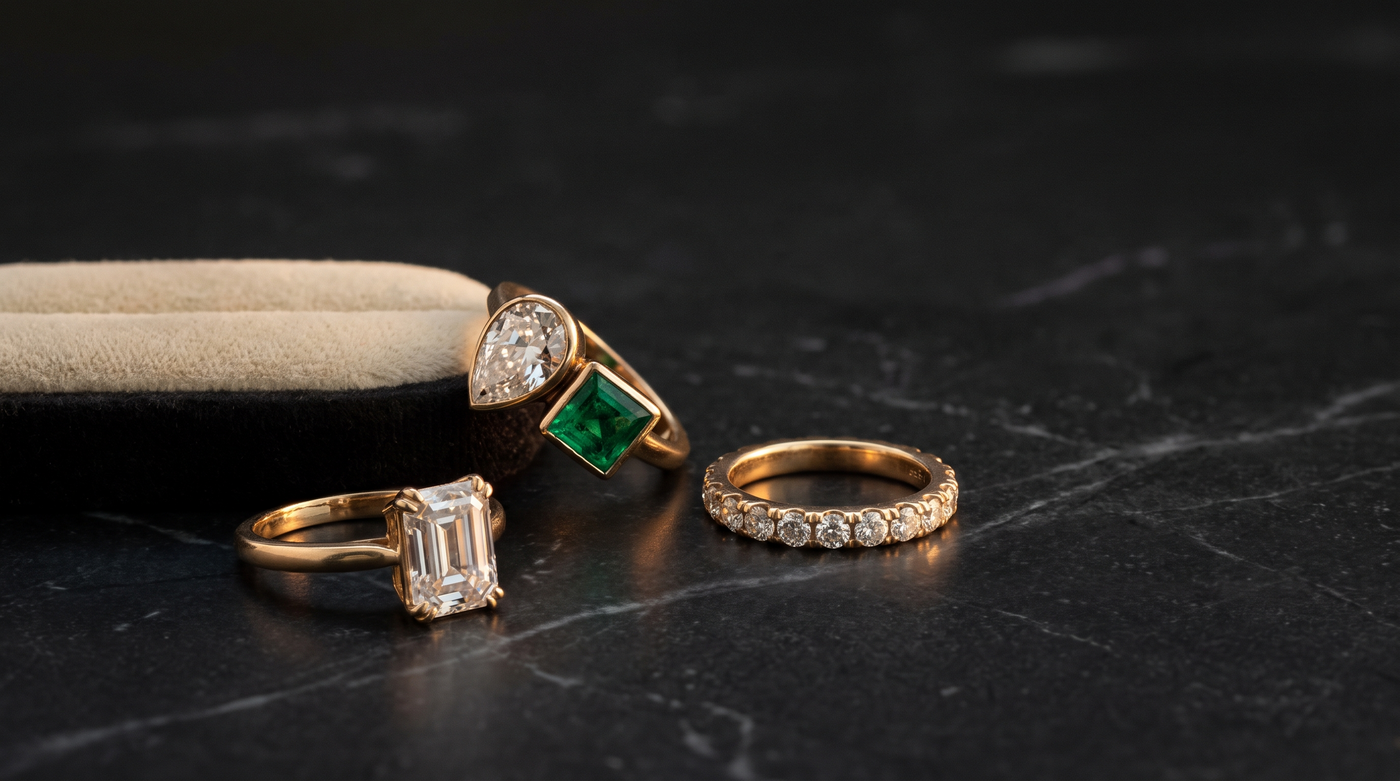
Long before a ring appears on social media, it appears in a photograph — on a hand held up for the cameras, on a starlet's finger in a magazine spread, on a princess descending a staircase. For a century, the engagement rings of famous women have done something quieter than dazzle: they have taught the rest of us what an engagement ring is supposed to look like. An emerald-cut diamond becomes the "Grace Kelly cut." A sapphire surrounded by diamonds becomes "the Diana style." The habit is old, and it is durable, because a famous ring carries two kinds of evidence at once — the taste of the era that chose it, and the love story that is supposed to have earned it.
What follows is not a ranking. It is a walk through six engagements, told in the order they happened, each one a small window onto what its decade believed a proposal should look like — and, for the collector browsing an estate case today, a reminder that the rings we still admire were almost always vintage before they were famous.
The Ring That Made an Actress a Princess
By most accounts, Prince Rainier III of Monaco proposed to Grace Kelly at her family's home in Philadelphia over the 1955 Christmas holiday with a ruby-and-diamond eternity band — a quieter, more private gesture before the public engagement was announced on January 5, 1956. The ring the world actually remembers followed soon after: a platinum Cartier setting built around a 10.47-carat emerald-cut diamond, flanked by two trapezoid baguette diamonds. Kelly wore it, with characteristic understatement, in her final film, High Society, released the same year she left Hollywood for Monaco.
The emerald cut was already a respected shape in 1956, but Kelly's ring did something specific to it — it made restraint look like the height of glamour. No halo, no clutter, a rectangle of light between two smaller rectangles. Seventy years later, an emerald-cut diamond flanked by baguettes is still shorthand for old-money composure, and it is one of the most requested silhouettes we source for collectors today. We have told the fuller story of Grace Kelly's engagement ring elsewhere on the Journal; here, it opens the story of what a camera-ready diamond can do to public taste.
A Diamond With Its Own Criminal Record
Elizabeth Taylor's most famous engagement diamond had a life before it belonged to her. The 33.19-carat Asscher-cut stone was known as the Krupp Diamond, having once belonged to Vera Krupp, the second wife of German industrialist Alfred Krupp — until it was stolen from her Nevada ranch in a 1959 raid and broken up on the black market before eventually resurfacing intact. Richard Burton bought the diamond at a New York auction on May 17, 1968, for $307,000, and gave it to Taylor aboard their yacht, the Kalizma, moored on the Thames. It was later renamed the Elizabeth Taylor Diamond and sold at Christie's in 2011, the year of her death, for $8,818,500.
Burton was not a man who gave one extraordinary diamond and stopped. A year later he bought Taylor the 69.42-carat pear-shaped stone that became known as the Taylor-Burton diamond, after outbidding Cartier in a purchase that made headlines on its own. It was not an engagement stone, but it belongs to the same story of a marriage told almost entirely in diamonds — a story we trace in full in the Taylor-Burton diamond. Together, the two stones are a reminder that a diamond's provenance — who owned it, what happened to it, who chose to give it away — can matter as much to its allure as its cut.
The Toi et Moi That Became a Kennedy Heirloom
When John F. Kennedy proposed to Jacqueline Bouvier on June 24, 1953, the ring that sealed it was not entirely his own choosing. Joseph P. Kennedy Sr., the future president's father, selected it from Van Cleef & Arpels' Fifth Avenue boutique, reportedly with guidance from Hélène Arpels, a family friend and fellow veteran of the Vogue offices where Bouvier had briefly worked. The result was a toi et moi design — a 2.88-carat round diamond set beside a 2.84-carat emerald-cut emerald, with tapered baguettes running along the shoulders, the two stones of near-equal size meant to read as "you and me." In 1962, by then First Lady, Jackie had the ring redesigned by Van Cleef & Arpels, replacing the baguettes with marquise diamonds arranged in a laurel-wreath motif.
The toi et moi is a far older idea than 1953 — Napoleon gave one to Josephine at the turn of the nineteenth century — and its Kennedy-era revival is one chapter in the history of the engagement ring as a form. What Jackie's ring shows is how a two-stone ring can carry meaning a solitaire cannot: two colors, two cuts, one setting, one sentence of symbolism that needs no caption.
Studio-Era Romance, in Platinum and Pear Shapes
Marilyn Monroe married Joe DiMaggio at San Francisco City Hall on January 14, 1954, and the ring he gave her was not a solitaire but a statement of permanence: a platinum eternity band set with baguette-cut diamonds nearly the width of her finger — thirty-five stones by most catalog counts, though period sources have never fully agreed on the number. The marriage lasted a little more than eight months; the ring outlasted it by decades, selling at a 1999 Christie's auction of Monroe's estate for $772,500, and again in 2011 for $516,600. An eternity band was, in its way, a bolder choice than a single diamond — it promised nothing about the future and everything about the intention behind the gift.

Twelve years later, Frank Sinatra proposed to a twenty-one-year-old Mia Farrow at his Palm Springs home with a 9-carat pear-shaped diamond set in platinum, purchased from William Ruser, a Beverly Hills jeweler whose other clients had included Taylor herself. The stone reportedly cost $85,000 in 1966 — well over $800,000 today — for a marriage that lasted two years. Farrow and Sinatra's pairing of a fifty-year-old crooner and a young ingenue drew as much comment as the ring did, but the pear-shaped diamond survived the era better than the marriage: it remains one of the most requested cuts among collectors drawn to estate diamond rings from the period, prized for the way its point elongates the finger.
Graceland's Detachable Diamonds
Elvis Presley proposed to Priscilla Beaulieu on Christmas Eve, 1966, with a ring built for versatility as much as sparkle: a 3.5-carat diamond solitaire paired with a second band of smaller diamonds cut in a crescent, designed to interlock with the solitaire band so the two could be worn as one wide ring or separated for a simpler look. It was made by Harry Levitch, a Memphis jeweler, for a sum reported at roughly $4,000 in 1966 — near $39,000 today. The couple married at the Aladdin Hotel in Las Vegas on May 1, 1967. Priscilla has said in later years that she still owns the ring, though she has rarely been photographed wearing it since the marriage ended.

The detachable design is a small piece of jewelry engineering easy to overlook, but it points to something true about the best mid-century rings: they were built to be worn every day for decades, and their makers planned for a woman's taste — and her wardrobe — to change over that time.
From a Ceylon Sapphire to a Modern Icon
No modern celebrity ring changed public taste as fast as the one Prince Charles gave Lady Diana Spencer in February 1981: a 12-carat oval Ceylon sapphire surrounded by fourteen round diamonds, made by the Crown jeweler Garrard and chosen, unusually for a royal commission, from the firm's existing catalog rather than designed from scratch. Sapphire engagement rings had circulated among the wealthy for generations, but Diana's made the combination a mainstream request almost overnight — a shift we cover in more depth in Diana's sapphire engagement ring. The ring has since passed to Catherine, Princess of Wales, who received it from Prince William in 2010, extending its story into a second royal generation.
The most recent addition to this lineage carries its own quiet tribute to Diana. When Prince Harry proposed to Meghan Markle in November 2017, the ring he commissioned with the London jewelers Cleave & Company set a cushion-cut diamond of roughly three carats — sourced from Botswana, a country tied to the couple's early relationship — between two smaller diamonds taken from Diana's personal collection. The original yellow-gold band, chosen at Markle's request against the platinum and white-gold fashions of recent decades, was later reset to a thinner pavé setting. It is a ring that does what the best celebrity rings have always done: borrow a shape or a stone from history and make it feel, briefly, like news.
Look closely at any of these rings and the pattern holds. An emerald-cut diamond, a toi et moi, an eternity band, a sapphire surrounded by diamonds — none of it was invented for the cameras. Every format above already had decades, sometimes centuries, of jewelry history behind it before a famous hand made it recognizable to everyone else. That is, in the end, the case for a vintage engagement ring: the design has already been tested by an era, sometimes by more than one, and what a collector inherits along with the stone is the certainty that it has never gone out of style, because it was never really in one. If a particular decade's silhouette has caught your eye — an Art Deco emerald cut, a mid-century eternity band, a sapphire trio in the manner of a royal commission — we would be glad to show you a comparable vintage engagement ring from the collection, or you are welcome to request a private viewing to see a piece in person before it finds its next owner.