The Princess Diana Ring Sapphire: Ceylon's Cornflower Blue and a Royal Legacy
Long before it became the world's most famous engagement ring, the twelve-carat stone at its center had a two-thousand-year story of its own — told here through the Ceylon sapphire trade that produced it.
On the twenty-fourth of February, 1981, the Royal family released a photograph that would outlive the marriage it was meant to announce. Lady Diana Spencer stood beside Prince Charles at Buckingham Palace, her left hand resting near his, an oval sapphire the size of a small coin catching the winter light. It was, by any measure of royal protocol, an unusual choice. It was also, in hindsight, the single most influential piece of jewelry of the twentieth century — copied, contested, and eventually inherited by a future queen consort. But the story that gets told and retold is almost always about the ring: who chose it, what it cost, how it scandalized the old guard at Buckingham Palace. Less often does anyone stop to ask about the stone itself — the twelve-carat oval of Ceylon sapphire that made the whole thing possible, and the extraordinary island four thousand miles away where it was pulled from the earth by hand.
A ring chosen, not commissioned
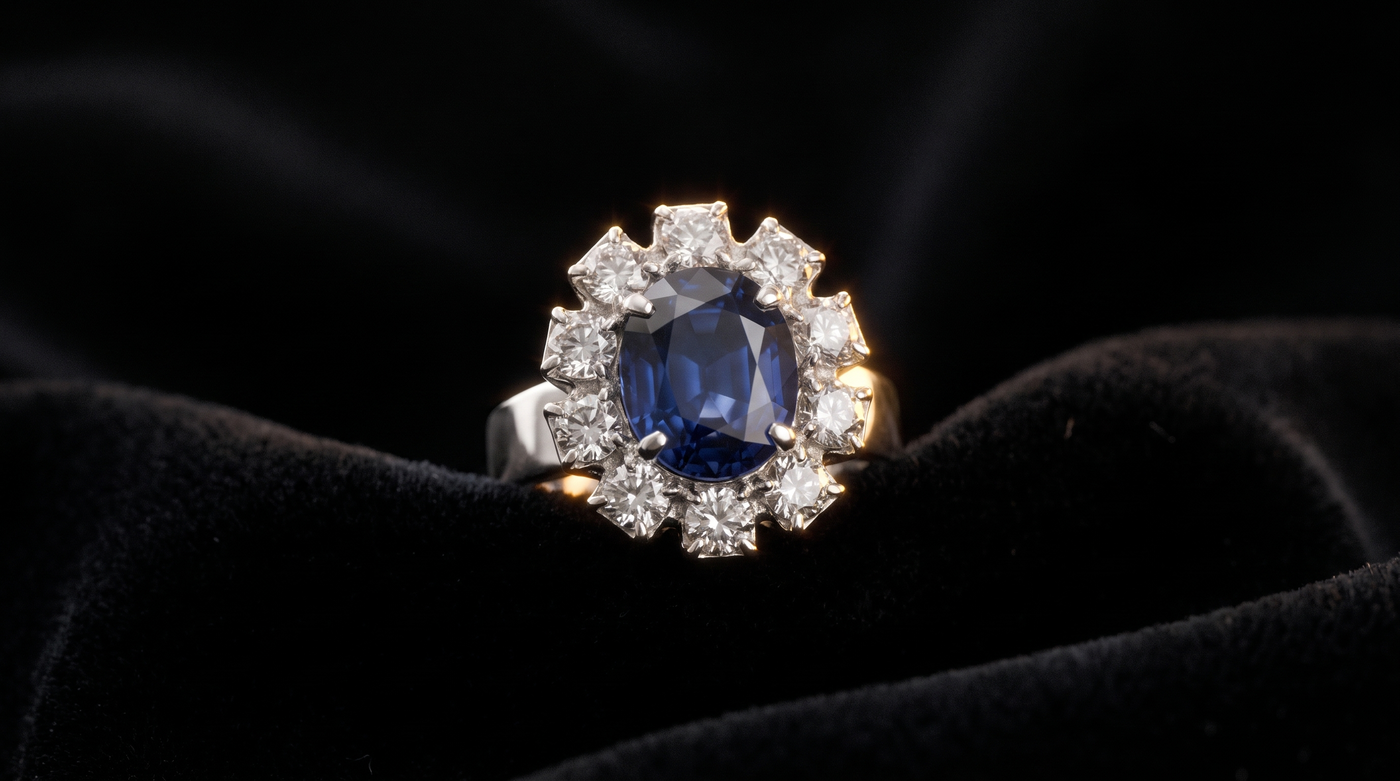
The popular myth holds that Diana's ring was designed exclusively for her — a bespoke commission worthy of a future princess. The truth is more interesting, and more telling of the young woman she was. Garrard, then the Crown Jeweller, presented Charles with a selection of ready-made pieces from its own catalog, and Diana chose the one she preferred: a twelve-carat oval Ceylon sapphire encircled by fourteen round diamonds, set in eighteen-karat white gold. It was not one-of-one. It was, at the time, available to any customer with roughly sixty thousand dollars and a visit to Garrard's Regent Street counter.
That detail unsettled parts of the royal establishment, who felt that a future queen's ring ought to be unique by definition, not by association. Diana's choice reads differently in retrospect — less a breach of protocol than an early, unmistakable sign that she intended to be herself inside an institution built to erase exactly that. Four decades later, the ring passed to Prince William, who gave it to Catherine Middleton in 2010. What began as a catalog piece is now, unambiguously, one of the most famous single objects in the world — proof that provenance is written by history, not by exclusivity at the point of sale.

Ceylon: the island that taught the world blue
Long before Garrard ever set a diamond, the stone at the center of that ring had already traveled a much older story. The island the trade still calls "Ceylon" — Sri Lanka since 1972 — has produced fine sapphire for roughly two thousand years, one of the oldest continuously worked gem sources on earth. Marco Polo wrote admiringly of the island's sapphires and rubies on his travels; medieval Arab traders carried its stones west along the same routes that moved silk and spice; a legend even places Ceylon gems in the jewelry King Solomon gave the Queen of Sheba, apocryphal but telling of just how deep the island's reputation runs.
The gem-trading heart of that history is Ratnapura — Sinhalese for "city of gems" — roughly sixty miles southeast of Colombo. There, alluvial gravel beds called illam, laid down by ancient rivers, still yield sapphire, ruby, and a dozen other gem species to miners working by hand. Sri Lanka has long restricted mechanized mining in these deposits, a policy that has as much to do with preserving a way of life as with protecting the resource: small crews still sink narrow pits twenty to fifty feet down, working largely as their grandfathers did, sieving gravel by lamplight for the flash of blue that makes the whole enterprise worthwhile.

Cornflower blue — the color the trade chases
Ask a gemologist what makes a Ceylon sapphire different from one out of Australia, Thailand, or Madagascar, and the answer usually starts with light. Ceylon's finest stones tend toward a medium tone with high transparency, a blue saturated enough to read as rich but never so dark it goes opaque under indoor light — the effect gemologists and auction houses alike describe as "cornflower blue," after the soft violet-blue field flower it resembles. It is a color that photographs beautifully and, more importantly, glows in candlelight and lamplight alike, which is precisely why nineteenth- and early-twentieth-century jewelers prized Ceylon material for pieces meant to be worn in the evening.
Diana's ring — and the version William later gave Kate — sits comfortably within that tradition: a stone chosen for exactly the qualities Sri Lankan sapphire is famous for, set in a halo of diamonds whose only job is to let the color do the talking. It is, in miniature, the same principle that guided fine sapphire jewelry for two centuries before Garrard ever cut a tray of rings for a prince to choose from.
Why sapphire, and why blue
Sapphire's symbolic weight predates any single royal wearer by a very long margin. Medieval clergy favored blue sapphire for ecclesiastical rings, believing the color represented heaven and clarity of purpose; Victorian sentimental jewelry often used sapphire alongside diamond to signify fidelity and sincerity, virtues a groom was meant to be promising along with the ring itself. By the time Diana's engagement was announced, sapphire already carried centuries of association with steadfastness — which made the choice, whether anyone at Buckingham Palace intended it or not, quietly appropriate for a match the public was told would last.
That symbolic durability is part of why sapphire has remained one of the most consistently requested stones among collectors of estate sapphire rings today. Unlike trend-driven categories, sapphire's appeal has never really needed a resurgence — it simply never left. A well-cut Ceylon sapphire from any decade still reads as considered, rather than of-the-moment, which is exactly the quality that makes a piece worth handing down rather than trading in.
What the ring changed
It is difficult to overstate the ring's commercial afterlife. Sapphire engagement ring sales reportedly rose in the ring's immediate wake in 1981, and again decades later when William proposed to Catherine with the same piece in 2010 — a rare case of one object driving two separate waves of demand a generation apart. Colored-stone engagement rings, long overshadowed by the diamond solitaire that De Beers had spent half a century promoting, suddenly had a royal precedent impossible to ignore. Jewelers on both sides of the Atlantic still field requests for "the Diana ring" as shorthand, whether or not the client can name the stone inside it.
We think the more interesting inheritance is the one the ring left for sapphire itself: proof, on the largest possible stage, that a colored stone could carry as much weight — sentimental, historical, and financial — as any diamond. It is a lesson we would have told our clients regardless, but it never hurts to have a princess make the case first. For more on the ring's fuller history and the family it now belongs to, our earlier piece on Princess Diana's engagement ring traces the whole arc from Garrard's tray to Kate Middleton's hand. Readers drawn to the deeper gem lore behind famous colored stones may also enjoy our account of the Star of India sapphire, the other great sapphire story of the last century.
Choosing a Ceylon sapphire of your own
Most collectors will never own the ring itself, but the material inside it is not, in fact, out of reach. Estate and vintage sapphire jewelry from the mid-twentieth century and earlier frequently carries genuine Ceylon origin, often at a fraction of what a comparable new stone would cost once a modern brand markup is added. The things worth learning to look for are the same qualities Garrard's buyers were looking for in 1981: an even, medium-toned blue rather than an inky near-black; strong transparency rather than a milky or included stone; and, where papers exist, an origin report confirming Sri Lankan provenance, since Ceylon material commands a real premium over sapphire from other sources.
We keep a working selection of estate sapphire rings for exactly this kind of search, each one researched for era, likely origin, and condition before it ever reaches a client. If you are considering a sapphire with a story behind it — royal-adjacent or otherwise — we would be glad to walk you through what we have on hand, or to keep watch for a particular cut and era on your behalf. Request a private viewing and we will set aside time to show you what Ceylon's oldest gem beds still have to offer, four decades after one oval stone changed how the world thought about a sapphire ring.