Grace Kelly's Engagement Ring: The Cartier Diamond That Rewrote Hollywood Romance
A 10.47-carat Cartier emerald-cut diamond that traveled from Monaco's throne room to Hollywood's soundstages — and never stopped turning heads.
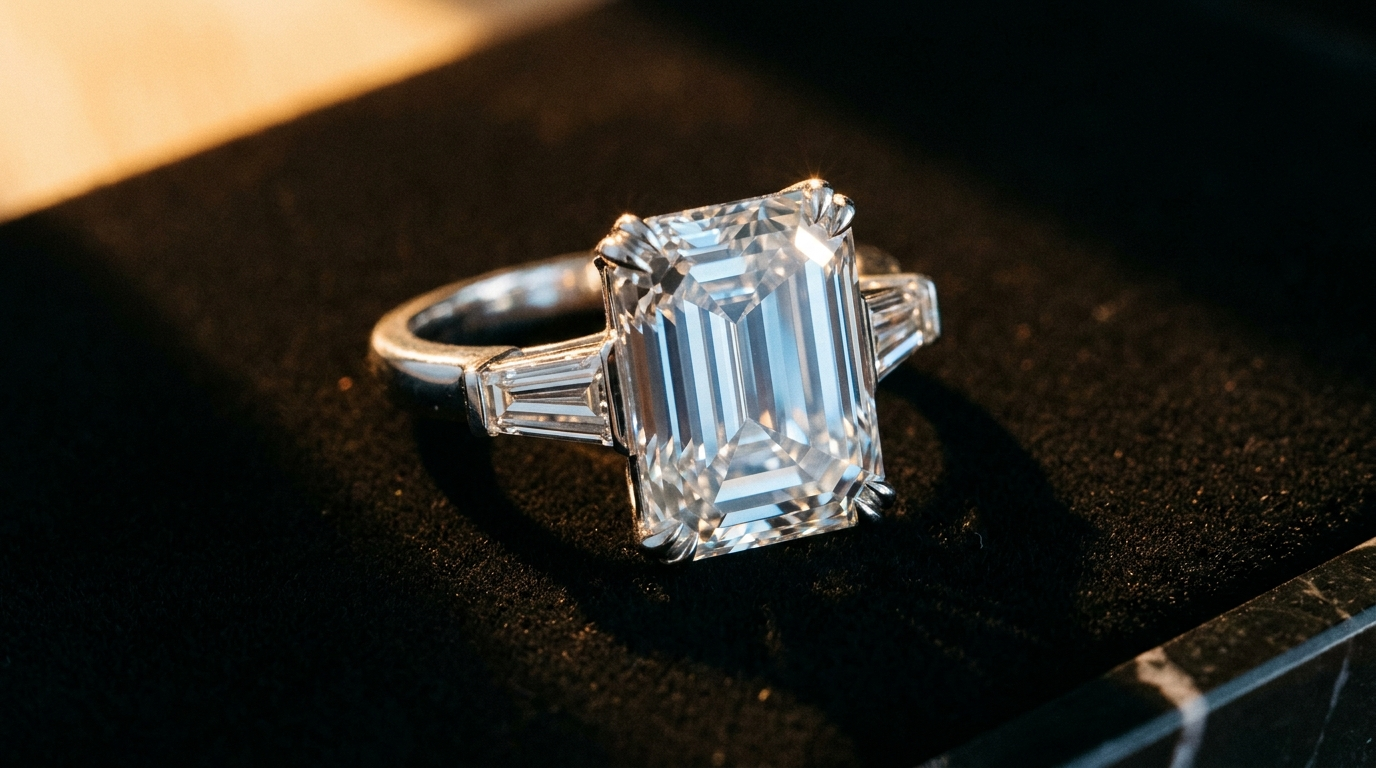
On a January afternoon in 1956, a small gathering of journalists assembled at a stone manor house in Philadelphia's Main Line suburbs. Grace Kelly — still weeks shy of her final curtain call on the MGM soundstage, still technically the most bankable actress in Hollywood — stepped into the drawing room wearing a ring that no one in that room had ever seen before. The stone was rectangular, its facets arranged in long parallel steps that caught the winter light through the window and sent it back as something cold and architectural, almost severe. No one present had words for it yet. They would come later.
The ring was a 10.47-carat emerald-cut diamond set in platinum with tapered baguette shoulders, commissioned from Cartier by Prince Rainier III of Monaco. It is, by any reasonable measure, the most influential engagement ring of the twentieth century — not because of its size, though that is considerable, but because of the way it arrived: on the hand of a woman in the middle of her own transformation, at the precise hinge between two lives. Everything Grace Kelly represented — composed beauty, Old World discretion, the particular grace of a woman who had earned her elegance rather than been born to it — was legible in that stone.
Nearly seventy years on, the ring still sets the standard against which every large emerald-cut diamond solitaire is measured. Its influence is not nostalgic. It is structural: designers, collectors, and buyers return to it not because they are sentimental about the 1950s, but because the ring solved a problem of form so completely that subsequent attempts have rarely improved upon it. This is its story — the stone, the commission, the woman who wore it, and what it means now for those who care about jewelry as an art of lasting things.
The Prince, the Actress, and the Architecture of a Proposal
Rainier Louis Henri Maxence Bertrand Grimaldi had been sovereign prince of Monaco since 1949, inheriting a principality of roughly one square mile and a constitutional requirement to produce an heir. The Grimaldi dynasty had ruled Monaco with various interruptions since 1297, and by the early 1950s the principality's continued independence was understood to depend, among other things, on the continued vitality of its ruling house. Rainier was unmarried at thirty-two, a condition that Monaco's political advisors regarded with some concern.
He had met Grace Kelly at the Cannes Film Festival in May 1955, an encounter arranged partly for its photogenic utility — the American film star visiting the European prince in his palace — and partly as genuine diplomatic hospitality extended to a studio whose goodwill Monaco had reason to cultivate. What neither party expected was the correspondence that followed, exchanged across the Atlantic over the course of several months, that arrived at the conclusion most fairy tales reserve for their closing pages. The letters between them, portions of which have been referenced in authorized biographies, were by accounts thoughtful and direct — two people assessing each other with more care than their public images might suggest.
By December 1955, Rainier had arranged to spend Christmas with the Kelly family in Philadelphia. The household on Henry Avenue was solidly established: Jack Kelly, Grace’s father, had made his fortune in brick contracting and had won the Olympic gold medal in rowing in 1920; her mother was a former model who had become a physical education instructor at the University of Pennsylvania. They were not aristocracy, but they were precisely the kind of American family — prosperous, athletic, Catholic, self-made — that in postwar Europe represented something both foreign and legible.
The formal proposal was made during this visit, and the first ring Rainier presented was an eternity band of alternating rubies and diamonds — the red and white of the Monegasque flag, a gesture of heraldic symbolism that Rainier apparently considered both romantic and appropriate. The band is rarely discussed now; it has been almost entirely eclipsed by what came next. Grace Kelly accepted, and the wedding date was set for April 1956. There remained the matter of an engagement ring worthy of the occasion.
Rainier commissioned the emerald-cut diamond ring from Cartier’s London house, then led by Jean-Jacques Cartier — grandson of Louis Cartier and the fourth member of the founding family to direct one of the three houses that Louis Cartier and his brothers had established in London, New York, and Paris in the early twentieth century. The brief, as near as the archival record allows us to reconstruct it, was unambiguous in its priorities: a stone of exceptional size and quality, a cut suitable to formal occasions and the scrutiny of press photography, a mounting of extreme simplicity. No ornamental excess. Nothing that would date.
The stone selected was a 10.47-carat diamond of high clarity. It was flanked by two tapered baguette diamonds set flush in a clean platinum mounting. The setting has no halo, no pavé shoulders, no milgrain edge, no decorative element beyond what the geometry of the stone and its baguette companions strictly requires. It is a ring that makes its argument through proportion alone, which is the hardest argument to make well and, when made well, the only one that lasts.
The Emerald Cut: A Grammar of Restraint
To understand why the ring looks the way it does — and why it has influenced so many rings made in the seven decades since — one must spend a moment with the emerald cut itself, because the choice of cut was not incidental to the commission. It was, in a meaningful sense, the commission’s entire statement.
The brilliant cuts that dominated mid-century engagement rings — round brilliants, pear shapes, marquises — are engineered for dispersion: they scatter white light into its spectral components, returning fire and scintillation in small rapid bursts. They reward motion. They perform for audiences. The emerald cut operates on entirely different principles. Its broad flat table and parallel step facets do not disperse light; they reflect it in large, slow, rectangular flashes. Gemologists describe this as the “hall of mirrors” effect — a quality that has a distinctive structural consequence. Because the cut relies on reflection rather than dispersion, it conceals nothing. Inclusions that would be masked by the optical complexity of a brilliant cut are visible in an emerald cut to anyone looking with attention. This is a stone that requires transparency in every sense of the word.
The cut’s origins lie in the emerald stones that gave it its name — the rectangular step-cut tradition developed specifically for the softer beryl family, whose crystals cleave differently from diamond and required a cutting approach that minimized stress fractures at the corners. Applied to diamond, the form was adapted with clipped corners (the octagonal outline that distinguishes the emerald cut from the older rectangular step-cut) and standardized during the 1920s, when the Art Deco movement’s appetite for geometric abstraction made the cut’s parallel lines and right-angle logic immediately attractive.
Through the Art Deco period and into the transitional years of the late 1930s, the emerald cut became associated with a particular register of taste: not flashy, not theatrical, but deliberate. By the Retro era of the 1940s and early 1950s, the form had migrated into settings of considerable scale — sometimes combined with yellow or rose gold, sometimes flanked by paired trapezoids or matching baguettes, sometimes set in architectural mountings with more visual complexity. But in the Kelly ring, the form returned to its purest mid-century expression. Platinum. Baguettes that echo the main stone’s geometry in diminished scale. No secondary ornament. The ring reads as architecture: something made according to principles rather than impulse.
This austerity is precisely what makes the ring so legible across contexts and across decades. A more elaborately set stone would have dated to its moment. The Kelly ring has no moment to date to. It exists in something closer to permanent present tense.

From the Cartier Archives to the Silver Screen
The engagement was announced formally to the American press on January 5, 1956, at the Kelly family home in Philadelphia. The photographs taken that day circulated through wire services within hours: Grace Kelly in a dark-colored suit, the ring visible on her left hand, Prince Rainier beside her in the carefully composed posture of a man accustomed to being photographed at occasions of consequence. The ring appeared in print — grainy, reduced, reproduced across hundreds of newspapers — before most readers had time to form a considered opinion about it. It was simply there, on her hand, a fact.
The public announcement preceded by several months the conclusion of Kelly’s MGM contract. She had one film remaining: High Society, Charles Walters’s musical adaptation of Philip Barry’s The Philadelphia Story, in which she played Tracy Lord opposite Bing Crosby and Frank Sinatra. The production was already underway when the engagement became public knowledge, and the costume department had sourced a prop engagement ring for Kelly’s character — something photographically legible, appropriately scaled, the kind of stone that reads from the back row of a cinema without requiring the audience to lean forward.
Rainier heard about the prop arrangement and intervened with something that, in retrospect, seems entirely in character. He contacted MGM and offered an alternative: Grace Kelly would wear the actual Cartier ring on screen. The studio’s costume designers and the film’s director agreed without apparent hesitation. The decision was made quietly, the kind of practical negotiation that happens off the record between a production company and the fiancé of a head of state, and its consequences were not immediately obvious to anyone involved.
What the decision accomplished, in historical terms, was to give the ring a second public debut — one that reached a far larger audience than the January press gathering in Philadelphia, and reached them in a context that foregrounded the ring’s meaning rather than simply its existence. In High Society, Tracy Lord is a woman of rigorous social composition caught between the comfort of a respectable marriage and the pull of authentic feeling; she is, in the film’s moral architecture, trying to become more fully herself at the cost of the life that has been arranged for her. Grace Kelly was, at the moment of filming, in a structurally analogous position — departing one life for another, standing at the threshold of an identity transformation for which no precedent quite prepared her.
The ring appears in several scenes. In the most commented upon, Kelly turns the stone against the light with what reads as unconscious deliberateness, as though the gesture belongs to a body that has been wearing the ring long enough to have forgotten it. She had owned it for months. The performance, in this moment, is inseparable from the reality.
High Society was released in July 1956. By that point, Grace Kelly had been Princess Grace of Monaco for three months. She and Rainier had married on April 19, 1956, at the Cathedral of Saint Nicholas in Monaco, in a ceremony watched by an estimated thirty million television viewers across nine countries — the largest live television audience for a single event that the medium had yet produced. The film was her farewell. She never returned to MGM, never accepted another role, never appeared on screen again after High Society.
The ring went with her to Monaco.

Cartier London and the House of Jean-Jacques Cartier
The Kelly ring belongs to a specific chapter in Cartier’s institutional history — the London house under Jean-Jacques Cartier, fourth generation of the founding family to lead one of the three houses that Louis Cartier and his brothers had established in London, New York, and Paris in the early twentieth century.
Jean-Jacques directed the London house from the early 1950s through the 1970s, a tenure characterized by a conservatism that ran somewhat against the more experimental tendencies of the Paris atelier during the same years. Where Paris through the 1950s and 1960s was developing increasingly abstract forms — the Panther motif, structural colorwork, the bold sculptural idiom of the Jeanne Toussaint era — London under Jean-Jacques returned repeatedly to the classical tradition: platinum settings for fine diamonds, step-cut and emerald-cut stones, formal three-stone arrangements, the solitaire mounting rendered with maximum restraint. This was the taste of a particular clientele: old British money, Continental aristocracy, the kind of customer who considered ostentation a form of vulgarity and for whom the quality of a stone was best served by the invisibility of its setting.
Rainier’s commission, from this perspective, was exactly the kind of brief the London house under Jean-Jacques was best equipped to answer. The Cartier archives record the full transaction: the ring created in London, transferred through the Paris house, delivered finally to the Monaco store for collection. Cartier’s director of image and heritage has described photographs held in those archives showing Grace Kelly and Prince Rainier pausing at the window of the Cartier boutique on the Rue de la Paix in Paris — a street that in 1956 remained the acknowledged center of the French luxury trade — looking in at the display cases. They are looking, in the archival photograph, at what is already in some sense theirs. The ring was in transit; the window they stood at was simply the coincident geography of that transit.
This provenance — London commission, Paris transit, Monaco delivery — maps the precise geography of mid-century luxury production. The three Cartier houses were, by the 1950s, operating with considerable independence of creative direction while sharing the family name and the central workshops that produced the actual objects. A commission that passed through London and Paris and Monaco in a single transaction was in no sense unusual; it was, rather, the normal functioning of a business designed for clients whose lives crossed those cities as a matter of course. What was unusual was the combination: a stone of this quality, a setting of this refinement, a recipient whose public image would ensure that the ring became something more than an engagement ring within months of its delivery.
The Legacy: How a Single Stone Shaped Seventy Years of Diamond Taste
The Grace Kelly ring did not create the emerald-cut engagement ring as a category, nor does it stand outside the broader history of the engagement ring as an institution — the cut had appeared in engagement settings since at least the early 1920s, and several significant emerald-cut diamonds had been worn by women of public note before 1956. But the Kelly ring definitively elevated the form. Before January 1956, the emerald cut was one option among many in the engagement ring vocabulary, favored by those with specific taste but carrying no particular cultural prestige beyond that taste. After Grace Kelly wore it — first in press photographs, then on screen in a film that reached tens of millions — it became associated with a distinct register of aspiration: intelligent elegance, European restraint, the suggestion of a sensibility informed rather than performed.
The ring’s influence can be traced in a direct line through subsequent decades. Elizabeth Taylor’s 29.4-carat Krupp Diamond — purchased by Richard Burton at Sotheby’s in 1968 for $305,000, then the highest price paid at auction for a jewel until Burton himself broke his own record a year later with the pear-shaped stone recounted in our story of the Taylor-Burton Diamond — drew on the cultural vocabulary that the Kelly ring had established, even if the commission itself was independent. Taylor wore it differently than Kelly wore hers: she wore it loudly, inseparably from her larger jewelry theater, as one emphatic voice in a chorus. The Kelly ring had established the form; Taylor demonstrated that the form could accommodate a different temperament.
In the decades since, the emerald cut has periodically fallen from fashion only to return with greater authority than it left with. The most recent such return — from roughly 2010 to the present — has been driven partly by a new generation of high-profile engagements in which the emerald cut appeared repeatedly: Beyoncé’s ring from Jay-Z, Amal Alamuddin’s ring from George Clooney, Anne Hathaway’s from Adam Shulman, Paris Hilton’s from Carter Reum, Sofia Richie’s from Elliot Grainge. Each of these is an independent commission from independent circumstances, but the cumulative effect has been to associate the emerald cut once again with a particular kind of cultural intelligence — a preference for form over flash, for endurance over novelty. It is part of a much longer story of celebrity engagement rings through history, in which each stone becomes a kind of cultural shorthand for the era that produced it.
The Kelly ring’s estimated current valuation — figures cited over the past several years range from approximately $35 million to $39 million — reflects both the stone’s intrinsic quality and its cultural biography. A diamond of comparable specifications — roughly 10.5 carats, high clarity, well-proportioned emerald cut — without the provenance would command substantially less: perhaps a quarter to a third of the figure attached to this particular stone. The remainder is, by any honest accounting, the price of the story. Which is not to diminish the story. In jewelry, as in most things that endure, the object and its narrative are not separable. The ring is worth what it is worth because it has meant what it has meant, and what it has meant has accumulated for nearly seventy years without interruption.
The ring remains in the possession of the Grimaldi family, Monaco’s ruling house, where it has been since Grace Kelly’s death on September 14, 1982, following a car accident on the Corniche road above Monaco. She was fifty-two years old. Prince Rainier survived her by twenty-three years, dying in 2005. The three children of their marriage — Princess Caroline, Prince Albert, and Princess Stéphanie — carry the estate of their parents’ life together, which includes, among its contents, a platinum ring with a 10.47-carat emerald-cut diamond that once appeared in a 1956 musical comedy and has not stopped signifying since.
What the Emerald Cut Means Now: An Estate Perspective
For collectors of vintage and estate jewelry, the Grace Kelly ring functions simultaneously as cultural touchstone and practical instructional text. It illustrates what the emerald cut achieves at its best: it rewards the stone rather than the setting. It tolerates no distraction and permits no concealment. A poorly proportioned mounting, a stone with visible inclusions that another cut would mask, a platinum that has not been worked to the right degree of subtle polish — all of these failures are immediately apparent in an emerald cut in a way that a brilliant-cut setting would obscure. You cannot flatter an emerald-cut diamond with a clever mounting. You can only serve it or fail it.
This is why the most compelling estate diamond rings in the emerald-cut tradition tend to emerge from the 1940s through the early 1960s — the same period that produced the Kelly ring. Platinum was, in this era, the default metal for fine diamond work in American and European ateliers. The cutters working in that period were producing step-cut diamonds by hand and wheel, guided by craft tradition rather than computer-optimized proportion tables, and the diamonds they arrived at tend to have the characteristics that distinguish period emerald cuts from their modern counterparts: broader tables, more open pavilions, longer and slower reflective flashes, a quality of light return that is less immediately dazzling and more quietly authoritative. These stones were calibrated for the lighting conditions of the world they were made for — jewelry rooms, candlelit interiors, the soft illumination of evening events — rather than the flat overhead lighting of a diamond-grading laboratory.
The cut was also, in this era, held to a standard of stone quality that current commercial practice rarely requires. Because the emerald cut conceals nothing, the diamonds selected for significant emerald-cut solitaires from this period are, as a class, of higher clarity than their equivalents in round-brilliant settings. The form demanded it. You could not sell a visibly included stone in an emerald-cut mounting to a serious client in 1955 and expect the relationship to continue.
These rings do not announce themselves. They require a second look, and then a third. They are acquisitions for the educated eye — the collector who has learned to read light moving through a step facet rather than simply to count carats on a certificate. They are also, in the estate market, consistently undervalued relative to their brilliant-cut contemporaries of comparable carat weight, in part because the brilliant-cut standard has become so culturally dominant that anything departing from it reads as niche rather than classic. This is a temporary condition. The pendulum has swung before; it will swing again. The collectors who understand the emerald cut’s formal intelligence now will own pieces that a later generation will wish they had acquired earlier.
A period emerald-cut diamond solitaire from this era — set in platinum, with baguette or step-cut shoulders, mounted with the particular economy of means that characterized the best atelier work of the period — carries the formal grammar of the Kelly ring without pretending to be something it is not. It is what it is: a well-made object from a specific moment in jewelry history, built according to principles that have not been improved upon, available to the collector who knows what she is looking for.
The Private Life of an Iconic Stone
Grace Kelly wore the Cartier ring for twenty-six years of marriage. In photographs from Monaco’s public life throughout the 1960s and 1970s — at state receptions, at Monte-Carlo Rally ceremonies, at the Red Cross galas she organized annually, at the cultural institutions she worked to establish within the principality — the ring appears on her left hand as a permanent feature of her public identity. It was not, by those years, the statement it had been in 1956. It had become, through long acquaintance, simply part of her.
There is a quality that very old, very significant rings acquire through continuous wear that distinguishes them from objects still in transit. Call it settled authority: the assurance of something that has not needed to prove itself for a considerable time. The Kelly ring had achieved this condition by the early 1960s. In photographs from that decade, it is visible not as the spectacular object it objectively remains but as the ring she wears — the way one wears anything that fits exactly and has always been there.
This is what jewelry at its highest level aspires to — not spectacle but intimacy. Not the ring that makes the room look, but the ring that makes the wearer feel, across decades, entirely herself. The Grace Kelly ring accomplished both simultaneously, which is perhaps the rarest achievement in the form: it was a public object of the first order, recognized around the world, photographed thousands of times, reproduced in every medium, and it was also a private object in exactly the sense that matters — something that belonged to its wearer in a way that went beyond ownership.
The ring now belongs to history in the way that all significant objects eventually do: it is beyond the reach of acquisition, fixed within a family and a dynasty, its biography closed in the sense that no new chapter will be written by a new owner. It will not appear at auction. It will not pass from Monaco. It is one of the few objects of its kind that exists entirely outside the market, held for reasons that no market value can adequately represent.
Acquiring the Tradition
The Kelly ring itself is not available — will never be available in any ordinary sense. But the tradition it represents, the mid-century emerald-cut diamond solitaire in platinum with step-cut or baguette shoulders, is one of the most durable and expressive forms in the estate jewelry canon. Rings from this tradition appear at auction with some regularity, and they move through private collections and estate sales more quietly — the way all significant objects circulate among careful hands.
At VERANE, we source from this tradition with deliberate attention to the formal qualities that make the emerald cut worth pursuing: proportion, clarity, period authenticity of setting, the particular quality of platinum work from the mid-twentieth century that distinguishes it from later or contemporary production. Our estate diamond ring collection includes period examples that carry the formal intelligence of the Cartier tradition without, naturally, claiming provenance they do not possess. They are what they are, and what they are is considerable.
The standard against which these pieces are measured was set in Philadelphia in January 1956. It has not materially changed since. The ring that established it is in Monaco, in a family collection, behind whatever privacy a ruling house maintains for the objects it considers irreplaceable. But the tradition is alive, and available, and worth understanding in full before you look for a piece within it.
If you are searching for an emerald-cut diamond of genuine period character — a ring that carries its weight without announcing it, that grows more interesting the longer you know it — we welcome the conversation. Pieces of this quality deserve consideration in person rather than on a screen, and we extend a private viewing to those who would prefer to examine them properly.
Request a private viewing — and allow us to show you what the tradition looks like when the right stone finds the right hand.