The Language of Gemstones: How Victorian Acrostic Jewelry Spelled Love in Stone
REGARD, DEAREST, and the Georgian-to-Victorian tradition of acrostic jewelry, in which the first letters of colored gemstones spelled a private word of love.
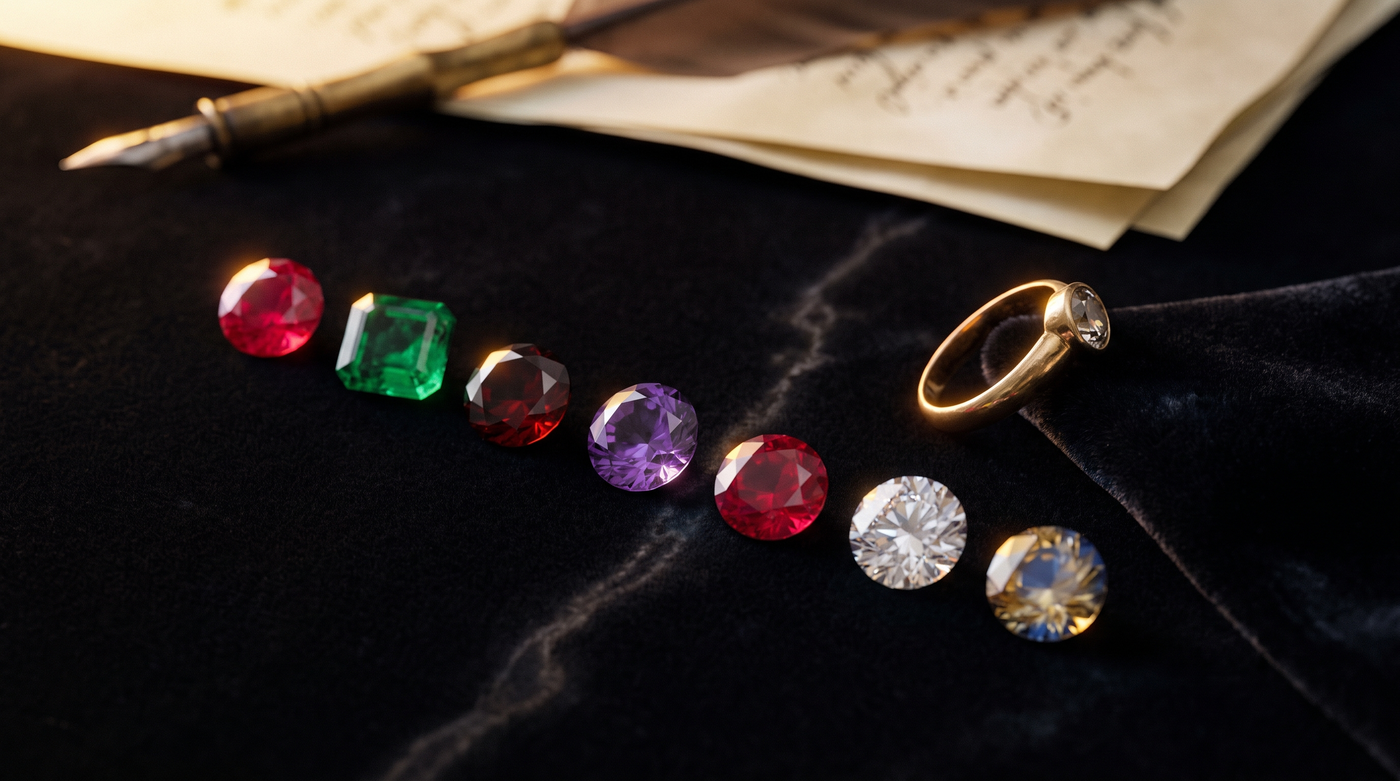
A ring is easy to read at a glance — a hoop of gold, a single stone, perhaps a maker's mark inside the band. A regard ring asks to be read twice. Turn a Georgian example under a candle, or a jeweler's loupe, and the stones set across its face resolve into a sentence. Ruby, emerald, garnet, amethyst, ruby, diamond — regard. The gem is the letter. The ring is the word. And the word, worn on a hand in a drawing room where a couple could rarely speak plainly of their feelings, was the entire point.
A Code Set in Stone
Acrostic jewelry works on a simple principle: the first letter of each gemstone's name becomes a letter of a word, and the stones are set in the sequence the word requires. It is a lapidary alphabet — G is for garnet, E is for emerald, R is for ruby — and a jeweler fluent in it could set almost any sentiment a client wished to give, provided the stones could be sourced and cut small enough to sit together in a single band or bezel.
The best-known example is REGARD: Ruby, Emerald, Garnet, Amethyst, Ruby, Diamond. In the period, "regard" carried more weight than it does now — closer to devoted esteem than to a passing glance — so a six-stone REGARD ring was, in effect, a one-word declaration a suitor could hand to a woman without saying anything aloud at all. A near-identical version, "REGARDS," sometimes closes the sequence with a seventh stone, a sapphire; jewelers of the period were not especially strict about which spelling they used, and both turn up in surviving pieces.
DEAREST asked for a longer sentence and a wider palette: Diamond, Emerald, Amethyst, Ruby, Emerald, Sapphire, Topaz — with turquoise standing in for topaz often enough that either stone is considered correct today. ADORE compressed the sentiment into five stones, Amethyst, Diamond, Opal, Ruby, Emerald, and was popular for its brevity and its milder cost. Whichever word a client chose, the logic held: the piece could be admired by a stranger as a pretty band of colored stones, and read by its intended owner as something considerably more direct.
Paris, and a Ring Attributed to the House of Mellerio
The convention is generally traced to Paris in the first years of the nineteenth century, and to the jewelry house Mellerio dits Meller — a firm that had already outfitted Marie Antoinette and would go on to serve Empress Joséphine. The house is commonly credited, under Jean-Baptiste Mellerio, with the earliest known acrostic piece: a ring spelling J'ADORE. The exact year attached to the story shifts depending on the source, 1806 in some accounts and 1809 in others, and no single surviving invoice has settled the question. We note it as it stands in the trade's own record: attributed, not proven, in the way most origin stories from a pre-photographic century tend to be.
What is better documented is the speed with which the idea traveled. French jewelers ran with the acrostic principle well beyond a single word — souvenir (from se souvenir, to remember) and amitié (friendship) both appear on French pieces of the period — and the fashion crossed the Channel within a generation. English jewelers adapted the vocabulary to English sentiments, and by the time Victoria took the throne in 1837, REGARD and DEAREST rings were an established, recognizable category of jewelry rather than a passing novelty.
Dearest, Adore, and the Victorian Vocabulary of Sentiment
Acrostic jewelry belongs to a broader Victorian instinct: an era that prized a coded message set in a form no chaperone or censor could intercept. It sits alongside the coded sentimentality of Victorian hair jewelry, in which a woven lock stood in for a person who was absent, traveling, or gone, and alongside the language of flowers, in which a bouquet's exact composition could carry an entire private conversation. Gemstones, in this context, were never only ornamental. Garnets signaled constancy. Sapphires suggested fidelity. A diamond stood, then as now, for permanence. An acrostic ring simply took that existing gemstone symbolism one useful step further, borrowing the stones' names rather than their meanings to spell out something exact.
The vocabulary was not fixed to three words. Beyond REGARD, DEAREST, and ADORE, jewelers set rings, brooches, and pendants to spell out given names, anniversaries, and French endearments. A smaller number of surviving pieces are said to spell FRIEND, built from a rarer set of stones — fluorite, ruby, indicolite, emerald, nephrite, diamond — a word documented less consistently than the others, and one that would have taxed even a well-stocked Georgian workshop to source. The scarcer the required letter, the more the finished piece said about what its maker was willing to search for.
The craft itself was exacting in a way that is easy to miss at a glance. Each stone in an acrostic ring is typically small, often under a quarter carat, cut to a matching profile so the row reads as a single continuous design rather than a haphazard collection of leftover stones. A skilled Georgian or Victorian jeweler needed a deep stock of loose, well-matched melee in six or seven different species — no small inventory in an age before global gem distribution — and the ability to set each one so its color, not its size, carried the sentence.
Rings, Brooches, and Lockets: How the Code Was Worn
The ring was the most common form, in part because a narrow band naturally accommodates a tidy row of small stones, but the code traveled comfortably into brooches, pendants, and lockets as well — anywhere a jeweler could set six or seven stones in a legible line or cluster. A locket added a second layer of privacy: the acrostic sentence on the outside, and often a woven curl of hair or a small painted portrait sealed within, so the piece carried two messages at once — one for anyone who noticed the stones, and one for the wearer alone.

Courtship in the period left little room for direct speech on the subject of one's feelings, particularly before an engagement had been formally sanctioned by both families. A ring that could be worn in company, admired for its color, and understood in full only by its recipient solved a genuine social problem. It let a suitor say regard, or dearest, in a room full of people who would only ever see rubies and diamonds.
Collecting the Language of Gemstones Today
Genuine Georgian and Victorian acrostic pieces survive in modest numbers, and the ones that reach the market today are prized less for carat weight than for the completeness of the sentence and the honesty of the setting. A REGARD ring missing its garnet, or a DEAREST brooch carrying a later replacement stone that breaks the intended color sequence, tells a different and less satisfying story than one where every letter survives as originally set. Closed-back settings, foil backing on some of the older stones, and hand-cut hinges are the marks connoisseurs look for; a modern reproduction is rarely shy about revealing itself under a loupe.

We keep a close eye on this period for exactly that reason. Our own Victorian jewelry holds pieces built on the same instinct — sentiment expressed through stone rather than statement — and the broader story of how a ring came to carry meaning at all runs through our earlier piece on the history of the engagement ring. Anyone drawn to the acrostic tradition will likely find a kindred piece among VERANE's vintage and estate jewelry, where provenance and the small, specific facts of a piece — a maker, a decade, a stone that has not been replaced — still carry the story a century and a half later.
A regard ring was never meant to be loud. It was meant to be understood by exactly one person, then returned quietly to the ordinary business of being a ring. That may be the most useful way to explain why these pieces still hold up: the message was never the ornament. The ornament was only ever the delivery method.
To see what has recently come into the house, browse our vintage rings, or request a private viewing to look at a piece in person.