Victorian Hair Jewelry: Love, Loss, and the Art of Hairwork
Brooches, bracelets, and lockets woven from a loved one's hair — the most intimate and strange expression of Victorian devotion, and one of the most personal corners of estate jewelry.
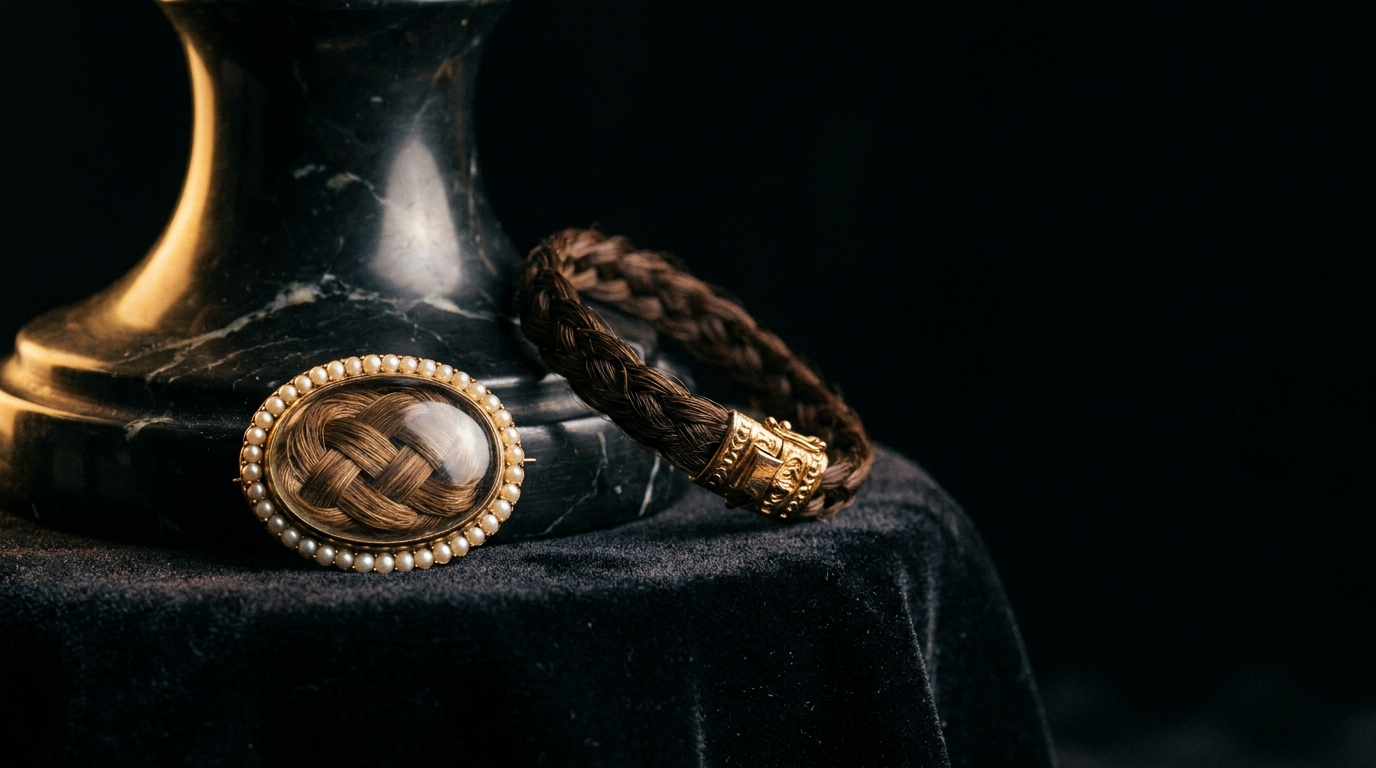
Of all the objects the nineteenth century left behind, few are as intimate, as quietly unsettling, or as deeply human as a piece of Victorian hair jewelry. A brooch the size of a coin, opened, reveals a lock of someone's hair coiled like a sleeping animal beneath glass. A bracelet, supple and warm to the touch, turns out on closer inspection to be woven entirely from human hair, plaited as fine as silk. To modern eyes the effect can be startling. To a Victorian, it was the most natural thing in the world: love, made wearable, and worn close to the skin.
At VERANE we handle a great many things that outlive the people who first owned them. But hair jewelry is its own category of survival. A diamond is forever in the marketing sense; a braid of hair set into gold is forever in a far more literal and tender one. It is the only kind of estate jewelry in which a fragment of the original wearer is, quite simply, still present. Understanding it means understanding an entire emotional architecture that the Victorians built around love and loss.
A Mourning Queen and the Birth of a Trend
Hairwork was not invented by the Victorians. Sentimental jewelry containing a loved one's hair had appeared in Georgian rings and lockets decades earlier, and the practice has roots stretching back to the seventeenth century. But it was Queen Victoria who turned a quiet custom into a national language of feeling. When Prince Albert died in December 1861, the Queen entered a state of mourning so total and so public that it lasted, in one form or another, until her own death in 1901. She wore a locket of Albert's hair against her body, and a grieving empire followed her lead.
Mourning became, paradoxically, a kind of fashion — codified, elaborate, and commercially enormous. Jet from the cliffs of Whitby, black enamel, and hair from the deceased were the materials of grief, and an entire industry rose to meet the demand. To wear a brooch holding a husband's hair, or a ring spelling a mother's initials in tiny gemstones above a woven plait, was not morbid. It was correct. It announced that you remembered, that you had loved, and that the bond had not been severed by death so much as transformed into something you could carry. This sensibility runs straight through the best Victorian estate jewelry we encounter today.

The Craft of Hairwork: Table Work, Palette Work, and Sepia
What elevates these pieces from sentiment to artistry is the sheer difficulty of making them. Hairwork was a genuine craft, and at its height a demanding one. There were broadly three methods, and a collector learns to read them the way one reads a hallmark.
The first and most painterly was palette work, in which hair was chopped, curled, or laid out in fine designs against a backing — a single sentimental curl, a feathery "Prince of Wales" plume, or a miniature scene of a weeping willow over a tomb. These compositions were sealed under glass in brooches, pendants, and rings, often with a border of seed pearls, which themselves signified tears.

The second was table work, developed in the earlier nineteenth century, which is responsible for the three-dimensional woven bracelets, watch chains, and necklaces that astonish people most. The hair was first sorted into strands of equal length, boiled in soda water, and dried. The strands were then mounted on a special braiding table — a round table with a hole at its center — and weighted with small bobbins around the rim. Working the bobbins in sequence, exactly as a lacemaker would, an artisan wove the hair into hollow coils, tubes, and intricate patterns around a wooden mold. The result was supple, glossy, and strong enough to mount in gold fittings and clasps.
The third, and rarest, was the sepia miniature: an image painted on ivory in a wash made from finely ground hair mixed with pigment, so that the picture of an urn, an angel, or a mourner was rendered, almost unbearably, in the very substance of the person being mourned. By mid-century, instruction in these techniques had reached ordinary drawing rooms. Between 1850 and 1859, the hugely influential Godey's Lady's Book published patterns and step-by-step guides, recasting hairwork as a genteel domestic pastime alongside embroidery and watercolor.
Not Only Grief: Sentimental Hair Jewelry
It is a common misreading to treat every piece of hair jewelry as mourning jewelry. A great deal of it celebrated the living. Hair was exchanged between friends, lovers, and family members as a token of affection, and woven into pieces that functioned more like a sentimental family tree than a memorial. A wreath made from a single person's hair generally commemorated the dead; a wreath gathering the hair of many — children, parents, a whole household, some living and some gone — was an emblem of connection and continuity.
Lovers were especially fond of it. A young man might carry a watch chain plaited from his sweetheart's hair; a bride might wear a bracelet holding strands from her mother and sisters on her wedding day. The vocabulary of nineteenth-century romance was woven right into the metalwork — acrostic motifs, clasped hands, the word Mizpah ("the Lord watch between me and thee"), and forget-me-nots. The impulse to lock devotion into a wearable object did not end with the Victorians; one can trace a direct emotional line from a hair bracelet to the twentieth-century idea of a love token sealed shut, a story we explore in our history of the Cartier Love bracelet. The materials changed; the longing did not.

Reading a Piece of Victorian Hair Jewelry Today
For the modern collector, hairwork occupies a singular place. These are among the most personal antiques in existence, and that intimacy is precisely their appeal. Condition is everything: hair is organic and fragile, glass crystals craze and cloud, and the delicate woven elements can loosen if a piece has been handled carelessly across a century and a half. The finest survivors tend to be those mounted in substantial gold settings — lockets, antique brooches, and pendants whose cases protected the hairwork from light and wear.
Provenance, where it survives, transforms these objects. An inscription inside a locket — a name, a date, "in memory of" — turns an anonymous curiosity into a documented fragment of a real life. Many of the loveliest examples are lockets and estate necklaces that pair hairwork with enamel — including the translucent fired enamel techniques such as plique-à-jour, which reached their height in Art Nouveau pieces made just as the Victorian era closed — or with pearls and a sepia miniature, combining several of the period's skills in a single jewel. As with all pre-owned fine jewelry, knowing exactly what you are looking at matters enormously, which is why we always begin with the question of what genuinely defines estate jewelry and how to judge it.
To hold a piece of Victorian hair jewelry is to hold a paradox the nineteenth century understood better than we do — that grief and love are the same devotion pointed in different directions, and that beauty is one of the few honest ways we have of carrying both. These were never merely ornaments. They were arguments against forgetting.
VERANE acquires and presents Victorian sentimental and mourning pieces only occasionally, and always with their stories intact. If you are drawn to the intimacy and craftsmanship of this remarkable corner of estate jewelry, we invite you to explore our Victorian collection or to request a private viewing, where a specialist can walk you through provenance, condition, and the quiet histories these jewels still carry.
— Eleanor Verane