The Cartier Love Bracelet: The True Story of Jewelry's Most Famous Lock
A screw, a screwdriver, and the 1969 idea that turned devotion into hardware — the true story of the Cartier Love bracelet, and how to collect the originals.
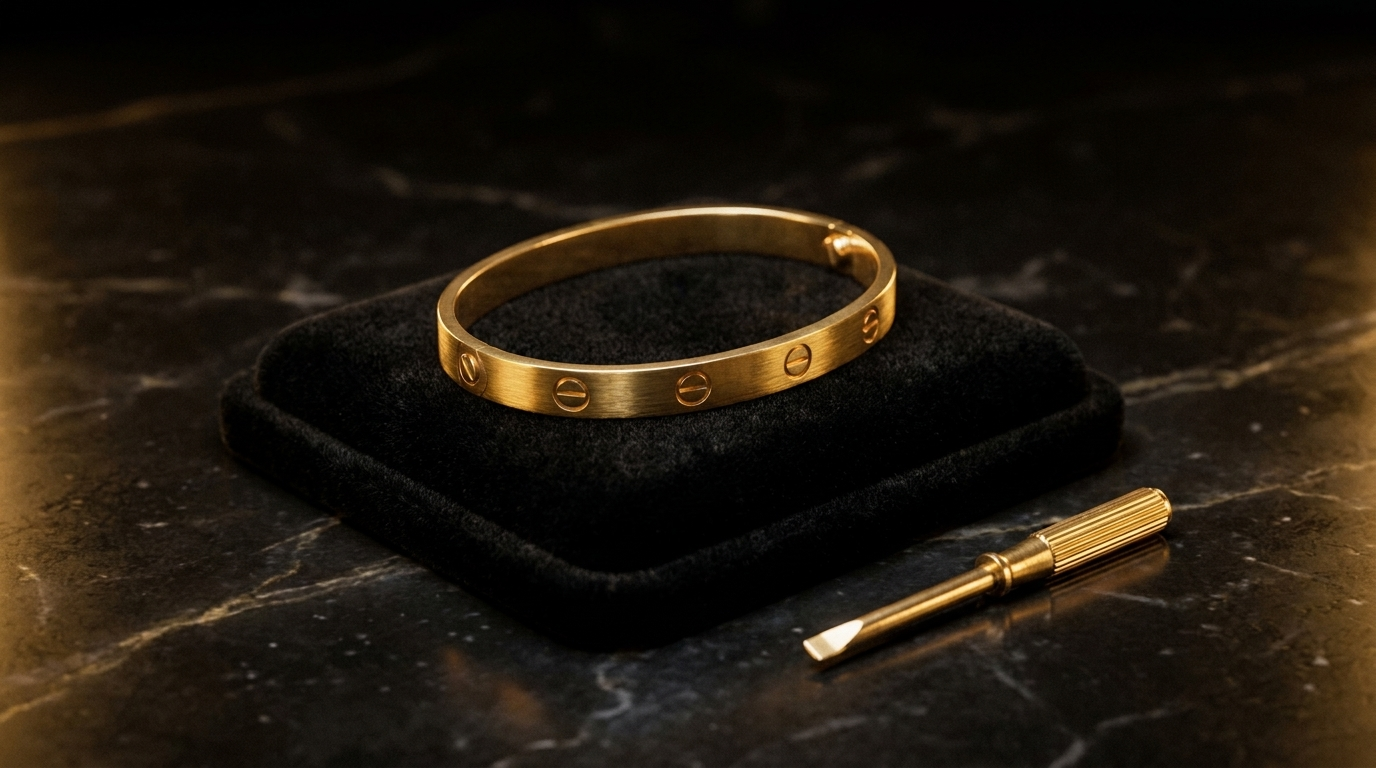
It is the only piece of fine jewelry that ships with a screwdriver. To put a Cartier Love bracelet on properly, you need another person: someone to hold the two golden arcs around your wrist, seat the screws, and turn them until the bracelet closes into a perfect, permanent oval. There is no clasp. There is no easy exit. That is the entire point — and it is why, more than half a century after it was designed, the Cartier Love bracelet remains the most recognisable love token on earth, and one of the most collected pieces of modern estate jewelry.
This is the story of how a heartbroken Italian designer in 1969 New York turned hardware into romance — and what to look for if you want one of the originals.
Who designed the Cartier Love bracelet?
The Love bracelet was created by Aldo Cipullo, a Naples-born designer who had arrived in New York in 1959 with little more than a portfolio and exceptional nerve. The son of a Roman costume-jewelry maker, Cipullo worked his way through the benches of David Webb and Tiffany & Co. before joining Cartier's New York house in 1969. He was 33, newly heartbroken — the story goes that the idea came to him in the small hours after a relationship ended — and consumed by a thoroughly modern question: in an age when marriages were dissolving and traditions loosening, what would a credible symbol of permanence look like?
His answer was disarmingly literal. Not a heart, not a flower — a bracelet that locks. "What modern people want," Cipullo said, "are love symbols that look semi-permanent — or, at least, require a trick to remove." The Love bracelet requires exactly that: a flat, functional screw at each side, turned with a small gilded screwdriver that came nestled in the box. Your partner fastens it on. Removing it alone, on a whim, is nearly impossible. Devotion, rendered in 18-karat hardware.
Cartier understood immediately what Cipullo had given them: not just a design but a ritual. The bracelet was an oval rather than a circle, engineered to sit close against the wrist bone — present, felt, not dangling. The screw motifs that ring the band were not decoration first; they were the working idea made visible.
The launch marketing has become legend in its own right. In the early years, the New York boutique was said to sell the bracelet only to couples — you could not, officially, walk in and buy one for yourself. And to seed the legend, Cartier presented pairs to the great couples of the age: Elizabeth Taylor and Richard Burton, Ali MacGraw and Steve McQueen, Sophia Loren and Carlo Ponti, the Duke and Duchess of Windsor. Among the most photographed wearers of the era was Grace Kelly, whose Cartier engagement ring had already made the house synonymous with Hollywood romance — the Love bracelet extended that story into the next decade. The gesture was perfect publicity precisely because it was true to the object — a thing designed for two people, fastened by four hands.
Other legends followed, as they always do with great jewels. The most persistent: that certain New York hospitals keep Cartier screwdrivers on hand because patients arrive wearing bracelets no one can remove. Like the best jewelry stories, it is repeated everywhere and verified nowhere — and the fact that it is so believable tells you everything about the design.
The nail, the screw, and the romance of hardware
Cipullo followed the Love bracelet two years later with its sibling — a bracelet formed from a single bent nail, which Cartier would come to call Juste un Clou. Together the two designs form one of the most coherent statements in twentieth-century jewelry: ordinary workshop hardware, the least precious objects imaginable, elevated into gold. It was Pop Art thinking applied to the wrist — Warhol's soup can, but wearable, and the very opposite of the diamond-encrusted formality that had defined the great houses for a century. We explored that older, grander world in our story of the Patiala Necklace, Cartier's largest commission ever — the Love bracelet is its philosophical opposite, and that is exactly why it mattered.
Cipullo died suddenly in 1984, just 48 years old, leaving a short, blazing catalogue of work. The early American pieces that carry his name have become the most sought-after of all.
Vintage Cartier Love bracelets: what collectors look for
Here is where the story turns from history to acquisition — because not all Love bracelets are equal, and the estate market knows it.
The Cipullo-era originals (1969 through the 1970s). The earliest bracelets were made in New York and stamped accordingly — many carry "Cartier" with "Aldo Cipullo" on pieces from the early seventies, a signature that commands a serious premium at auction. These early examples differ from the modern production in ways a trained eye spots instantly: the proportions are slightly slimmer, the screws are fully removable rather than captive, and the gold carries the softer, hand-finished character of small-batch work. When a signed Cipullo example surfaces at auction, bidding routinely sails past the price of a new bracelet — provenance, as ever, is the most valuable material of all.
The mechanism dates the piece. Original bracelets used two completely separate screws — charming, and famously easy to lose. Cartier re-engineered the system decades later so the screws stay attached to the band. A "vintage" bracelet with a modern captive-screw mechanism is telling you a story that doesn't add up; the hardware should match the era of the hallmarks.
Read the marks like a dossier. A genuine piece carries crisp, correctly positioned stamps: the Cartier signature, the gold fineness (750 for 18k), a serial number, and on older examples the maker's and assay marks appropriate to their place of manufacture. Forgers reproduce the look; they rarely reproduce the punctuation — the exact tells we walk through in our guide to spotting a fake signed piece. This is precisely the discipline we apply to every signed piece that enters our own Cartier estate collection — signature, serial, mechanism and metalwork must all agree before we will offer a piece.
Condition tells the truth. A Love bracelet is worn daily, often for years without removal — that is its nature. Honest wear (a soft film of hairline scratches collectors call patina) is expected and even loved. What matters is structural: screws that seat cleanly, halves that align without strain, no amateur resizing. An over-polished bracelet, stripped of its history to look new, has lost something it cannot get back.
An old idea wearing modern clothes
For all its modernity, Cipullo's lock-on bracelet belongs to a tradition far older than 1969. Victorian sweethearts exchanged gold padlock bracelets — some with working keys kept by the giver — and wove Victorian hair jewelry from a beloved's own hair. Georgian lovers wore gimmel rings whose interlocking hoops joined two hands into one band. The fede ring, clasped hands in gold, goes back to Rome. Jewelry has always wanted to say bound to you; Cipullo simply said it in the industrial language of his own century, and said it so clearly that the message has never needed updating.
That is the real reason the Love bracelet endures while trendier designs of its era have vanished: it is not a fashion object that happens to carry meaning, but a meaning that happens to take the form of an object. Half a century on, waitlists still form for new ones — while the originals, the New York pieces with Cipullo's name and the loose screws and the stories in their scratches, have become true estate jewels: rarer every year, and carrying exactly the kind of documented past we built this house around.
Acquiring a piece of the story
Signed Cartier from the Cipullo era passes through our vitrine more rarely than we would like — and rarely lingers. If a Love bracelet, or any signed period Cartier, is the piece you have been hunting, our specialists can search privately on your behalf and verify any example you are considering elsewhere. Browse the current signed Cartier collection and our estate diamond bracelets, or request a private viewing — in Mayfair, New York, or wherever you are, fully insured, entirely in confidence.
Every piece in the Verane vitrine arrives with its provenance documented and its authenticity guaranteed for life — because at this level, the story is the stone.