Kashmir Sapphire: The Stone the Himalayas Gave Only Once
In the summer of 1882, a landslide in a remote Himalayan valley exposed a seam of blue crystal unlike any the world had seen — and the mine that produced it was exhausted within five years.
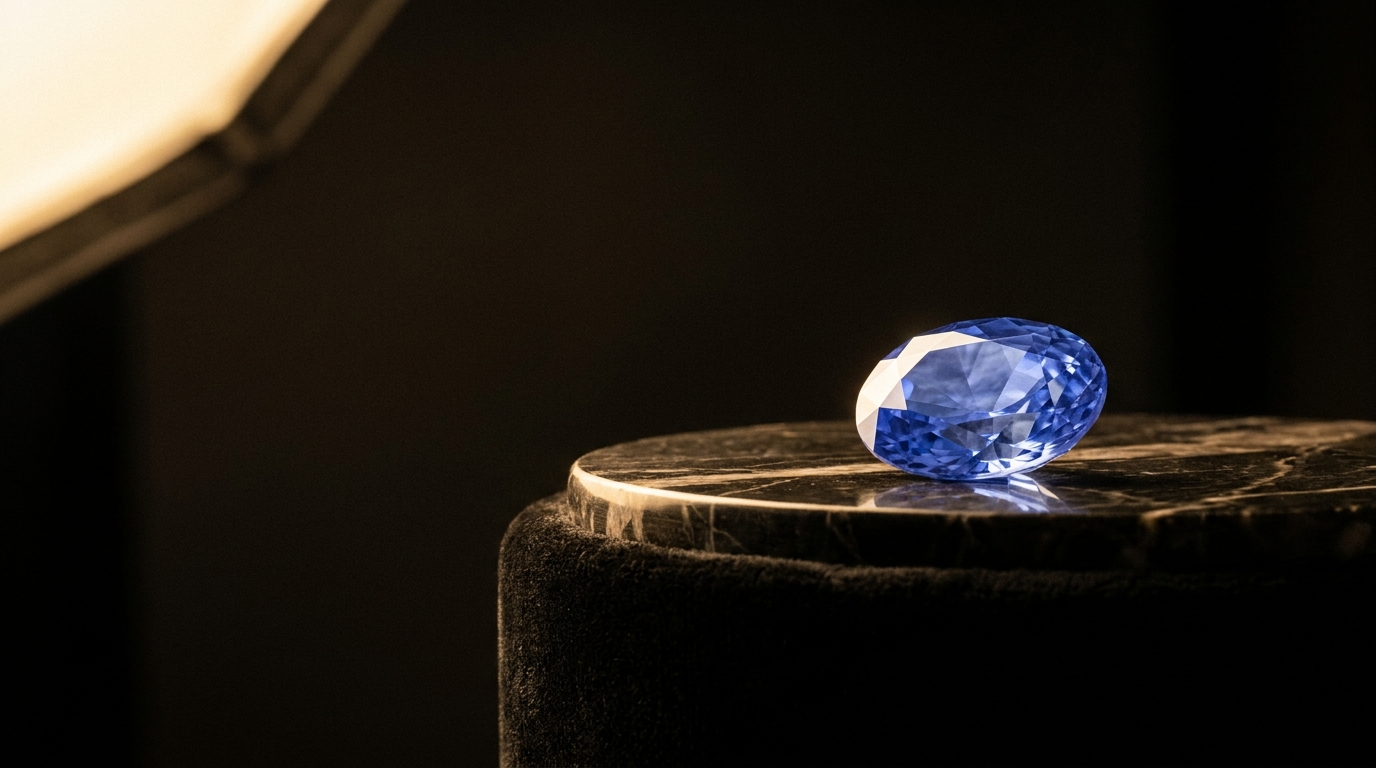
There is a particular shade of blue that gemologists reach for a very specific word to describe — not vivid, not bright, not electric, but velvety. It is a word that seems to belong to fabric or to shadow, not to stone. Yet no other word has ever adequately described what comes out of a single high valley in the western Himalayas: the Kashmir sapphire, a gem so precisely itself that the entire trade has spent 140 years measuring everything else against it.
The mine that produced these stones is, for all practical purposes, gone. The finest examples were pulled from the earth in a window of perhaps five or six years, at an altitude where the air is thin and the season short. What exists today — in auction rooms, in estate collections, in private vaults — is the complete supply. There will not be more.
The Landslide That Changed Everything
In 1882, traders from the Paddar Valley in the Zanskar range of what is now the Indian state of Jammu and Kashmir came across a deposit of blue crystals that had been exposed by a recent landslide. The stones were vivid and unusual — unlike the lighter Ceylon sapphires they knew, and unlike the dark inky blues of Burma. They brought samples down from the mountains, and word reached the Maharaja of Kashmir.
The Maharaja moved quickly. Royal guards were dispatched to the Sumjam mine — a site sitting at roughly 4,500 metres above sea level, accessible only during the short alpine summer — and extraction was placed under direct royal control. British gem merchants arrived, recognized what they were looking at, and within a few seasons the stones were moving through the trade in Calcutta and London. The GIA and SSEF, the laboratories that today certify Kashmir origin, trace their understanding of these gems back to the mineralogical reports that followed that first discovery.
The productive period was short. By 1887, T. D. LaTouche of the Geological Survey of India had visited the site and filed the first formal account of the mines. By the late 1880s, the richest pockets of the primary deposit were largely spent. By 1900, production was negligible. By 1930, the mines were effectively abandoned. Subsequent efforts to find new veins in the surrounding valley floor — petitioned for by the Maharaja, surveyed by the British — turned up little of significance. The sky had opened once, briefly, and then closed.
Why the Color Is Different
The blue of a Kashmir sapphire is the result of geology operating under very specific conditions. Sapphire is corundum — aluminum oxide — colored by trace amounts of iron and titanium. That combination produces blue in sapphires from many origins. What Kashmir does differently is microscopic: the crystals grew slowly in a pegmatitic host rock, and as they cooled they developed an extraordinarily fine network of rutile silk — microscopic needles of titanium oxide arranged within the crystal lattice.
In a lesser stone, such inclusions would be liabilities, reducing transparency and value. In a Kashmir sapphire, they behave differently. The silk scatters the light that passes through the stone in a way that softens and diffuses it, eliminating the harsh flashes that can make other blues seem almost aggressive. The result is a color that appears to glow from within, saturated without being heavy, deep without losing luminosity. Gemmologists describe it as the blue of a clear sky at high altitude — which is, not coincidentally, exactly where it was formed.
This quality — the velvety internal light — does not diminish in artificial lighting the way many vivid blues do. A Kashmir sapphire looks equally itself by candlelight and by day. It is this consistency, as much as any absolute color measurement, that the great origin laboratories look for when they certify a stone's provenance.
The Question of Proof
Because the name Kashmir commands perhaps the highest premium in the colored-stone world — prices for fine examples have regularly exceeded $50,000 per carat, and the finest stones at auction have surpassed $200,000 per carat — the certificate of origin is not a formality. It is the document that separates one category of stone from another.
The laboratories trusted for this determination are a short list. The Swiss Gemmological Institute (SSEF) and the Gübelin Gem Lab in Lucerne are considered the primary authorities for Kashmir origin; their reports are the ones the major auction houses — Sotheby's, Christie's, Bonhams — require for unqualified Kashmir attribution. The American Gemological Laboratories (AGL) is also respected for origin work. The GIA, pre-eminent for diamond grading, is generally considered less authoritative for sapphire origin determination.
What these laboratories look for is a combination of chemistry and crystal structure: the trace element ratios, the particular character of the rutile silk, the presence of certain fluid inclusions, and a spectroscopic fingerprint that corresponds to the geological conditions of the Sumjam deposit. It is not an exact science — origin determination never is — but a certificate from SSEF or Gübelin attributing Kashmir origin carries enormous weight in the market, and for good reason. There is, quite literally, no other place on earth that produces this particular blue.
At Auction: A Record Written in Blue
The auction record for Kashmir sapphires has moved steadily upward for decades, outpacing most other colored stones in consistent demand. In May 2025, a 35.09-carat Kashmir sapphire known as the Regent Kashmir sold at Christie's Hong Kong for approximately $9.5 million — a per-carat price of roughly $271,000, setting a new auction record for the variety. The same stone had previously sold at Christie's Geneva in 2015, at a per-carat price then considered remarkable; a decade later, it had climbed by more than a quarter again.
In April 2026, a Kashmir sapphire ring achieved 15.6 million Hong Kong dollars at auction, confirming that demand for the finest examples remains undiminished. These are not anomalies. They are the predictable consequence of a fixed and diminishing supply meeting a collector class that has grown considerably more sophisticated about provenance over the past generation.
Part of what drives this market is the same thing that drives interest in any estate category: the knowledge that authenticity cannot be manufactured. A fine Kashmir sapphire cannot be replicated or reordered. It exists because a landslide happened in a remote Himalayan valley 143 years ago, and because a small quantity of exceptional rough was produced in the years immediately following. Every stone in circulation today is, in the strictest sense, a historical artifact — a piece of a deposit that no longer gives.
The Stone in Context: Estate Jewelry
For the collector of estate jewelry, Kashmir sapphires appear in a predictable historical range. The most important pieces were made between roughly 1890 and 1940 — Edwardian rings and brooches set in platinum and old-cut diamonds, Art Deco suites from the great Paris houses, mid-century pieces from American jewelers working with stones acquired through the London trade. Any piece set with a certified Kashmir sapphire of meaningful size from this period represents a convergence of rarity at two levels: the stone and the setting are both artifacts of eras that have closed. Among the storied sapphires that define the canon — the Star of India, the Logan, the Blue Belle of Asia — the Kashmir origin certificate remains the single most consequential document in the colored-stone trade. Ceylon sapphires, the more widely available relative, have made their own mark on history — most famously as the 12-carat stone at the heart of Princess Diana's engagement ring, chosen from Garrard's catalog in 1981.
When such pieces appear in our collection, the origin certificate travels with the stone. The Kashmir attribution is always stated plainly, never implied; the laboratory, the report number, and the stone weight are part of the record. This is the standard the market requires, and it is the standard a piece of this provenance deserves.
The estate sapphire rings in our collection — including any Kashmir-origin examples currently available — represent some of the most historically significant colored stones we offer. For clients seeking an Art Deco-era piece anchored by a Kashmir sapphire, or an Edwardian platinum setting from the period when these stones first entered the European market, we maintain an active interest list. Pieces of this character are rarely offered openly; they tend to move between collectors quietly, by private arrangement. You may also find relevant pieces among our estate diamond necklaces, where sapphires occasionally appear alongside diamonds of similar period and provenance.
The Blue That Belongs to No Other Place
It is worth sitting with the strangeness of the Kashmir sapphire's story. A landslide, at altitude, in a valley most of the world could not find on a map, exposed a seam of stone that proceeded to define a color standard for an entire industry — and then the seam was gone. The mine produced its finest material in perhaps five or six years. Everything that has happened since — the auction records, the certificates, the decades of gemmological research, the premium that accrues to the name Kashmir the way no other geographic modifier in the colored-stone world quite matches it — flows from that brief window.
The stones that came out of that mine in the 1880s are still circulating. They pass from estate to collector to estate again, each transfer adding another layer to a provenance that began in a high Himalayan summer. They do not age, they do not diminish, and they do not reproduce. The sky gave them once.
If you are considering acquiring an estate sapphire with Kashmir provenance, we welcome the conversation. Request a private viewing with our team, and we will present what we have — along with the documentation that makes the attribution a certainty rather than a claim. Earlier acquisitions in our Antwerp Diamond Heist journal piece and our guide to estate jewelry offer further context on how provenance shapes value in the rare-gem market.