The Antwerp Diamond Heist: How the 'Heist of the Century' Was Undone by a Sandwich
How a polite con man, a crew called the School of Turin, and a near-perfect plan emptied a vault beneath Antwerp's diamond district — and how a discarded sandwich brought it all undone.
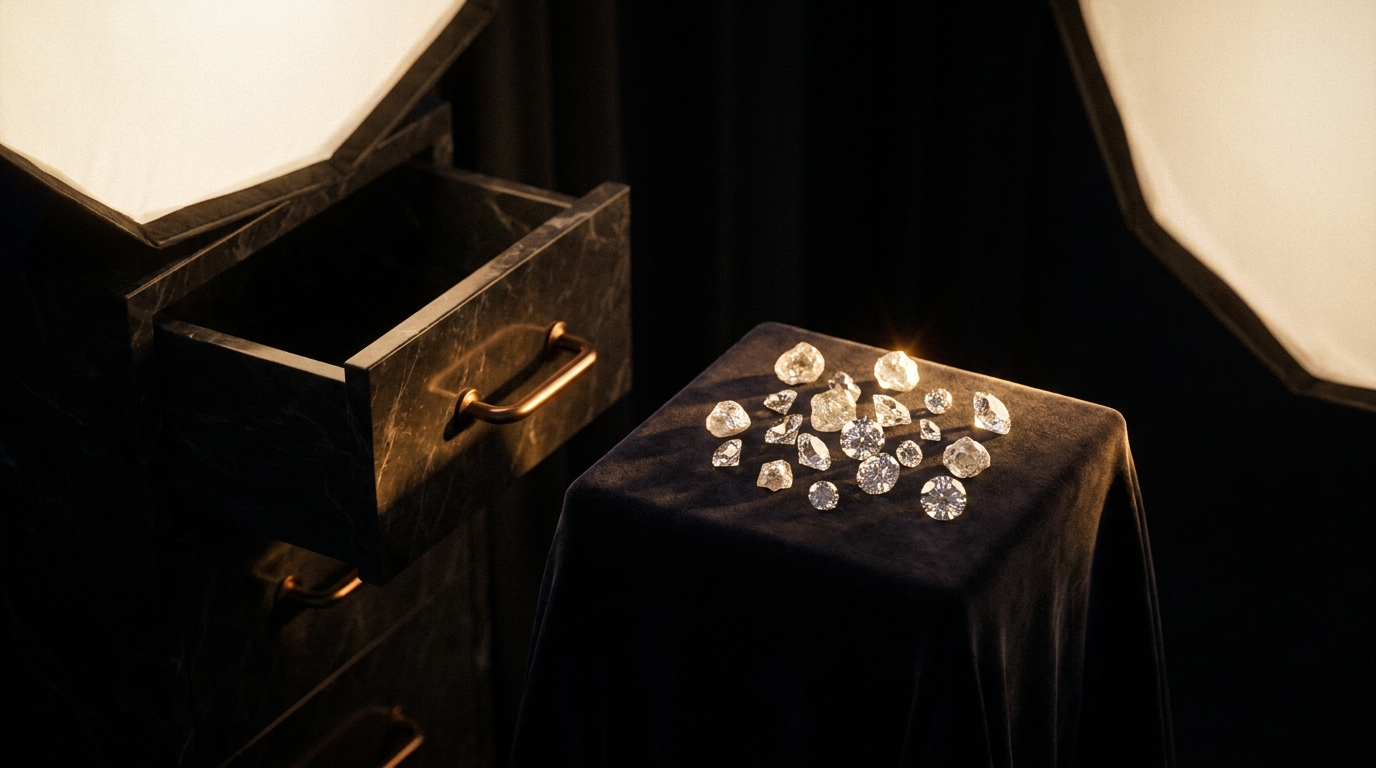
On a quiet weekend in February 2003, a vault buried two floors beneath the streets of Antwerp gave up a fortune. By the time the diamond district stirred to life on Monday morning, more than a hundred safe deposit boxes had been emptied of loose stones, gold, and jewelry valued at upwards of one hundred million dollars. No alarm had sounded. No guard had stirred. No window had been broken. The press, reaching for a measure equal to the audacity, called it the heist of the century — and for once the phrase was not hyperbole. To this day it remains the largest diamond theft ever committed, and most of what was taken has never been seen again.
What makes the Antwerp diamond heist endure, more than two decades on, is not only its scale but its strangeness. This was not a smash-and-grab. It was a patient, years-long act of impersonation, executed against one of the most heavily defended rooms on earth, by men who never fired a shot. And it was undone, in the end, not by a detective's flash of genius but by a half-eaten sandwich tossed into a ditch. It is a story about how much desire a small, cold crystal can concentrate — and about the one thing a stolen diamond can never carry with it.
At VERANE, our days are spent in the company of stones with long memories: diamonds that have passed through estates, auction houses, and the occasional scandal. The Antwerp diamond heist belongs to that lineage of tales that remind us why provenance — the documented life of a jewel — is not a formality but the very thing that makes a stone truly, securely yours. To understand why, it helps to begin where the diamonds did.
Antwerp, the world's diamond heart
To understand the Antwerp diamond heist, one must first understand Antwerp. For more than five centuries, this Belgian port has been the gravitational center of the world's diamond trade. It was here, by legend, that a Bruges goldsmith named Lodewijk van Berken perfected the scaif — a polishing wheel charged with oil and diamond dust that, around 1475, allowed facets to be cut with true symmetry for the first time. The craft took root in the Low Countries and never left. By the twentieth century the great majority of the world's rough diamonds passed, at one point or another, through a handful of streets clustered behind Antwerp's central station.
The district is small, dense, and deceptively ordinary. Along Hoveniersstraat, Schupstraat, and Rijfstraat — a quarter of perhaps one square kilometer, closed to traffic and watched by police, cameras, and bollards — billions of dollars in stones change hands each year inside plain mid-century buildings. The trade runs on a currency older than any contract: trust. Dealers still seal transactions worth millions with a handshake and the Yiddish-Hebrew phrase mazel und broche, "luck and blessing." A man's word and his reputation are his collateral. Discretion is not merely good manners here; it is the operating system.

That culture of trust is the district's great strength and, as the heist would prove, its quiet vulnerability. A place that runs on familiarity can be infiltrated by anyone patient enough to become familiar. The thieves did not have to break the system from the outside. They had only to be let in — and then to wait.
The man who became a regular
Into this world walked a courteous Italian who introduced himself as a diamond merchant. Leonardo Notarbartolo was, by every account, charming, soft-spoken, and entirely convincing — a man who could borrow a building's secrets simply by being allowed to belong there. He rented an office inside the Antwerp Diamond Center at Schupstraat 9–11, the very building beneath which the target vault lay. The lease came with something far more valuable than a desk: a safe deposit box of his own, in the vault he would one day empty, and a tenant's right to come and go.
For more than two years he played the part. He kept ordinary hours. He made small talk. He carried parcels and rented his box and became, to the guards and the neighbors, an unremarkable fixture of the place. All the while he was studying it — the rhythms of the security staff, the placement of every sensor, the choreography of the vault door. He is alleged to have installed a tiny camera above the vault door, disguised among the fittings, that recorded the guards entering the combination and transmitted the footage to a storage device hidden inside a fire extinguisher. The vault was, in effect, filming its own betrayal.
This is the detail that unsettles people most about the Antwerp diamond heist. The most sophisticated lock in the building was the assumption that a polite regular with a key and a reason to be there was exactly who he claimed to be. Social engineering — the patient cultivation of trust — did more to open that vault than any tool the crew would later bring downstairs.
The School of Turin
Notarbartolo did not work alone. Investigators came to believe he was part of a loose fraternity of expert Italian thieves the Belgian press christened the School of Turin — La Scuola di Torino — a network prized for meticulous planning and technical artistry rather than brute force. In later interviews Notarbartolo described his accomplices only by nicknames, refusing to say which alias belonged to which man, and the portraits he sketched have the texture of a heist film precisely because the heist itself was so improbable.
There was Speedy, an anxious, paranoid man and a long-time friend, who would draw the unlucky job of disposing of the crew's garbage; Belgian police came to believe this was Pietro Tavano. There was The Monster, tall and powerfully built, said to be a gifted lock picker, electrician, mechanic, and driver all at once, whom police identified as Ferdinando Finotto. There was The Genius, a specialist in alarm systems, believed to be the electronics expert Elio D'Onorio. And there was The King of Keys, an older man described as one of the finest key forgers in the world — a craftsman whose true identity has never been established, and who, as far as the public record shows, was never caught.
Each man, in this telling, was a specialist, and the heist was less a robbery than a collaboration — a dark mirror of the very craftsmanship Antwerp is built on. The same district that prizes the master cutter and the master setter was undone by a team of masters of a different kind.
The vault that could not be cracked
The vault beneath the Diamond Center was considered close to impregnable, and the list of its defenses reads like a catalogue of everything a designer could think to fear. It sat two floors below ground. The steel door carried a combination lock with an astronomical number of possible permutations and a magnetic field sensor that would raise the alarm the instant the two plates protecting it were parted. Inside and around it were infrared heat and motion detectors, a seismic sensor tuned to the faintest vibration, Doppler radar, and a light sensor. The building above ran its own private security force, and the whole quarter was among the most surveilled in Europe.
Then there were the boxes themselves. Each of the 189 safe deposit boxes was secured twice over — a unique key lock and a separate three-letter combination — so that even a thief standing inside the open vault would face nearly two hundred individual locks, each demanding both the right key and the right code. The architecture of the place assumed that defeating any one layer would be useless, because the next layer would catch you. To win, an intruder would have to defeat all of them, in sequence, in the dark, and leave before morning. It was supposed to be impossible. The interest of the story lies in watching the impossible come quietly apart.
How the thieves cracked the vault
The genius of the operation was that almost none of it happened in a hurry. Much of the work was done, calmly, in the days and weeks before the theft. According to the account assembled in Flawless, the definitive book on the case by Scott Andrew Selby and Greg Campbell, the crew dismantled the vault's defenses one assumption at a time.
The magnetic sensor on the door was the most elegant problem. At a moment earlier in the week when the field was inactive, the bottoms of the screws holding its two plates were quietly cut away and the plates held in place with adhesive tape, so that the alarm circuit could later be kept intact with a custom aluminum plate even as the door was opened — the sensor fooled into believing it had never been disturbed. The thermal and motion detector was disabled with something almost insultingly mundane: on what looked like a routine visit, a film of ordinary hairspray was sprayed across its lens, dulling its sensitivity. The combination, captured on the hidden camera, was already known. And a long, two-part, three-dimensional key — the work, presumably, of the King of Keys — completed the door.
On the long weekend of 15–16 February 2003, with the district emptied and the offices silent, the crew let themselves in. They killed the lights and swung open the vault door, then pried apart the day gate with a crowbar. To slip past the infrared sensor inside, a thief held up a shield of polystyrene to mask his body heat and fixed it in front of the detector; the ceiling light sensor was simply covered with tape, after which they could switch the lights back on and work in comfort. Then came the long, patient labor of the night: with a custom-made, hand-cranked device they levered open box after box — 109 of the 189, by the official count, though early reports such as the BBC's mistakenly put the figure at 123. They emptied the loose diamonds, the gold, the cash and securities into bags, took what they could carry, and walked out into an ordinary Antwerp morning. On its own terms, it was a masterpiece of patience.
The fortune that vanished
What disappeared that weekend has never been fully accounted for, and it may never be. The figure most often cited is more than one hundred million dollars, but the true total is genuinely unknowable; in a district built on privacy, not every dealer who lost stones was eager to declare exactly what had been sitting, untaxed and uninsured, in a private box. Some losses, almost certainly, were never reported at all.
The deeper problem for investigators was the nature of the loot. Much of the haul was loose, uncut, and unmarked — the most untraceable form a fortune can take. A signed, polished, certificated diamond leaves a paper trail; it can sometimes be recognized by its proportions and inclusions, like a face in a crowd. But a parcel of rough stones poured into a velvet pouch becomes, almost instantly, anonymous money. Scatter those stones across a dozen markets and they dissolve into the global river of diamonds, indistinguishable from any other.

It is a vanishing that resonates with other great losses in the history of fine jewelry. We have written before about Cartier's lost Patiala Necklace, a masterpiece dismantled and scattered until only a gutted fragment remained, and about the lost Fabérge eggs of the Romanov court, several of which are still missing a century after they were sold off. Some of the most fascinating vanishings involved not just the objects but the investigations — inquiries suppressed to protect powerful names, evidence filed away, culprits never charged; the theft of the Irish Crown Jewels from Dublin Castle in 1907 is the defining example of that darker pattern. The same disappearance recurred in our own century: most of the gems taken in the Hatton Garden heist of 2015 were prised from their settings and never recovered — nor were the stones taken in the 1964 theft of the Star of India sapphire from the American Museum of Natural History, a brazen overnight raid that stunned New York before a swift recovery closed the case. Stones and the jewels they sit in have a way of slipping out of history — and, sometimes, of slipping back in when no one expects it. The diamonds taken from Antwerp simply slipped out, and for the most part stayed gone.
Undone by a sandwich
If the heist was a triumph of planning, its unraveling was almost comically human. A crew that had spent two years anticipating every sensor failed to solve the most ordinary problem of all: what to do with the trash. In the days after the robbery there was incriminating refuse to dispose of — packaging, receipts, food wrappers, the small detritus of men who had spent a tense weekend underground. The job fell to the anxious accomplice, who dumped it along a wooded stretch beside the E19 motorway between Antwerp and Brussels.
The land happened to belong to a retired grocer named August Van Camp, a man with a standing grievance about people fly-tipping on his property. When he found the fresh pile of garbage the next morning, he did what an aggrieved landowner does: he called the police — and, as it turned out, he had been complaining about that particular spot for long enough that someone listened. Among the debris investigators found receipts, a videotape from the Diamond Center, and — the detail that has since passed into legend — a partially eaten salami sandwich.
The sandwich carried DNA. That DNA matched Leonardo Notarbartolo, the courteous merchant who had, with remarkable nerve, returned to the Antwerp Diamond Center only days after the theft and was already under the eye of the city's specialist diamond detectives, led by Agim De Bruycker. He was arrested on 21 February, five days after the heist. A vault that had withstood ten layers of engineered security had been betrayed, in the end, by a crust of bread thrown into a ditch. There is a hard little lesson in that, and it is the same one every great jewel teaches: it is rarely the stone's defenses that fail. It is the people around it.
The trial, the sentence, and the diamonds that never came back
Notarbartolo was found guilty of orchestrating the Antwerp diamond heist and, in 2005, sentenced by the Antwerp court of appeal to ten years in prison. The men police identified as his accomplices — Pietro Tavano, Elio D'Onorio, and Ferdinando Finotto — each received five years. The King of Keys, the master forger at the heart of the operation, was never publicly identified and never stood trial.
The justice was real but incomplete, because the prize itself was gone. Despite the arrests, the overwhelming majority of the stolen diamonds were never recovered. They had become, as loose stones do, untraceable — dispersed into a market that asks few questions of a clean, colorless crystal. Notarbartolo was released on parole in 2009, but the story did not end there. A condition of his parole was that he compensate the victims of the heist, which he never did; in 2011 a European Arrest Warrant was issued, and in 2013 he was detained at Paris's Charles de Gaulle airport during a layover on a flight from the United States to Turin. He was returned to a Belgian cell to serve out the remainder of his sentence, finishing in 2017. The stones, meanwhile, stayed missing.
The other story: was it really an insurance fraud?
No account of the Antwerp diamond heist is complete without the version Notarbartolo himself offered — and a careful reader should treat it as exactly that: a claim made by a convicted thief, not an established fact. In a celebrated 2009 interview with Wired magazine, he insisted that the truth was murkier and more cynical than the legend. He claimed the crew had been hired by a diamond merchant from within the trade; that the real haul was far smaller than reported, perhaps around eighteen million euros; and that the whole affair was engineered as an insurance fraud, with someone positioned to claim the value of stones that had quietly been removed in advance.
It is a seductive story, because it flatters our suspicion that the most spectacular crimes must have a hidden hand behind them. But experts have largely dismissed it. As the authors of Flawless noted, the vault had actually been denied an insurance policy because of its security shortcomings — which makes a fraud built on collecting that insurance close to impossible. Notarbartolo had every motive to muddy the record, to settle scores, or simply to spin a better tale than the unglamorous truth. The most likely version remains the simplest: a brilliant, patient theft, betrayed by careless garbage. We include his account here not because we credit it, but because the willingness to question a too-convenient story is the same instinct that protects a collector. In jewelry as in crime, the tidy narrative is the one to examine hardest.
The heist of the century in popular imagination
Few crimes have been retold as often. The case became the subject of Flawless: Inside the Largest Diamond Heist in History, the meticulous 2010 book by Scott Andrew Selby and Greg Campbell that remains the standard account. In 2025 Netflix released a documentary, Stolen: Heist of the Century, drawn from that book and produced by Steven Spielberg's Amblin Entertainment with Raw TV. Pierce Brosnan has narrated the episode devoted to it in a heist series; Michael Caine's audio anthology opens with it; and a scripted Italian drama, Everybody Loves Diamonds, dramatized the whole improbable saga in 2023. The Antwerp diamond heist has become, in other words, modern folklore — the rare true crime so well-constructed that storytellers keep returning to it as if to a perfect machine.
The fascination is understandable. The heist offers everything: an impregnable vault, a gentleman thief, a team of named specialists, a fortune in the world's most concentrated form of wealth, and a downfall as ordinary as litter. But beneath the glamour there is a quieter truth that matters far more to anyone who actually buys and keeps fine jewelry.
What the heist of the century teaches a collector
It is tempting to read the Antwerp diamond heist purely as a caper, and it is a marvelous one. But for those of us who care about provenance, the deeper lesson is about traceability and trust — the two things the thieves spent two years dismantling. The stones that vanished from Antwerp were valuable precisely because they were anonymous: undocumented, uncertified, easy to move and impossible to identify. Their lack of a history was not a flaw in the eyes of a thief; it was the entire point.
The pieces we are proudest to handle are the exact opposite. They are signed, dated, and accompanied by the paper trail of their lives — the maker's mark, the certification, the record of the hands they have passed through. A diamond with a name, an era, and an honest history is not merely more beautiful; it is more secure, because its story cannot be quietly erased. Consider the Cullinan Diamond, the largest gem-quality stone ever found: from the moment it was unearthed in a South African mine in 1905, every transfer, every cutting decision, and every placement in the Crown Jewels was publicly documented — the polar opposite of the anonymous rough in those Antwerp vault boxes. The same principle holds for colored stones: a Kashmir sapphire carrying an SSEF or Gübelin origin certificate commands its premium precisely because that document is the stone's biography — as impossible to fabricate as a genuine Golconda provenance. That is the difference between a stone that can disappear into a ditch and a jewel that belongs, unmistakably, to someone. Provenance is not paperwork for its own sake. It is the assurance that what you own is genuinely yours, and genuinely what it claims to be — the very thing the Antwerp thieves spent a fortune trying to strip away.
If you are drawn to diamonds whose histories are a matter of record rather than rumor, we invite you to explore our current estate diamond necklaces and estate diamond rings, alongside our latest acquisitions — each one documented, authenticated, and offered with its provenance intact. And when a particular piece speaks to you, we would be glad to request a private viewing on your behalf: an unhurried introduction to a jewel whose story we can tell you in full, from the first hand that wore it to your own. For more tales from the storied, sometimes scandalous world of historic gems, the Hope Diamond's own journey — recounted in our piece on the Hope Diamond's storied provenance — makes a fitting next chapter.