Golconda Diamonds: The Lost Mines and Legends of the First Water
Long before Brazil or South Africa, a granite fortress above the Deccan plain was where the world went for diamonds, and its name still marks the finest water a stone can have.
Before there was a Kimberley or a Minas Gerais, there was a road that ran east of the Deccan Highlands toward a granite citadel above the plain, and along it came merchants from Persia, Venice, Paris and London, all in pursuit of the same small, hard, nearly colorless objects. The citadel was Golconda. The objects were diamonds, and for most of recorded history the world had almost no other place to find them.
What Golconda Actually Means
The word is often spoken as if it named a single mine. It did not. Golconda was a fortress and a kingdom—the seat, from the early sixteenth century, of the Qutb Shahi sultans—and above all a market, where rough stones from a scatter of alluvial workings along the Krishna and Godavari rivers were bought, cut and sold. The deposits lay a week or two of travel from the fort; the trade lived in its shadow. Of the two dozen or so workings associated with the kingdom, the one history remembers best is the Kollur mine, on the south bank of the Krishna.

For roughly two thousand years, by the long-standing account, India was the only significant source of diamonds. That monopoly ended in the 1720s, when diamonds turned up in Brazil, and was finished off in the late 1860s and 1870s, when the discoveries in South Africa—the Eureka stone first, then the Star of South Africa—opened a different geology on a far larger scale. The great Cullinan diamond, found in South Africa in 1905, belongs to that later world, and is worth setting beside Golconda precisely because it is so unlike it: found in a kimberlite pipe, in a country the Golconda merchants never imagined.
Type IIa Diamonds and the Meaning of “Water”
The reputation of Golconda rests on something that can now be measured but was first simply seen. Most diamonds contain traces of nitrogen, which tints the stone faintly toward yellow. A small minority—commonly put at one to two percent of all natural diamonds—contain none. Gemologists call these type IIa diamonds. Many of the Golconda stones belong to that group: chemically as close to pure carbon as nature allows, and for that reason strikingly clear.
The old trade had its own vocabulary for what the eye perceived. A stone of exceptional transparency was said to be of the first or finest water, a phrase Tavernier himself used; the modern trade speaks of a limpid, almost liquid quality, as though light passed through the diamond rather than into it. It is a subtle distinction, and a difficult one to photograph. It is also the reason an experienced buyer will turn a Golconda stone slowly in daylight before saying anything at all.
The word diamond here deserves one caution. Type IIa describes a stone's chemistry, not its color or its price, and not every type IIa diamond came from Golconda. What distinguishes the Golconda stones is the combination—purity, transparency, and a documented origin in the Indian mines.
Tavernier and the Kollur Mine
Much of what we know of the trade in its prime comes from one man. Jean-Baptiste Tavernier, a Parisian gem merchant born in 1605, made six voyages to Persia and India between 1630 and 1668, and on the second of them reached the Kingdom of Golconda and the diamond workings at Kollur. His account, Les Six Voyages, published in Paris in 1676, remains the principal European eyewitness description of the Indian mines and of the courts that bought their produce. Smithsonian scholars call him the first European to describe the diamond mines of India in detail.
What he found was labor on an enormous scale and technology of the simplest kind: shallow pits dug into gravel and clay, crowds of men, women and children sifting by hand, the walls collapsing in heavy rains. Later estimates put the Kollur workforce in the tens of thousands at its height, though the figures vary between sources and should be held loosely. The rulers of Golconda claimed the largest stones for the crown, which is one reason the most famous diamonds of the age pass so quickly from mine to treasury.

The Famous Stones, and What Is Known of Them
Nearly every celebrated old diamond has at some point been attributed to Golconda. The honest record is more uneven, and it is worth sorting what is documented from what is merely repeated.
The Great Mogul is the clearest case of an eyewitness account. Tavernier examined it in 1665 in the treasury of the Emperor Aurangzeb, and recorded it as rose-cut and rounded, in his phrase like an egg cut in half, at about 280 carats by his reckoning. The Venetian lapidary Hortensio Borgio had cut it for Aurangzeb's father, Shah Jahan, and was said to have done so badly. Most modern scholars now identify the stone with the Orlov diamond in the Kremlin Armoury, though that identification, however widely accepted, is not beyond dispute. Its precise mine, too, is a belief rather than a fact.
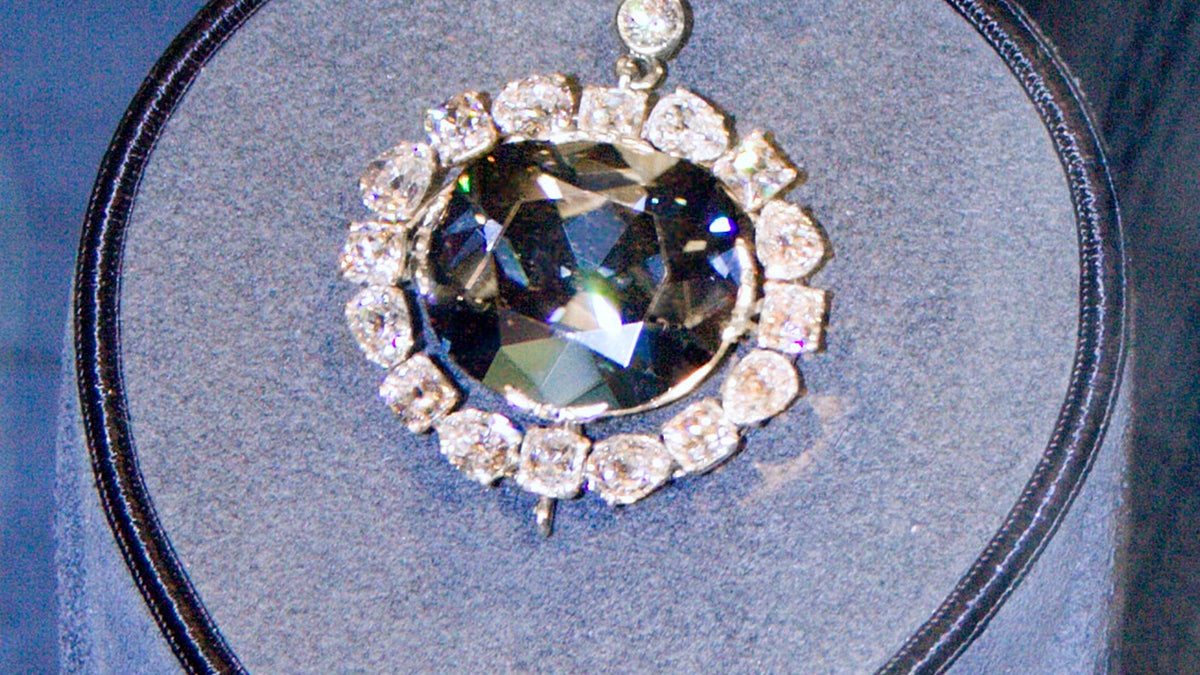
The Hope belongs to the same traveler. Tavernier acquired a large blue stone in India—the record does not name its mine, though tradition points to Kollur—and sold it to Louis XIV in 1668. It was recut for the king as the French Blue, stolen in 1792, and later emerged in London as a smaller stone. Smithsonian researchers concluded in 2005 that it was almost certainly cut from the French Blue, and the Hope Diamond has been in Washington since Harry Winston gave it to the Smithsonian in 1958. At 45.52 carats it is a type IIb diamond—boron, not an absence of nitrogen, gives it its blue—so it is a Golconda stone of a different and rarer kind. The tale of a curse that followed it is a later invention, and entirely legend.
The Regent has a firmer paper trail. Thomas Pitt, the governor of Fort St. George, acquired it from an Indian merchant around 1701, had it cut in London to about 141 carats, and in 1717 sold it to Philippe, Duke of Orléans, then Regent of France. It has been at the Louvre since 1887. The familiar story of a slave who hid the rough stone in a wound and was murdered for it is legend; Pitt's purchase is not.
The Koh-i-Noor is a more tangled matter. Victorian writers linked it to Kollur and to Tavernier's Great Mogul, but modern scholarship doubts both links, and the stone's origin is, honestly, unresolved. It now weighs 105.6 carats and is shown in the Jewel House at the Tower of London. The Dresden Green, a 41-carat natural green stone acquired by Augustus III of Poland at the Leipzig fair in 1742, is generally attributed to the Indian mines as well, though its earliest history is slight and the attribution is received opinion rather than record.
The Idol's Eye, a 70.21-carat stone, is said to have been prised from the eye of a temple idol. That is legend, and a pleasing one. What is documented is its later life: it was among the diamonds owned by the Ottoman sultan Abdul Hamid II, passed to Harry Winston in the twentieth century, and is now in private hands.
Why the Name Still Carries Weight
The mines are gone. Worked hard through the seventeenth and eighteenth centuries, the Golconda deposits were largely spent by the first half of the nineteenth, and much of the Kollur site now lies beneath the waters of an irrigation reservoir for most of the year. No new Golconda diamond will ever be mined. Every stone that bears the name is therefore an old one, and each is a survivor of a trade that wound down in the early nineteenth century.
This is why Golconda has become a term of distinction at the great auction houses. It is applied not as a place-name alone but as a verdict: a stone of the first water, of type IIa purity, with a credible origin in the Indian mines. Diamonds carrying that attribution have sold at auction for a considerable premium over comparable stones without it—a measure of how seriously the market takes the word, and of how little supply remains to meet it. In 2013 a pink 34.65-carat stone from the Jewels of the Nizams of Hyderabad, the Princie, set a record for a Golconda diamond at Christie's.
We prefer to think of it differently. A Golconda diamond is a piece of a vanished economy, carried across continents by merchants who wrote down what they saw. To hold one is to hold the clearest possible evidence of a place that no longer produces anything at all.
Seeing Such Diamonds in Person
Old Indian diamonds do not often come to market, and when they do the attribution deserves the same scrutiny we would give a signature on a painting. At VERANE we speak plainly about what a stone's papers support and what they do not. If your interest lies in the period, the cutting and the provenance, our estate diamond rings are a place to begin, and we would be pleased to set aside an afternoon for you. Please request a private viewing, and we will bring the stones to the table—in good daylight, and without hurry.