The Dresden Green Diamond: An Apple-Green Stone and the Saxon Court That Kept It
The largest natural green diamond in the world — forty-one carats of apple-green, formed by radiation deep in the earth and kept by the Saxon court since the 1740s.
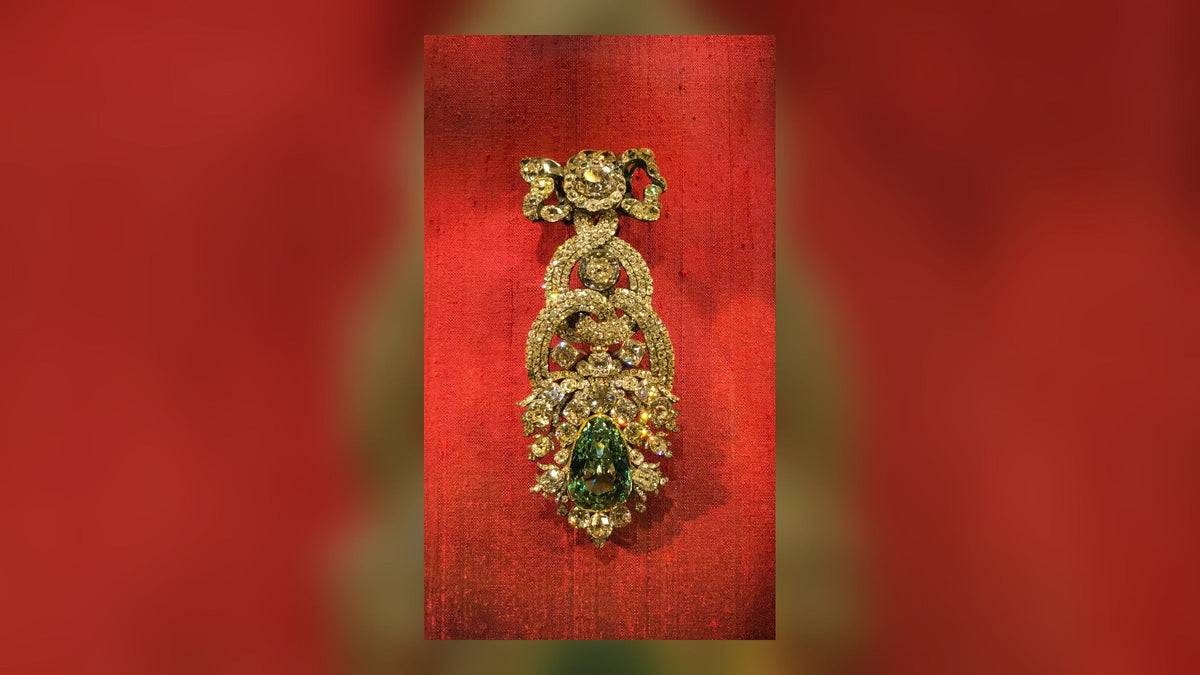
The first thing the record gives us is a date and a place of sale, not a name: October 1722, a London news-sheet, a notice of a large green diamond. After that the trail thins. A stone of roughly forty-one carats, an apple-green not seen before or since in a diamond of that size, appears for a moment in print and then vanishes into the private rooms of dealers and princes. What follows is as much the story of what is known as of what is not, and we have tried to keep the two carefully apart.
We know where it ends. The Dresden Green Diamond has been in Saxony for some two hundred and eighty years, and the court that acquired it is the reason we can say anything about it at all.
Golconda Origins: Where the Stone Most Likely Began
Nearly every great colored diamond of the early modern world comes back, sooner or later, to the same stretch of southern India. The region around Golconda, and the Kollur mine area in particular, supplied the stones that European courts and Mughal treasuries prized long before South African and Brazilian fields were opened. The Dresden Green is most likely a Golconda stone. The word is "likely" and not "certain," because no document ties it to a mine, and anyone who tells you otherwise is supplying the paperwork.
This is the same Indian ground that is associated with the Hope Diamond, a blue stone whose own early chapters are debated. Both belong to an age when a diamond left the earth with no certificate and arrived in Europe carrying only a merchant's word. The honest course, with the Dresden Green, is to treat everything before the 1720s as undocumented.

How the Dresden Green Got Its Color
Most diamonds are colorless carbon, and the exceptions are accidents of geology. Green is among the rarest of them, and the cause is almost literal: natural radiation. Over spans of time we have no instinct for, radioactive minerals and groundwater in the earth bombard the crystal and knock carbon atoms out of their places in the lattice. The vacancies left behind absorb red light, and what the eye receives is green.
The difficulty is that this radiation usually reaches only a little way into a stone. Many natural green diamonds carry their color as a thin skin or in scattered patches, and the cutter's work is to keep what he can. The Dresden Green is the exception that keeps collectors and gemologists returning to it: the apple-green is evenly distributed through the stone. It is a Type IIa diamond of very high clarity, which means it is exceptionally pure chemically, and the color is natural and untreated. It was made by the earth, slowly, and nobody improved on it.
The Largest Natural Green Diamond Arrives in Saxony
The stone reaches the Saxon court through Friedrich Augustus II, Elector of Saxony, who ruled in Poland as Augustus III. A Dresden inventory of 1741 is the first place the diamond is noted there. A tradition, repeated often and never fully proved, says he bought it at the Leipzig fair around 1742. Take that as the tradition it is. What is better attested is the price. Frederick the Great, no admirer of his Saxon neighbor and a careful counter of other people's expenses, reported it as about 400,000 thaler.
Such a purchase was not whim. Friedrich Augustus was the son of Augustus the Strong, who had spent a reign turning Dresden into a stage for the Saxon dynasty and who had given the court's treasure rooms their lasting form. In that culture, jewels were an instrument of state: they proved wealth, lineage and taste to rival houses at a glance. A green diamond of this size, with nothing comparable in any other treasury, was precisely the kind of object such a court wanted to own. It remains, today, the largest known natural green diamond.
For readers who keep a list of the great named stones, it sits oddly among its famous neighbors. It is not the largest diamond ever found: that distinction belongs to the rough Cullinan, unearthed in South Africa in 1905. It is not a blue stone with a legend of misfortune attached. Its distinction is quieter and, to our eyes, more interesting. Color of this kind, at this size, with no flaw in the saturation, was a thing nature produced once.
The 1768 Hat Ornament
A stone alone is a stone. The Dresden Green is remembered as a jewel because of how it was framed. The court jeweler Franz Michael Diespach set it in 1768 in the ornament it still wears, a hat clasp, or aigrette, of the sort worn on a nobleman's hat at the courts of the century. Diespach worked with earlier elements made by Jean Jacques Pallard in 1746, so the piece carries two hands and two decades of the Saxon workshop's thinking.
The design is plain in the best sense. Two large brilliant-cut white diamonds flank the green stone, and 411 medium and small diamonds surround it. The setting does not compete with the diamond. It supplies a cold, clear white field against which the green reads as a color and not as a glitter. The white stones are the argument; the green is the conclusion. It is a good lesson in how the eighteenth century understood display, and it is the reason a stone of this size could be worn on the head of a man in motion, in candlelight, among other men doing the same.
The Green Vault and What It Has Survived
The diamond belongs to the Grünes Gewölbe, the Green Vault, within the Staatliche Kunstsammlungen Dresden. The name has nothing to do with the diamond: the vault is said to take it from the green-painted pillars of its original rooms, a detail that has the pleasant look of a coincidence and is simply an old name. Augustus the Strong shaped the vault into one of Europe's great treasuries, and his son added to it.
The twentieth century was not kind to Dresden. The city was devastated in February 1945, and in the confusion that followed, Soviet forces removed the treasures from the Saxon collections. They were returned in 1958, and the Green Vault was painstakingly rebuilt and reopened in the decades since. The Dresden Green came back from that long absence, and it is part of the reason the museum's rooms carry the weight they do.
Then, on November 25, 2019, thieves broke into the Historic Green Vault in a burglary that shocked the museum world. The Dresden Green was not there. It was in New York, on loan to The Metropolitan Museum of Art for the exhibition "Making Marvels," where it was seen by an American public that had rarely had the chance. A loan arranged months earlier for ordinary reasons of scholarship and exhibition kept it out of the building that night. We would not call that luck a moral. We will say only that museums lend their great objects so that they may be seen, and on this occasion the lending did more than anyone planned.

What the Stone Confirms
Set the facts side by side and the Dresden Green tells a consistent story. It was formed by radiation over eons, mined most likely in Golconda, carried to Europe by routes we cannot trace, bought by a Saxon elector for a sum his rival thought worth recording, and fixed in a hat ornament by a court jeweler in 1768. It has stayed in Dresden since, through war, loss and return. At every stage the provenance is either documented or openly marked as unknown, and that candor is, in our view, part of what makes it trustworthy.
That is the standard we hold at VERANE. A jewel is more than the weight and color of its stone; it is the unbroken chain of hands, places and decisions that brought it to the present. The great named diamonds are the extreme case, but the principle reaches down to every piece we handle. An unusual color, a maker's mark, a dated inventory entry, an honest gap in the record: each is information, and each deserves to be read carefully before the stone is admired.
The Dresden Green will remain in Saxony, where it belongs. If its story has made you curious about what a good provenance looks like at a more personal scale, we would be glad to show you. Our collection of vintage and estate diamond rings gathers pieces whose histories we have researched with the same care, and you are welcome to request a private viewing to see them in person.
Eleanor Verane