Archaeological Revival Jewelry: The Castellani Family Who Resurrected Ancient Rome
How a Roman family of goldsmiths studied Etruscan tombs and the Campana collection, chased the lost secret of granulation, and gave the nineteenth century its most learned jewelry style.
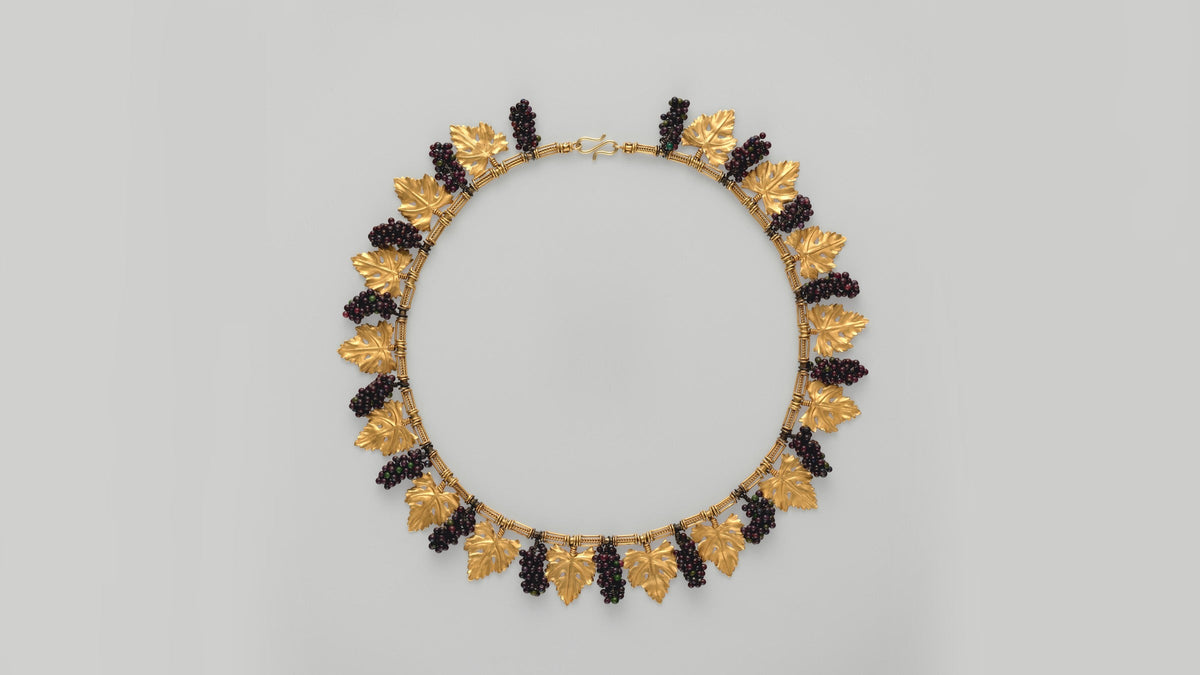
In the spring of 1862, visitors to the International Exhibition in London paused before a case of gold that looked as though it had been lifted from a tomb. Tiny spheres of metal, each smaller than a grain of sand, formed borders, triangles and rosettes across surfaces of warm, unpolished yellow. The jewels were new, but their grammar was thousands of years old. They came from a Roman house of goldsmiths, the Castellani, and they would give a name to one of the Victorian era's most enduring tastes: archaeological revival jewelry.
It is a story about a family, a buried civilization, and a technique that nineteenth-century goldsmiths could admire but not quite explain. It is also a story with a few legends tucked inside it, and we will mark them as we go.
Fortunato Pio Castellani and the Roman Workshop
Fortunato Pio Castellani (1794–1865) opened his goldsmith's workshop in Rome in 1814, in the shadow of a city that was already a destination. The Metropolitan Museum places the shop near the Trevi Fountain, and in those years Rome's visitors were the young gentlemen, artists, writers and collectors of the Grand Tour, who arrived to study antiquity and left with something to carry home. Jewelry fashioned in the manner of the ancient world was an obvious souvenir, and the Castellani understood the appetite early.
What distinguished Fortunato from his competitors was not merely commerce but curiosity. He became a friend of Michelangelo Caetani, later Duke of Sermoneta, a learned aristocrat and archaeologist who encouraged him to look to antique goldwork for inspiration. When the Regolini-Galassi tomb at Cerveteri was opened in 1836, its gold, worked in repoussé, filigree and granulation, offered a lesson no pattern book could. Fortunato studied the finds and set himself a task that would occupy his family for a generation: to make gold the way the Etruscans had.
By the 1850s he had passed the business to his sons. Alessandro (who died in 1883) became the firm's scholar, diplomat and traveling salesman. Augusto (1829–1914) became its antiquarian, assembling a study collection of ancient jewelry and goldsmith's work that later grew into a private museum. Fortunato himself died in 1865, just as the style he had imagined was reaching its widest audience.
The Campana Collection and the Etruscan Revival
The Castellani were not working from imagination alone. They had access to ancient jewelry itself, and one of the most important sources was the collection of the Marchese Giampietro Campana, a Roman antiquarian who amassed one of the largest private collections of his age. Campana was jailed for embezzlement in 1857, the charge arising from his role at the papal savings bank, and his holdings were afterward sequestered and sold. The greater part went to Napoleon III and the Louvre, with other pieces going to the Hermitage and to the South Kensington Museum, now the V&A.
The family tried to keep ancient jewelry in Italy as the sale loomed. Though most of it went abroad, the Castellani had by then handled the objects, restored and studied them, and in time built a personal collection of their own to serve as models. Handling the real thing mattered. An antique earring, held in the hand, reveals how a wire was twisted or a sheet was domed, and no drawing can quite say so.
The resulting style, often called the Etruscan revival or Italian archaeological jewelry, drew on Etruscan, Greek and Roman sources: amphora pendants, palmettes, rosettes, wreaths of gold leaves, and Roman intaglios and cameos mounted as if freshly excavated. The firm also made use of micromosaic, glass tesserae set in tiny patterns, which had its own Roman pedigree.

The Secret of Granulation
Granulation is the decoration of a gold surface with minute spheres, fixed so cleanly that they seem to rest on the metal like dew. The finest ancient examples show no visible solder at all; each grain touches the ground only at a single point. For centuries after the Etruscan world faded, no goldsmith could reproduce it with confidence.
How the ancients did it remains a reconstruction rather than a certainty. The explanation most often cited today, which took shape in the early twentieth century, holds that a glue mixed with powdered copper mineral was used to hold the grains in place; when heated in a low-oxygen atmosphere, the copper was freed to form a bond at the point of contact, fusing grain to sheet without conventional solder. Goldsmiths in Britain and Germany worked out practical versions of the method in the 1930s, long after the Castellani.
That final point is worth pausing over. The Castellani never fully recovered the lost method, and historians of the technique have observed that their granulation appears to have been conventionally soldered, with grains somewhat larger than the finest Etruscan work. Their achievement lay elsewhere: in creating a convincing, beautiful and entirely wearable modern idiom out of an ancient vocabulary.
The legend of the hill-town goldsmiths. The family's own account, repeated ever since, says that Alessandro went in search of living practitioners and found them in the hill country of central Italy, where village goldsmiths were said to have preserved a thread of the old technique. In some tellings the town is Sant'Angelo in Vado, in others it is placed in Umbria, and the craftsmen were brought to Rome to work in the Castellani shop. It is a charming story, and it rests on the firm's own testimony rather than independent proof. We treat it as legend, and a useful reminder of how a good workshop story becomes part of the record.
Grand Tour Patrons and the 1862 Exhibition
The clientele was formidable. The Roman aristocracy, among them the Borghese, Doria, Torlonia and Orsini families, were steady patrons. Foreign visitors came as well; Nathaniel Hawthorne visited the shop in 1858, and Robert and Elizabeth Barrett Browning bought jewelry there in 1860 and 1863. The sculptor William Wetmore Story purchased a micromosaic brooch. One later scholar of the firm, Geoffrey Munn, wrote that no fashionable visitor to Rome would have considered the Grand Tour complete without calling at the shop.
Alessandro's politics shaped the firm's geography. A supporter of Mazzini and the Roman Republic, he left the papal states in 1860 for exile, opening a branch in Paris and, in 1861, one in London. He organized the Castellani display for the International Exhibition of 1862, and the attention it won made archaeological revival jewelry a fashion across Europe. By the Paris exhibition of 1867, nearly every important jeweler was showing something in the antique manner. Seen beside the rest of the period's Victorian jewelry, it stands out as one of the most intellectual strands of the age.

Giuliano, Melillo and the Rival Workshops
The Castellani trained, and then lost, some of their finest talent, and the style outgrew its originators. Carlo Giuliano (1831–1895), born in Naples, worked for Alessandro Castellani and was sent to London to help establish the firm's branch there in the early 1860s. He later worked independently, and by 1875 had a shop at 115 Piccadilly, where he became known for polychrome enamel, Renaissance-inspired designs and fine granulation. After his death in 1895 his sons carried on the business. Giuliano also worked in the archaeological idiom, as the Met's necklace of gold satyr heads strung with lapis and pearls shows.
In Naples, Giacinto Melillo (1846–1915) was placed in charge of the Castellani workshop in 1863 when still a young man. Augusto Castellani later stated that much of his brother's jewelry was Melillo's work. Around 1870 Melillo took over the workshop and traded under his own name, though he continued for a time to make Castellani-style jewelry that was sold through Alessandro. The collector Count Michel Tyskiewicz, writing in 1896, judged Melillo a goldsmith of the first order. The lesson for collectors is that the best of this tradition was a collaborative, cross-border craft, and not the product of one family alone.

Reading Castellani Marks and Collecting Archaeological Revival Today
Castellani pieces are sometimes stamped with a monogram described in standard references as interlaced C's set back to back. It is a helpful sign, but never a verdict on its own. Many pieces from the great revivalist workshops, including Melillo's, circulated without signature, and marks need to be read in the context of construction, materials and period. Our guide to how to read jewelry hallmarks sets out the principles, and the same caution applies here: a mark is evidence to be weighed against the object itself.
The qualities that interest a connoisseur are physical. Look for the quality of the wirework, a surface of satin gold with a deliberately soft finish, and the way ancient motifs are adapted rather than copied outright. Compare the discipline of the granulation with the hand-finishing described in our article on hand engraving and milgrain, a different craft with a related patience. Look, too, at how an intaglio or micromosaic is mounted, and whether condition and later alterations have been disclosed honestly.
Museums hold the benchmark examples, among them the Metropolitan Museum, the Victoria and Albert Museum and the British Museum, and the Castellani collections reached the Villa Giulia in Rome after the firm closed in the early twentieth century. Studying them is the best preparation for the market. At VERANE's estate jewelry, we approach this material as provenance first: where a piece can be attributed, we say so, and where it can only be described as in the manner of the Castellani, we say that instead.
The family's gift to jewelry history is, in the end, an idea: that the past can be studied closely enough to be made new. Nearly a century and a half later, the surfaces of those rosettes and wreaths still hold the light in an unusual way, soft and deep rather than bright. If the world of Etruscan revival and archaeological design appeals to you, our estate necklaces are a natural place to begin, and we would be glad to show you pieces in person through a private viewing.