Colombian Emeralds and the Spanish Galleons: Muzo, Chivor, and the Treasure Fleets
How the mines of Muzo and Chivor gave the world its standard of green, and how Spanish galleons carried it from Cartagena to Seville, to the seabed off Florida, and to the Mughal court.
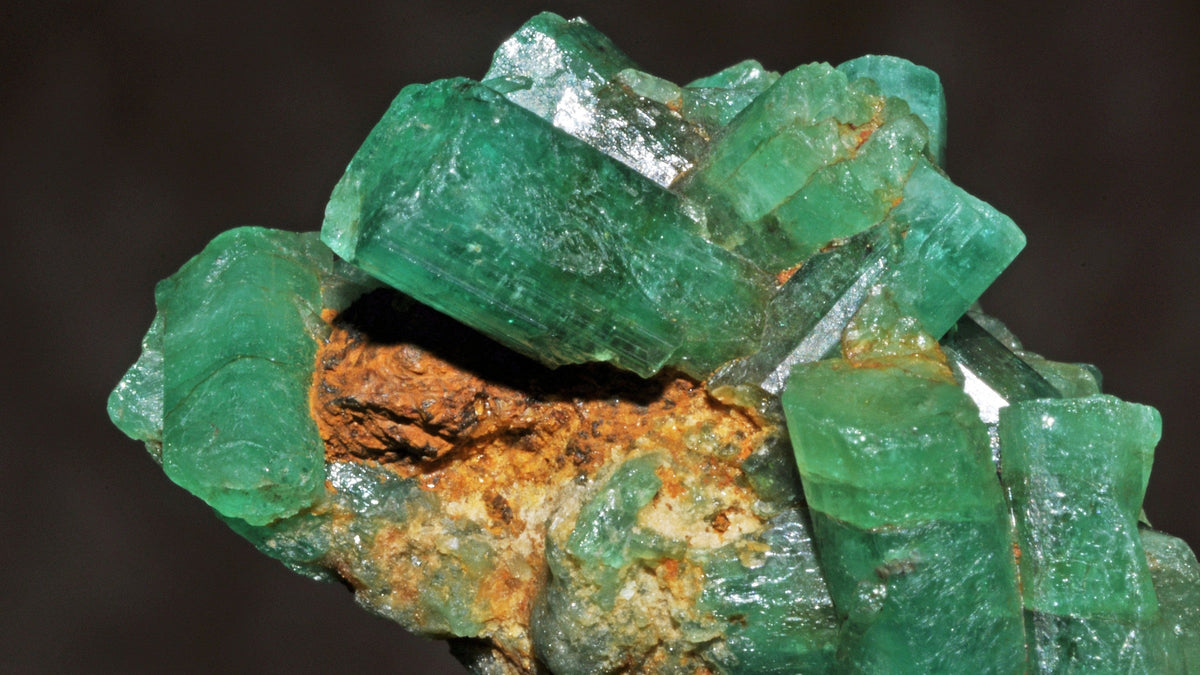
Before there was a Colombia, there was a green that the Muisca of the high Andean plateau carried, traded and offered, and that the men who rode up from the Caribbean coast in 1537 had not yet learned to name. Within a generation, Spain had named it, taxed it, boxed it, and put it on ships. Soon afterward, it was in Seville, in Goa, and at the Mughal court. Few gemstones have a biography so closely bound to a single place, and fewer still can be traced so plainly along the routes that carried them. These are the Colombian emeralds, and their story begins in two mountain mining districts: Muzo and Chivor.
Muzo and Chivor: Where Colombian Emeralds Began
The two great sources lie in the eastern cordillera of the Andes, in what is now the department of Boyacá and its neighbor Cundinamarca. Chivor, in the Somondoco valley to the east, was known to the Muisca long before any European arrived; the district takes its older name, Somondoco, from the lord who held it when the Spanish arrived. Muzo lies to the west, on the slopes that fall toward the Magdalena River, the territory of the Muzo people, who came to be nicknamed the “emerald people.” Their miners worked the rock with pointed wooden stakes, long before steel arrived.
The two districts are not twins. Muzo is the name the trade associates with the deepest, most saturated green, often with a slightly warm cast. Chivor stones are often a touch cooler and bluer. Collectors argue the merits of each with the conviction usually reserved for vintages of wine, and a good estate emerald with a laboratory report naming its origin is read the same way.
The Muisca, the Conquistadors, and the Cost of Green
Gonzalo Jiménez de Quesada left the Caribbean coast in April 1536 with an expedition that struggled up the Magdalena River and reached Muisca territory in early 1537. One of his captains, Pedro Fernández Valenzuela, came upon the ancient workings at Somondoco, where, in the record that survives, a leading local lord held the mines. Chroniclers of the conquest describe emeralds among the tribute and treasure the Spanish found in the Muisca towns, and the Spaniards seized what they could. We should say plainly what followed: the mines were worked by forced Indigenous labor, and later by enslaved Africans, and the human cost of the green that crossed the Atlantic was very large.
The richer deposits at Muzo came next. Spanish prospectors reached the district in the 1540s, but the Muzo people resisted for years; the captain Luis Lanchero is credited with finally subduing them around 1559 or 1560, founding the town of Muzo in the process. As Muzo came into production, Chivor was neglected. Mining there tapered off in the seventeenth century, its last documented activity falling in the 1670s, and by 1772 the mines were abandoned and their very location was forgotten. Colombian mining engineer Francisco Restrepo rediscovered Chivor in the 1880s by following old Spanish manuscripts, and in the early twentieth century a German gem merchant, Fritz Klein, put the mine back on the map.
A word about legend. The tale of El Dorado, the gilded king of Lake Guatavita, is a story the Spanish told themselves from Muisca accounts, and its emerald offerings are more reported than proven. Muzo has its own founding myth, of two lovers, Fura and Tena, turned into mountains. We repeat these as stories. The documented history is quite dramatic enough.
Gota de Aceite: Why Colombian Emeralds Set the Standard
Emerald is beryl colored by trace amounts of chromium and vanadium. Colombia’s emeralds formed under unusual conditions, from hot mineral-rich brines moving through black shale, and the crystals that resulted combine a saturated, even green with exceptional transparency in the best examples. Under the loupe, Colombian stones are often recognized by the three-phase inclusions, tiny pockets of liquid, gas and a salt crystal, that gemologists sometimes call a garden, or jardin.
The trade has a phrase for the finest of them: gota de aceite, a “drop of oil.” It is not a laboratory grade. It describes the look of a stone whose green seems to glow from inside, with a soft, liquid quality, as if a single drop of green oil had been caught in the crystal. When a dealer says it, he is saying the stone has life.
The world noticed. Before Colombia, the great emeralds of the ancient and medieval world came from the Egyptian workings near the Red Sea. By the late sixteenth century, the Spanish colonial stones had largely displaced them.

The Treasure Fleets and the Atocha
Once mined, the emeralds went to the coast, to ports such as Cartagena de Indias, where the Crown’s share, the royal fifth, was due before the rest was registered for shipment. From there they traveled aboard the annual convoys that linked the Americas to Spain: heavily armed galleons carrying silver from Potosí, gold, pearls, dyestuffs and emeralds, sailing together for protection through the Caribbean and out by the Straits of Florida. The system moved extraordinary wealth for much of two centuries, and it lost some of it to weather.

The best known loss is the Nuestra Señora de Atocha. In early September 1622, she sailed from Havana as part of the Tierra Firme fleet bound for Spain, and a hurricane drove her onto the reefs of the Florida Keys. She sank with the greater part of her cargo, and for more than three centuries she lay under the Gulf waters. Her main hull was found in 1985 by salvors working under Mel Fisher, and the recovery included a large quantity of rough emeralds, reported in 1986 press accounts, which the Gemological Institute of America cited as numbering more than 2,300. When GIA’s laboratory examined a group of the crystals, it identified them as Colombian.
It is a useful fact for anyone who loves old stones. The emeralds that surfaced from the Atocha confirmed, from the seabed, that Colombian emeralds were already moving toward Europe in quantity by 1622. A wreck dated to a single September is as firm a provenance as any stone can have.
From Seville to Mughal India
Seville was the clearing house. From there, emeralds went to the courts and jewelers of Europe, and, through Portuguese and Spanish trading networks into the Indian Ocean, to Goa and beyond. Mughal India became the single largest market. The Mughal emperors and their nobles prized the stone, and Indian lapidaries carved it as nowhere else: with flowers, with prayers, with the names and titles of owners. Many of the finest engraved emeralds that survive from the Mughal world are now believed by gemologists to be Colombian in origin, which is to say that the same green that left Cartagena aboard a Spanish galleon ended up, later, beneath an inscription in Persian or Arabic script on the other side of the planet.

The mounting in that photograph belongs to a later chapter, when an Indian prince had old stones reset in gold and diamonds. The Maharaja of Patiala was also the patron behind Cartier’s largest commission, which we tell in the story of the Patiala Necklace.
Colombian Emeralds in Estate Jewelry Today
For the collector, the history is not a footnote. It is the reason that an emerald from an old Art Deco ring or a Victorian suite can carry the weight of the whole story above. Colombia remains the benchmark by which other emeralds are measured, just as the Kashmir sapphire and the Burmese ruby stand for their own single places. Each is a stone one place made, and each rewards the patient collector who learns to read it.
A few honest notes belong here. Emeralds are nearly always treated with oil or resin to improve their clarity, and this practice is old and accepted in the trade, but the degree of enhancement matters and should be disclosed. Origin cannot be judged by eye alone; a respected laboratory report is the proper evidence, and we state an emerald’s origin only where one supports it. An estate emerald’s setting also tells its own tale, whether in the clean geometry of the 1920s and 1930s, the heavier gold of mid-century, or the claw settings of earlier decades.
If you wish to see how these stones look in period settings, our selection of estate emerald rings is the place to begin, and our estate necklaces and Art Deco jewelry carry emeralds of the same lineage. Each piece is one of one, authenticated and documented. If a particular stone has caught your eye, we would be glad to show it to you privately: request a private viewing.
Header photograph: rough emerald crystals on matrix, Muzo mine, Boyacá, Colombia, by Géry Parent, CC0, via Wikimedia Commons.