The Lost Romanov Jewels: Sewn Into Corsets, Scattered by Revolution
From diamonds stitched into the Grand Duchesses' clothing to the 1925 Fersman inventory and the 1927 Christie's sale, the documented story of the Russian imperial jewels and where they scattered.
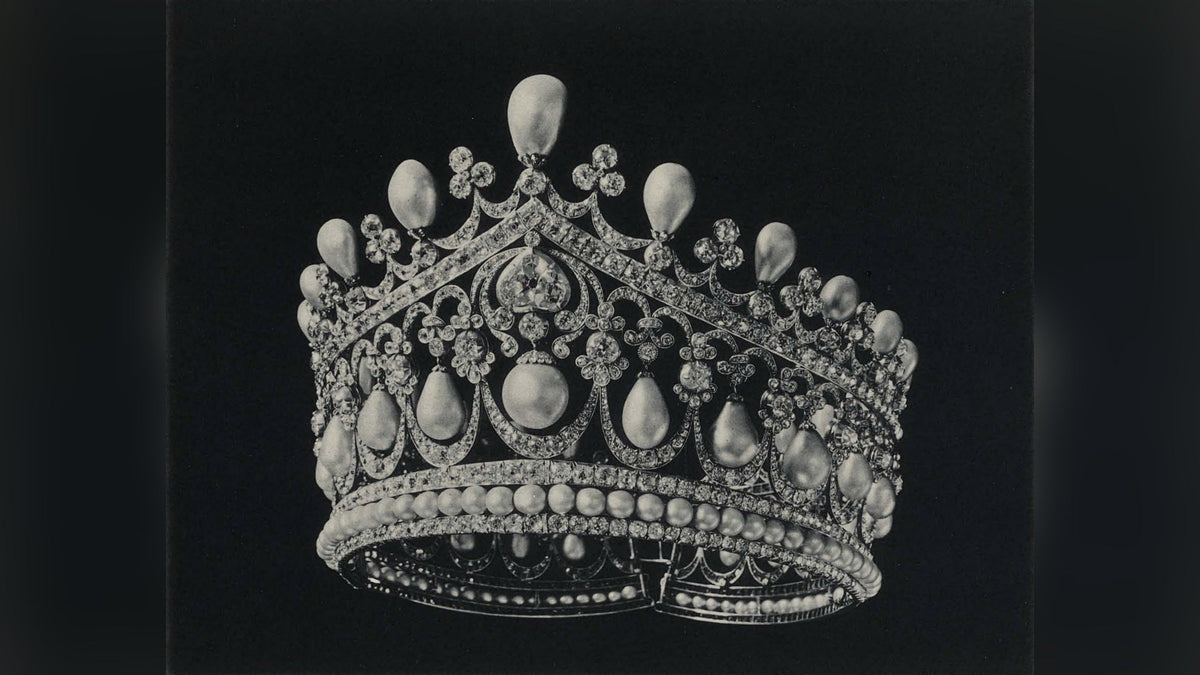
On the night of 16–17 July 1918, in the cellar of a requisitioned house in Yekaterinburg, the last Russian imperial family was killed. It is a subject that deserves restraint, and we approach it here only as far as the jewels require. Accounts differ on many details, but a thread runs through them: the Grand Duchesses and their brother had, by several accounts, sewn precious stones into their clothing and undergarments, as a private reserve against a future none of them could see. What became of those stones, and of the far larger treasure the dynasty left behind, is the story of the lost Romanov jewels.
Jewels sewn into corsets: what the record says
The popular image is vivid: gems stitched into the corsets of the four Grand Duchesses, so many that the stones turned bullets and prolonged the killing. Historians are more careful. Robert Massie, as cited in the standard reference accounts, describes the three younger sisters, Tatiana, Maria and Anastasia, as carrying more than 1.3 kilograms (about 2.9 pounds) of diamonds sewn into their clothing, and notes that the stones may have given them some protection from the first volley. Alexei is reported to have had jewels sewn into an undergarment and his cap, and the maid Anna Demidova a small pillow filled with gems.
The details beyond that are contested. Witnesses and later investigators disagreed about which daughter wore what, and the often-repeated claim that the jewels "deflected" the bullets rests on later testimony rather than anything measured. Accounts cited by Helen Rappaport describe the men who handled the bodies searching them for hidden stones, and a bag of diamonds weighing some 8.2 kilograms reaching Yekaterinburg afterward. We treat the figures as reported, not established. What is clear is the reason for the stitching: a family under guard had every cause to hide something portable and durable, and a diamond is both.
The Bolshevik seizure of the imperial crown jewels
The jewels in the cellar were the family's private reserve. The imperial crown jewels, the regalia and state treasure of the dynasty, were a separate matter. Collected from the reign of Peter the Great onward, they had been kept at Saint Petersburg and were moved to Moscow during the First World War. After the Bolsheviks took power, the treasure passed into the keeping of the new state, and in February 1920 the agency known as Gokhran was created to account for confiscated valuables.
One Russian account describes sealed boxes opened in the Kremlin Armoury in March 1922, with no inventories found among the stones. That date, and the claim about the missing lists, come from a single secondary source and we mark them as such. The surer record is the one the Soviet state itself published.

The Fersman inventory of 1922 and the 1925 plates
The treasure was formally examined in March and April 1922. The mineralogist Alexander Fersman wrote the descriptions, assisted by S. N. Troinitzky and A. N. Benois, with a panel of jewelers that included Agathon Fabergé, and the photographer I. N. Alexandrov made the plates. The result was Russia's Treasure of Diamonds and Precious Stones, published in 1925–26 by the People's Commissariat of Finance in four parts of twenty-five plates each, with English and French editions. It described 406 separate pieces, and each entry cites its place in the old imperial inventory of 1898 and in the new inventory of 1922.
The book stated that the jewels it showed would not be sold. In practice it served as a catalogue that foreign dealers could read, and later sales leaned on it. Only about twenty copies are known today, and the GIA Library's scan, placed online in 2016, gave the public its first full view. For anyone studying the imperial jewels, it is the foundation document.
It is also, for readers of this Journal, a useful reminder of scope. The Fersman plates concern the state treasure: crowns, diadems, orders, necklaces and loose stones. The Fabergé eggs belong to a different chapter, which we have told elsewhere in our pieces on the lost Fabergé eggs.
Soviet jewel sales and the 1927 Christie's sale
By the late 1920s the Soviet government needed foreign currency, and the treasure became a source of it. Estimates vary with the source, but by most accounts roughly three-quarters of the 773 items counted in 1922 were dispersed in the following years, and a large share of them in the 1920s and 1930s. The Great Imperial Crown and the Orlov Diamond stayed in what became the Diamond Fund.
A well-documented sale took place at Christie's in London on 16 March 1927. Billed as jewels of the Russian State, it offered 124 lots, many of them pairs or sets, mostly eighteenth-century work from the reigns of Elizabeth and Catherine the Great. It was not the family's personal jewelry. A syndicate that included the London dealer Norman Weisz (spelled Weiss in some accounts) had bought the consignment from the Soviet state for a reported £50,000. The diamond nuptial crown, lot 62, sold for £6,100 to the dealer Founès, and Pierre Cartier later acquired it.

Not everything sold was gathered and described. Many pieces from those sales were reset, divided or never traced again, which is why the 1925 plates matter: they are often the only careful picture of a jewel that left Russia.
The Vladimir tiara: a jewel carried out in a bag
Some of the dynasty's jewels left Russia by a different road. The Vladimir tiara was made by the Saint Petersburg jeweler Carl Edvard Bolin, at a reported cost of 48,200 rubles, and given in 1874 to Grand Duchess Maria Pavlovna by her husband, Grand Duke Vladimir. It was set with fifteen large pearl drops. In 1917 her jewels were hidden at the Vladimir Palace in Petrograd. The British dealer and intelligence agent Albert Stopford retrieved them, reportedly carrying them out in bags, and reached London in late September 1917. The Grand Duchess died in exile in 1920.
Her daughter, Elena, Princess Nicholas of Greece, inherited the collection and sold pieces to support her exiled family. In 1921 Queen Mary bought the tiara, with a diamond rivière, from her for a reported £28,000. Queen Mary later had it altered to hold fifteen of the Cambridge cabochon emeralds, with the pearl drops kept as an alternative, and the tiara passed to Elizabeth II in 1953. Its fuller afterlife belongs with the British crown jewels, but the point here is simple: a documented chain of owners, each of whom can be named.
What resurfaces, and why provenance matters
Jewels from the same Grand Duchess still reach the market. In November 2021 Sotheby's Geneva sold a sapphire and diamond brooch with matching ear clips, the brooch set with a 26.80-carat Ceylon sapphire of about 1900, which the house traced to Maria Pavlovna and to Stopford's 1917 journey. It had first been auctioned in 2009. Her emeralds followed another path: after her death her son Boris sold them to Cartier, who reset them, and they were sold again in 1936.
These stories share a pattern. A royal or noble jewel reaches the estate market through a dealer, a sale, an heir in need, or a jeweler's ledger, and what survives of its identity depends on paper: an inventory number, a maker's mark, a photograph, a receipt. When the paper is there, a piece can be read as history. When it is not, the honest course is to say so.
That is how we try to work at VERANE. Few pieces we handle have a documented imperial past, and we do not suggest otherwise. But the habits the Romanov jewels teach apply to any estate jewel: ask where it has been, ask who can prove it, and record what is known and what is only said. Our estate diamond necklaces are described in those terms, piece by piece.
If the history of Edwardian court jewelry draws you, we would be glad to show you Edwardian jewelry from our collection, in private, with whatever provenance we hold laid out beside it. You are welcome to request a private viewing at your convenience.