The Affair of the Diamond Necklace: The Con That Helped Topple a Throne
A forged signature, a hired look-alike queen, and 2,800 diamonds — the 1785 swindle that disgraced Marie Antoinette and helped light the fuse of revolution.
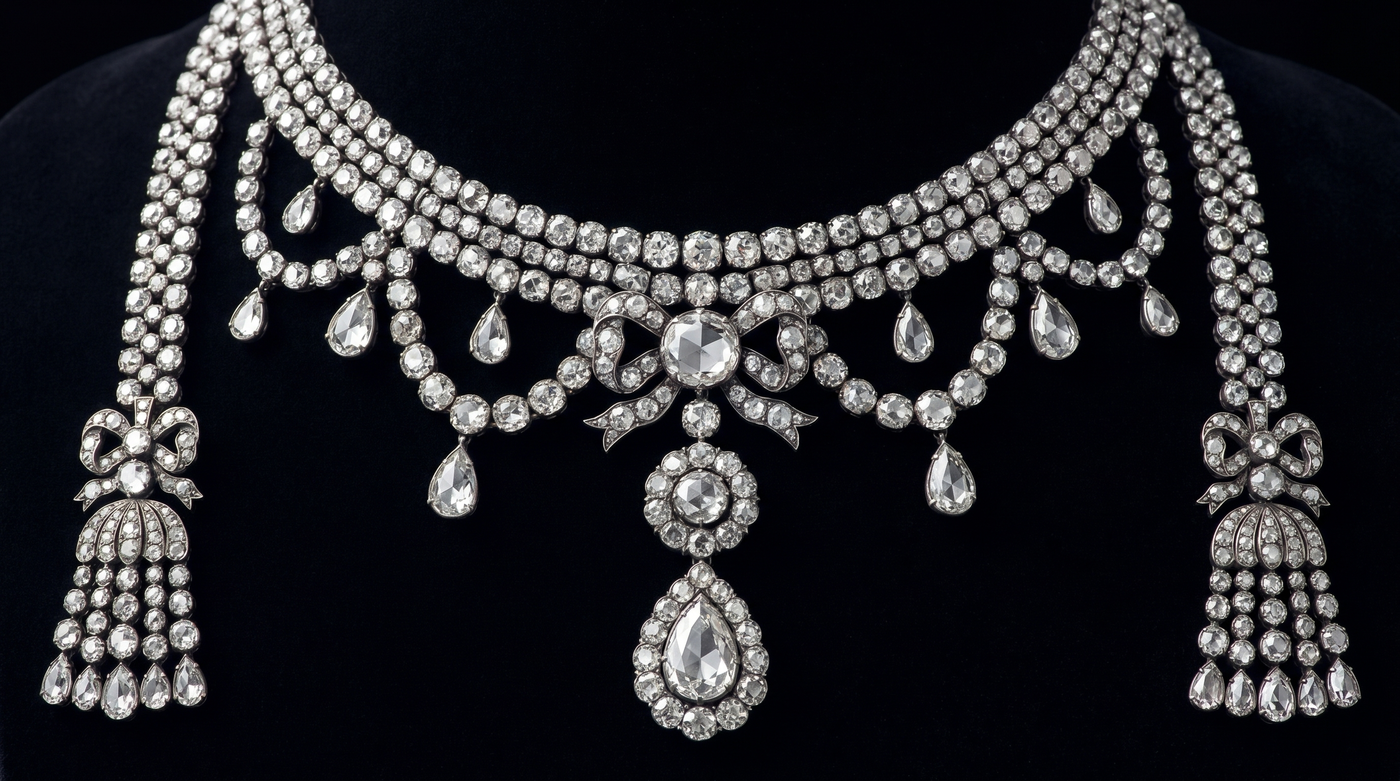
Some jewels are remembered for the necks they adorned. This one is remembered for the throne it helped bring down. The necklace at the heart of the most notorious scandal of the eighteenth century was never worn by the queen blamed for it — and within months of its disappearance it had ceased to exist at all, prised apart and scattered across London. Yet its short, strange life did more lasting damage than almost any piece of jewelry in history.
A Necklace Fit for a King's Mistress
The story begins not with Marie Antoinette but with an earlier court and an earlier appetite. In the early 1770s the Parisian crown jewelers Charles Auguste Böhmer and Paul Bassenge set out to build the most extravagant diamond necklace ever assembled, a cascade of brilliants intended for Madame du Barry, the mistress of Louis XV. They gathered hundreds of diamonds — by many accounts close to 650 stones, totaling some 2,800 carats, sourced patiently over years — into a riot of festoons, tassels, and looping strands designed to blaze across the chest and shoulders.

Then their market vanished. Louis XV died of smallpox in 1774, du Barry was banished from court, and Böhmer and Bassenge were left holding a masterpiece no one had commissioned and almost no one could afford. They turned to the new queen. Twice the necklace was offered to Marie Antoinette, and twice she declined it; by some accounts she found it gaudy, by others she remarked that France had more need of a warship than of such a bauble. The asking price had been pushed down toward 1.6 million livres, an astronomical sum, and still the jewelers could not move it. Their capital was frozen in diamonds. They were, quietly, facing ruin.
The Self-Styled Comtesse de la Motte
Into this opening stepped one of history's great confidence artists. Jeanne de Saint-Rémy de Valois could trace her blood, distantly and genuinely, to the Valois kings of France, but her childhood had been one of poverty and begging. She married a gendarme, Nicolas de la Motte, and the pair styled themselves Comte and Comtesse de la Motte, trading on her royal-sounding lineage to claw their way toward the edges of Versailles. She was charming, observant, and entirely without scruple, and she understood the one currency the court ran on: the appearance of favor.
Her mark was Cardinal Louis de Rohan, Grand Almoner of France, a man of immense wealth and wounded vanity. Rohan had badly offended Marie Antoinette years earlier and had been frozen out of her circle ever since. He longed to be restored to the queen's good graces, and that longing was a door Jeanne could see straight through. She let it be known that she was an intimate of the queen — she was not — and that she might intercede on the cardinal's behalf.
A Forged Signature and a Midnight in the Grove of Venus
What followed reads like theater because it was staged like theater. Jeanne produced a correspondence: warm notes, apparently from the queen to the cardinal, thawing and then encouraging. They were forgeries, written by her lover and accomplice Rétaux de Villette in a passable imitation of the royal hand. Rohan, desperate to believe, believed.
To seal his conviction, Jeanne arranged a meeting. On a summer night in 1785, in the shadowed Grove of Venus in the gardens of Versailles, the cardinal was brought to a veiled woman he took to be the queen herself. She pressed a rose into his hands and murmured a few words of forgiveness before being hurried away. The woman was Nicole Le Guay d'Oliva, a young Parisian of striking resemblance to Marie Antoinette whom Jeanne had hired for the part. Rohan left the garden certain he had been forgiven by his sovereign. He had been forgiven by no one.
Now the trap closed. The forged letters turned to the necklace. The queen, Jeanne explained, wished to acquire Böhmer and Bassenge's great jewel discreetly, paying in installments, and needed a trusted nobleman to stand as her agent. Rohan, flattered to be chosen, agreed. He negotiated terms with the jewelers, presented a contract bearing the forged approval of "Marie Antoinette de France" — a signature no true royal would have used, a detail his eagerness blinded him to — and in February 1785 took possession of the necklace.
The Diamonds Vanish into London
He handed it, as instructed, to a man he believed to be the queen's courier. The man was one of Jeanne's confederates. The necklace passed into the la Mottes' hands and was never seen whole again. Within weeks Nicolas de la Motte had carried the diamonds across the Channel to London, where the great strands were broken up and the stones sold off piecemeal to dealers who asked few questions about so sudden a supply of fine brilliants. The most expensive necklace in Europe had been reduced to anonymous loose diamonds, dispersed beyond recovery.
The scheme unraveled over money. When the first installment came due and no payment appeared, Böhmer — increasingly anxious — approached the queen directly to thank her for at last purchasing the necklace. Marie Antoinette had no idea what he meant. The truth surfaced piece by alarming piece, and on Assumption Day in August 1785, before the assembled court, Cardinal de Rohan was arrested in his ceremonial vestments and marched to the Bastille. Jeanne was seized soon after, along with d'Oliva, Villette, and the flamboyant occultist Cagliostro, swept up as a suspected accomplice.
The Trial That Disgraced a Throne
The crown made a fateful choice: rather than settle the matter quietly, it allowed Rohan to be tried before the Parlement of Paris. The trial became a public spectacle, and the verdict, handed down on 31 May 1786, was a catastrophe for the monarchy. The cardinal was fully acquitted — a humiliation for the queen, since the court had effectively ruled it plausible that Marie Antoinette might solicit a prince of the Church to buy her diamonds in secret. Rohan was stripped of his offices and exiled, but he walked free. Cagliostro, too, was acquitted.

Jeanne de la Motte was not so fortunate. She was sentenced to be whipped, branded on the shoulder with the letter V for voleuse — thief — and imprisoned for life in the Salpêtrière. She did not stay. Disguised as a boy, she escaped to London, where she published venomous memoirs heaping the blame on the queen, ensuring the slander outlived the crime. Marie Antoinette, by the consensus of historians, had done nothing — she neither ordered the necklace nor ever touched it — yet the public, already primed to resent her extravagance, decided the affair confirmed everything they suspected. The damage to her reputation was permanent.
What the Affair Left Behind
Napoleon would later call the Diamond Necklace Affair one of the events that led to the Revolution, and the judgment has stuck. A fraud built on a forged signature and a hired look-alike had exposed a monarchy that could be made ridiculous, and a queen the people were already prepared to hate. Three years after Rohan's acquittal, the Bastille fell.
For those of us who live among historic jewels, the affair carries a quieter lesson. Great pieces are fragile not only in their settings but in their very existence — a necklace of 2,800 carats could be unmade in a London back room and lost forever, exactly as Cartier's lost masterpiece, the Patiala Necklace, would be dismantled and scattered a century and a half later. The pattern of powerful institutions suppressing inconvenient truths to protect their own — prosecutions quietly shelved, investigations that named a culprit but filed the name away — repeats across the great jewelry scandals of history; the theft of the Irish Crown Jewels from Dublin Castle in 1907 is perhaps the most instructive later example. It is why provenance matters so profoundly: the documented, unbroken life of a stone is what separates a treasure from a rumor. The same instinct runs through the long, traceable history of jewels like the Hope Diamond, whose every owner can be named — the opposite of diamonds that simply disappear. That power of a famous diamond to seize public attention never fades: it was as vivid in 1969, when the world watched Richard Burton outbid Cartier for the 69-carat Taylor-Burton Diamond at auction, as it was in the gilded halls of Versailles two centuries before.
At VERANE we are custodians of pieces with histories worth keeping intact: signed, period, and certified estate diamond necklaces and other rare vintage and estate necklaces whose stories can be followed rather than guessed at. If you would like to discover a jewel with a provenance you can hold, we invite you to request a private viewing.