The History of Tiffany & Co.: Charles Lewis Tiffany and the House of the Blue Box
From a Broadway stationer's shop in 1837 to the Tiffany Diamond, the six-prong setting and the blue box, the history of Tiffany & Co. is the provenance beneath every signed Tiffany jewel.
A house that now stands for a single shade of blue began as a stationer's shop. The history of Tiffany & Co. is, at its root, the history of one man's judgment — a New England merchant's son who understood, earlier than his rivals, that Americans were about to want jewels, and that they would trust a house that told them plainly what things cost. For a collector of vintage and estate pieces, that history is not background. It is the provenance beneath every signed Tiffany jewel.
Charles Lewis Tiffany and the 1837 founding
Charles Lewis Tiffany was born in Killingly, Connecticut, in 1812. In September 1837 — the house's own account gives the fourteenth; other sources say the eighteenth — he and his friend John B. Young opened a shop on Broadway at Warren Street in New York. The stock was stationery and fancy goods, and the opening capital is usually given as $1,000, advanced by Tiffany's father. The firm's own records, as the house tells it, show takings of $4.98 across the first three days.
It was not an auspicious beginning, but the shop had a habit that was then unusual. Prices were marked on the goods, and payment was in cash, without credit or haggling. In the city's crowded commercial life, that plainness was itself a form of distinction. J. L. Ellis joined as a partner in 1841, and the firm traded for a time as Tiffany, Young & Ellis. In 1853, when Young and Ellis retired and Tiffany took control, the name became Tiffany & Co., and the business turned decisively toward jewelry and silver.
Tiffany's instinct for the public moment showed early. In 1858 he bought a length of the first Atlantic telegraph cable — the house's own history gives it as twenty miles — and sold short pieces as souvenirs. When the Civil War came, he is recorded as turning much of the firm's capital to swords, medals and other war materials. Both episodes tell the same story: a merchant who read events quickly and kept the confidence of his customers.

The King of Diamonds and the French crown jewels
The episode that gave Tiffany his sobriquet came from Europe's misfortunes. When the July Monarchy of Louis-Philippe fell in 1848 and the aristocracy of France grew anxious to convert its jewels into cash, Tiffany bought diamonds in quantity at depressed prices. The press took to calling him the "King of Diamonds." The epithet endures; the exact year and extent of the purchases are told differently by different sources, and we prefer to say so rather than to repeat a tidy date.
A second, better-documented chapter followed in 1887, when part of the French Crown Jewels was sold at auction in Paris. Tiffany & Co. bought several pieces, and the acquisition fixed the house's standing on both sides of the Atlantic. Some accounts put the share at roughly a third of the lot; we have not found that figure confirmed in a primary source and do not rely on it here. What is certain is the effect — a New York shop had become a buyer of royal stones.
The house's reputation rested on more than stones. In 1878 Tiffany & Co. took the principal awards for silver and jewelry at the Paris Exposition Universelle, and Charles Tiffany was made a Chevalier of the Légion d'honneur. At the 1889 Exposition the house won a grand prize for silverware and a gold medal for its orchid brooches — a reminder that the naturalistic jewel was already a Tiffany specialty. By the time of his death in 1902, aged ninety, Tiffany had built one of the Gilded Age's great houses.
The Tiffany Diamond
The most famous stone to pass through the house was found, in the late 1870s, in the Kimberley diggings of South Africa — the year is given as 1877 or 1878 depending on the source. The rough crystal, a yellow diamond of 287.42 carats, was bought for Tiffany, reportedly for $18,000, and sent to Paris to be cut. The work fell to George Frederick Kunz, then a young gemologist newly arrived at the house, who is recorded as spending the better part of a year studying the stone before the first facet was cut.
The result was a cushion-shaped brilliant of 128.54 carats. Where a conventional brilliant carries 58 facets, this one has 90, the extra facets added to draw out the depth of color. A fancy yellow diamond of that size is rarely seen, and for a century and more it has been shown rather than sold: exhibited at world's fairs, and later set by Jean Schlumberger in the "Bird on a Rock" form pictured here. It has been worn on very few occasions, and we leave the roll of those occasions to the house.

For readers who follow great stones, the contrast with the Cullinan diamond, also a South African discovery, is instructive: one stone was cut for a crown, the other for a shop counter.
The Tiffany Setting
If the Tiffany Diamond is the house's legend, the Tiffany Setting is its most useful invention. Introduced in 1886, it lifted the stone clear of the band on six slender prongs, so that light could enter from every side. The design is generally credited to Charles Tiffany himself, and it became the form that most people still picture when they hear the words "diamond solitaire." Our essay on the history of the engagement ring traces how the solitaire came to carry such weight; the Tiffany Setting is a principal chapter in that story, though not the only one, and earlier raised mountings existed.
The blue box and the house's designers
The robin's-egg blue now called Tiffany Blue was chosen, the house says, for the cover of its Blue Book in 1845, a catalog generally described as the first mailed to customers in the United States. The box in the same color followed in the middle of the century; the house does not give a precise year, and neither shall we. The color was trademarked in 1998 and later standardized with Pantone as "1837 Blue." A color so quiet, held so long, has become the house's signature more surely than any logo.
The design record is as distinguished as the color. After his father's death in 1902, Louis Comfort Tiffany — the stained-glass and Favrile-glass master — became the firm's first design director, bringing the opals, enamel and nature-drawn forms of the Art Nouveau movement into its jewelry; our essay on Art Nouveau jewelry places that moment in context. Before him, Paulding Farnham directed much of the house's jewelry design through the 1890s, and the botanical brooches of that decade — orchids chief among them — are represented in the collection of the Metropolitan Museum of Art. Jean Schlumberger, who joined in 1956, made enamel and gem-set creatures of rare liveliness. Elsa Peretti arrived in 1974 with a sculptural, organic vocabulary in silver and gold, which we discuss in our profile of Elsa Peretti, and Paloma Picasso followed in 1980.

The house has changed hands in our own time. LVMH announced its purchase in November 2019, renegotiated the price in 2020, and completed the acquisition on January 7, 2021, at about $15.8 billion. The flagship on Fifth Avenue and the workshops carry on; the jewels of the earlier house, however, remain what they were.
Collecting estate Tiffany & Co.
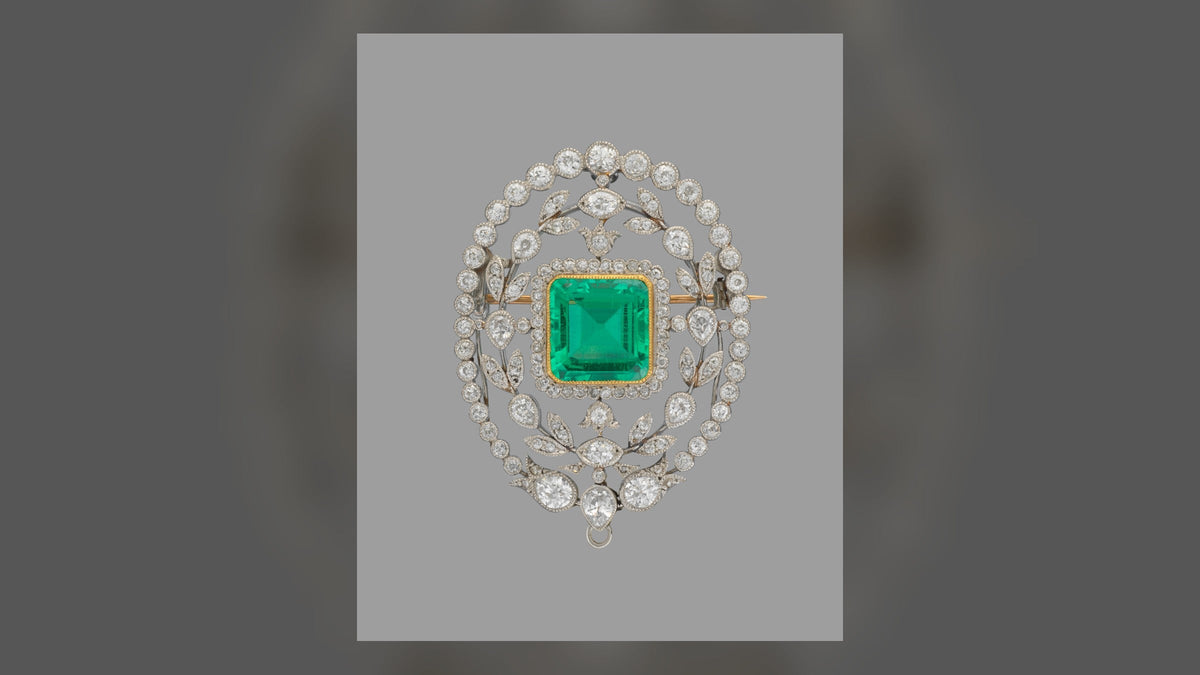
A piece signed Tiffany & Co. rewards the same scrutiny as any other. The period of manufacture can usually be read from the mark, the design and the construction; a platinum-and-diamond brooch of about 1900 and a hammered-gold bracelet of the 1870s tell very different stories of the same house. Where a maker's attribution is claimed, it should be supported by the mark and by what is known of the firm's work, and we address this at some length in our guide to how to spot a fake signed piece. Provenance, condition and original materials matter more than any famous name.
The continuity of craft is what draws many collectors to vintage Tiffany jewelry: a house that has kept its standards across nearly two centuries leaves a record that can be read in the metal. If you would like to see estate pieces in person, we would be glad to receive you. Browse estate Tiffany & Co. or request a private viewing, and we will arrange it at your convenience.
— Eleanor Verane