Is Estate Jewelry a Good Investment? What Holds Value and What Doesn't
An honest, provenance-led look at which estate jewelry has held its value, which has not, and why condition, documentation and rarity matter more than any headline.
Every few years a headline announces that a necklace or a ruby has sold for a sum that seems to belong to another economy, and the question follows close behind: is estate jewelry a good investment? The honest answer is that some of it has held its value remarkably well, much of it has not, and the difference is rarely the thing a first-time buyer expects. This is a guide to what the record shows. It is editorial, not financial advice, and we have tried to say what is known, what is only pattern, and where we simply do not know.
A caveat comes first, and it is the most important sentence here. Fine jewelry is an illiquid, pleasure-first asset, best bought to be worn, enjoyed and handed down. If a piece also keeps its value, that is a welcome result and not something anyone can promise.
What Holds Value: Signed Estate Jewelry From the Great Houses
Start with the maker. A piece signed by Cartier, Van Cleef & Arpels, Tiffany & Co., Boucheron, Bulgari or JAR carries something beyond its metal and stones: a design language, a workshop standard, and an archive that can often confirm a piece’s origins. At auction, signed work from these houses is consistently among the most sought-after material, because buyers know what they are looking at and can compare like with like.
The signature is not a guarantee, and it is not decoration. A genuine mark on a piece of the right period, in the right style, with consistent construction, is evidence. A mark on a piece that does not match the house’s known work is a warning. We have written separately about how to spot a fake signed piece, and it is worth reading before any purchase in this category.

Period Pieces: Art Deco, Belle Époque and Fine Victorian Jewelry
The second pillar is period. Work from the great design eras, the Belle Époque and Edwardian garland style of roughly 1900 to 1915, the geometry of the 1920s and 1930s, and the best of the Victorian age, is finite. Nobody is making more of it. Important period pieces have a deep base of collectors, and the most distinctive examples are the ones that attract competitive bidding when they surface.
What the market rewards within a period is quality of design and execution: platinum work pierced and milgrained by hand, well-matched stones, a composition that could only have come from its decade. A plainly made piece from a celebrated era does not inherit the celebrity. If this is the part of the field that interests you, our guide to antique, vintage and estate jewelry explains the terms, and our Art Deco jewelry shows the period in wearable form.

Rare, Natural, Untreated Stones
The third pillar is the stone itself, and here the language of the trade is exact. Kashmir sapphire, Burmese ruby of the so-called pigeon’s blood color, Colombian emerald, natural pearls and fine old-mine diamonds are valued because they are rare, because their sources are limited or exhausted, and because a laboratory report can document their origin and whether they have been enhanced.
The auction record shows what that combination can do. In October 2015, Sotheby’s Hong Kong sold a 27.68-carat Kashmir sapphire at a price GIA reported as $242,145 per carat, then a record for sapphire. In May 2015, the 25.59-carat Sunrise Ruby, a Burmese stone, sold at Sotheby’s Geneva for $30.3 million, the first ruby to exceed $1 million per carat. Records of this kind are periodically surpassed, and they describe the extreme top of the field. They are not a guide to what an ordinary stone will fetch. We tell the stories of these stones in our pieces on the Kashmir sapphire, the Burmese pigeon’s blood ruby and Colombian emeralds.
Treatment matters. Heat treatment of sapphire and oil treatment of emerald are long accepted in the trade, but the degree should be disclosed, and in general the market pays more for stones that are natural and untreated, with a report to prove it. A treated stone sold as an untreated one is among the surest ways to lose money in this category.
Provenance, Condition and Documentation
Then there is the biography. Two sales are the standard touchstones. In April 1987, Sotheby’s Geneva sold the jewels of the Duchess of Windsor for more than $50 million, against a pre-sale estimate commonly reported at around $7 million, with proceeds going to the Institut Pasteur. In December 2011, Christie’s New York sold the Elizabeth Taylor collection for $115.9 million, including the buyer’s premium, then a record for a private jewelry collection at auction. La Peregrina, a natural pearl with a centuries-long history, brought $11.8 million, a record for a pearl jewel. The famous Taylor-Burton diamond belongs to the same story.
The lesson is a careful one. These were owners whose names are known worldwide, and the pieces had extraordinary documentation. Provenance can add a great deal; it adds it only when it can be proved. A story that cannot be documented adds nothing, and legend, the unverified tale a seller repeats because it sounds right, should be treated as legend.
Condition and originality work the same way. An intact piece, with its original stones, its original settings, and its maker’s mark undisturbed, is worth more than the same piece after a clumsy repair or alteration. An original box, receipts, a laboratory report or an archive letter all raise confidence, and confidence is what a future buyer pays for.
What Doesn’t Hold Value
The other side of the ledger is as important. Mass-produced modern jewelry, however pleasant, has no scarcity to support its price. Pieces that are heavily worn, damaged, or altered, whether by resizing, stone replacement or conversion to a new design, lose the originality that collectors pay for. Stones that have been treated and presented as natural are a liability. And generic gold jewelry, with no maker and no distinguishing design, is usually valued mainly for the weight of its metal, which moves with the gold price and not with the taste of collectors.
None of this makes such pieces a poor choice to wear. A well-made gold chain can give decades of pleasure. It is simply not what the question of value is about.
Auction vs. Retail: The Estate Jewelry Investment Reality
Anyone considering estate jewelry investment should understand the structure of the market. At auction, the buyer pays the hammer price plus a buyer’s premium, and the seller typically pays a commission and other fees. At retail, the price includes a dealer’s expertise, authentication, documentation and the cost of holding stock. In both cases, the amount a buyer pays is not the amount a seller can expect to receive. The gap between the two, the spread between retail and resale, can be wide, and it must be recovered before there is any gain at all.
Illiquidity compounds this. A stock can be sold in seconds; a significant piece of jewelry may take months to find the right buyer or the right sale, and the right sale may be a season away. Time horizon matters: results over a few years can look very different from results over decades, and past results are not a forecast. Condition, documentation and rarity drive outcomes in both channels. A piece that has all three tends to find buyers in any market; a piece that lacks them can be hard to sell at any price.
We make no predictions, and nobody honestly can. What we can say is that the pieces that have done best share qualities that can be examined before a purchase: a respected maker or period, natural stones with documentation, intact original condition, and a provenance that can be proved. If you are new to the field, our introduction to what estate jewelry is is a good place to begin.
The most reliable return on fine jewelry is the one that arrives every time it is worn. Buy what you love, buy from a seller who documents what they sell and discloses treatments and repairs, ask for laboratory reports on important stones, and keep every piece of paper. If the piece later proves to have held its value, that is a pleasant bonus. If you are drawn to the signed work of the great houses, our vintage Tiffany jewelry is a place to begin, and our full range of estate jewelry is always one of one, authenticated and documented. If a particular piece has caught your eye, we would be glad to show it to you privately: request a private viewing.
This article is for general information and is not investment, tax or financial advice. Values can fall as well as rise, and fine jewelry can be difficult to sell. Please consult a qualified professional before making any financial decision.
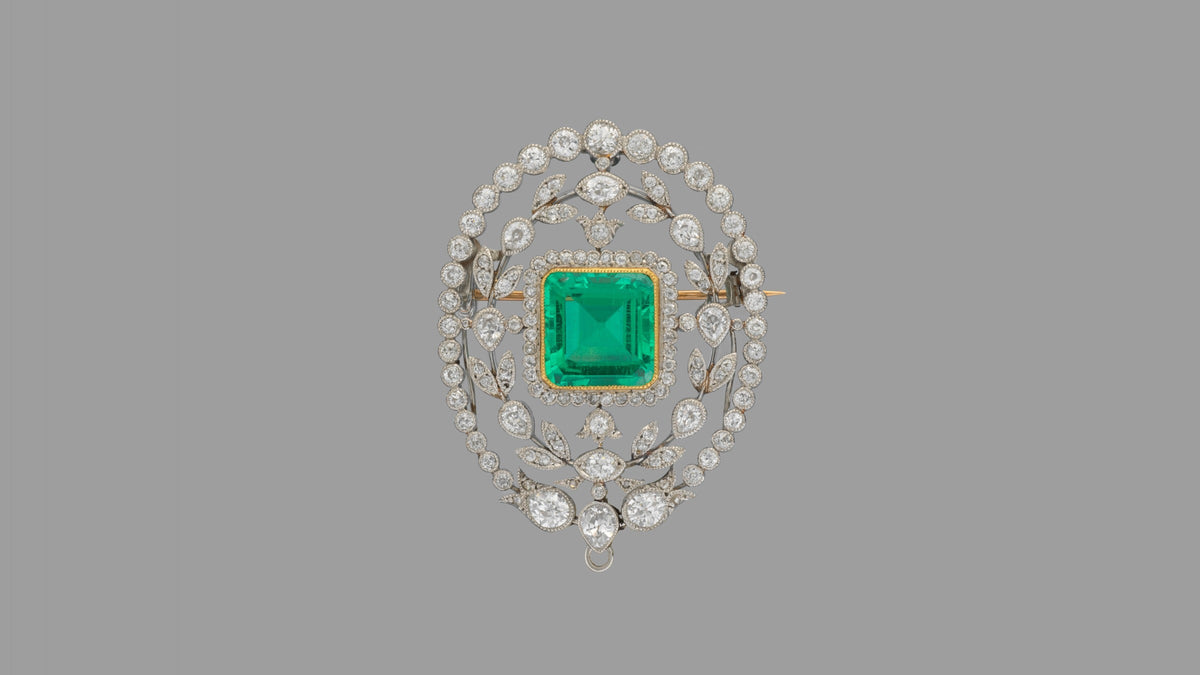
Header photograph: brooch, Tiffany & Co., American, c. 1900, emerald, diamonds and platinum. The Metropolitan Museum of Art, Gift of Susan Dwight Bliss, 1953 (53.153.1). Public domain (CC0); background extended to fit the page. A museum object, shown for context; not VERANE stock.